

Mourning Dove
Zenaida macroura
A common, slender dove whose long, pointed, white-edged tail feathers and soft muted tan-brown coloring make it a familiar sight and sound across open country.
- Feather type
- Long, tapering, pointed tail feathers edged in white; soft sandy-brown contour feathers; black-spotted wing covert feathers
- Colours
- Soft grayish-brown to tan overall, black spots on the wings, a pinkish wash on the breast, iridescent patch on the neck
- Bird size
- Medium, slender, ~30 cm including a long pointed tail
Found a feather like this?
Identify any feather from a photo, free.
Overview
The Mourning Dove is one of the most widespread and abundant birds in North America, easily recognized by its soft, muted coloring, small head, and long, tapering tail. Its name comes from its mournful, cooing call, often mistaken for an owl by unfamiliar listeners.
It is a common visitor to suburban yards, farmland, and open country, often seen perched on wires or foraging on the ground in pairs or small flocks. Its wings make a distinctive whistling sound on takeoff, produced by modified flight feathers.
Feathers from this species are soft and understated, dominated by warm sandy-tan and gray tones, with the long, white-tipped tail feathers being the most distinctive feature when found on their own.
Identifying the Feather
Size and Shape
Long, tapering tail feathers are the most recognizable feature, pointed rather than square-tipped, often fanning to reveal white edges and tips.
Color and Pattern
- Body contour feathers are soft grayish-tan to buff, with a subtle pinkish wash on the breast.
- Wing covert feathers show small black spots, a helpful identifying mark.
- Tail feathers are dark toward the tip with white edging, visible when the tail is fanned or from below in flight.
Comparisons
Compared to the Eurasian Collared-Dove, which has a squared tail with a bold white band and a black half-collar, Mourning Dove feathers show a slimmer, pointed tail and lack any neck collar. Compared to the Rock Pigeon, Mourning Dove feathers are more uniformly soft tan-gray without the Rock Pigeon's iridescent neck patch or variable body coloring.
Plumage & Molt
Sexes look similar, though males show slightly more iridescence on the neck and a subtle pinkish breast wash. Juveniles appear scaly, with pale buffy edges to their body feathers that wear away with age. Molt is gradual over the year.
Habitat & Range
Mourning Doves are found across nearly all of North America, from southern Canada to Central America, in open habitats including farmland, grassland, suburban yards, and woodland edges. Northern populations migrate south for winter, while southern populations are largely resident year-round.
Behavior & Field Notes
Mourning Doves forage on the ground for seeds and grain, often in pairs or small flocks. Their wings produce a sharp whistling sound on takeoff, an anti-predator signal to other doves. Their call is a soft, mournful "coo-OO-oo-oo-oo." They build a flimsy platform stick nest, often in trees or shrubs. A long, soft tan-gray feather with a white-edged tip found in open or suburban habitat is a strong match for this species.
Frequently asked questions
What tail shape best identifies a Mourning Dove feather?
A long, tapering, pointed tail feather with white edging near the tip, distinct from the squared tails of other common doves.
How do Mourning Dove feathers differ from Eurasian Collared-Dove feathers?
Mourning Dove tail feathers are pointed and slender, while Eurasian Collared-Dove tail feathers are square-cut with a broad white terminal band.
Why does a Mourning Dove's wing make noise in flight?
Modified outer flight feathers produce a sharp whistling sound on takeoff, which is not itself a distinguishing feather color trait but relates to feather structure.
What color pattern should I expect on Mourning Dove wing feathers?
Soft tan-brown wing covert feathers marked with small, discrete black spots.
Mourning Dove guides
In-depth guides for identifying and understanding Mourning Dove.

Mourning Dove identified by the community
Real feathers identified with Feather Identifier.


Other feathers you may enjoy

Victoria Crowned Pigeon
Large lace-like fan crest plumes over dense body contour feathers

Plain Pigeon
Contour feathers, plain and uniformly toned, with a white wing patch

Zenaida Dove
Contour and flight feathers, faint iridescent sheen on neck

Pink Pigeon
Soft contour feathers with graduated tail

Nicobar Pigeon
Long, hackle-like elongated neck feathers with iridescent sheen
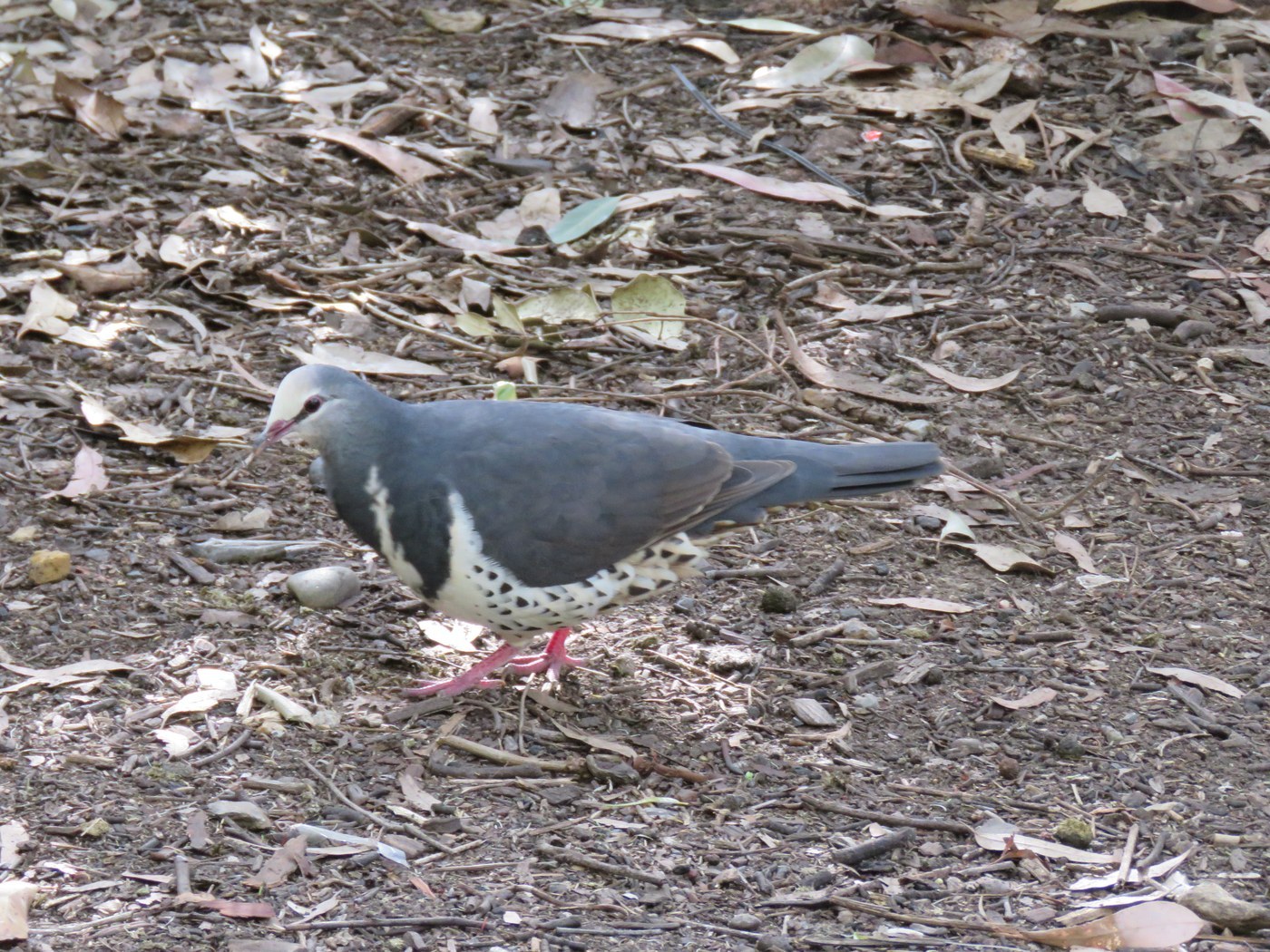
Wonga Pigeon
Dense, soft body contour feathers over a stocky frame

Squatter Pigeon
Dense, cryptic body contour feathers with a bold facial pattern

White-winged Dove
Broad, sturdy flight feathers with a bold white wing stripe

Western Crowned Pigeon
Rounded fan crest plumes over dense soft body feathers

Snow Pigeon
Dense insulating body contour feathers with a bold white rump and belly patch

Zebra Dove
Contour feathers with bold, extensive black-and-white barring

Scaly-naped Pigeon
Contour feathers with iridescent scaled nape pattern