

White-crowned Pigeon
Patagioenas leucocephala
A dark slate-colored Caribbean pigeon topped with a bright white crown, closely tied to mangrove and coastal forest habitats.
- Feather type
- Contour feathers, glossy dark body with a contrasting white cap
- Colours
- Dark slate-gray body with a bright white crown patch
- Bird size
- Pigeon-sized, ~33-36 cm
Found a feather like this?
Identify any feather from a photo, free.
Overview
The White-crowned Pigeon is found in mangrove forests, coastal hardwood hammocks, and small islands throughout the Caribbean and along the coasts of southern Florida and the Yucatan Peninsula. It has an overall dark slate-gray body plumage with a subtle iridescent sheen on the nape, and a bright, crisp white patch capping the crown that gives the species its name. It typically nests on small offshore islands and commutes to the mainland to feed.
Identifying the Feather
- Crown feathers: bright white, sharply demarcated from the dark body, more extensive and brighter in adult males than females
- Body feathers: uniform dark slate-gray with little pattern, appearing nearly blackish in poor light
- Nape feathers: show a subtle iridescent green-to-bronze sheen when caught in direct sunlight
- Tail feathers: dark gray-black, unbanded, and relatively long and squared
- Compare with the Scaly-naped Pigeon, which lacks the white crown and instead shows scaled iridescent feathering on the nape
Plumage & Molt
Males typically show a more extensive and brighter white crown than females, whose crown patch is often reduced and slightly duller. Juveniles lack the white crown almost entirely, showing only a faint pale forehead that develops into the full white cap with maturity. Adults undergo a complete molt following the breeding season.
Habitat & Range
This species breeds colonially on small mangrove islands and keys throughout the Caribbean, southern Florida, and parts of the Yucatan Peninsula, commuting to coastal hardwood forest on larger landmasses to feed. Some populations show seasonal movements between breeding islands and mainland foraging areas, while others are largely resident.
Behavior & Field Notes
White-crowned Pigeons feed mainly in the forest canopy, moving between fruiting trees on nearby larger landmasses from their island roosts. The voice is a deep, resonant cooing. Nests are simple stick platforms built in shrubs or low trees on predator-free islands, often in dense colonies. Observers note its habit of flying in small groups at dawn and dusk between roosting islands and mainland feeding sites.
Frequently asked questions
What is the defining feather feature of this species?
The bright white crown patch sharply set off against the otherwise dark slate-gray body is the clearest identifying mark.
Do males and females differ in crown coloring?
Yes, males generally show a more extensive and brighter white crown, while the female's patch tends to be smaller and slightly duller.
How do juvenile feathers differ from adults?
Juveniles show little to no white on the crown, with only a faint pale forehead that develops into the full cap as they mature.
How does this species differ from the Scaly-naped Pigeon?
The Scaly-naped Pigeon lacks a white crown and instead has scaled, iridescent feathering across the nape and neck.
White-crowned Pigeon guides
In-depth guides for identifying and understanding White-crowned Pigeon.

Other feathers you may enjoy

Victoria Crowned Pigeon
Large lace-like fan crest plumes over dense body contour feathers

Plain Pigeon
Contour feathers, plain and uniformly toned, with a white wing patch

Zenaida Dove
Contour and flight feathers, faint iridescent sheen on neck

Pink Pigeon
Soft contour feathers with graduated tail

Nicobar Pigeon
Long, hackle-like elongated neck feathers with iridescent sheen
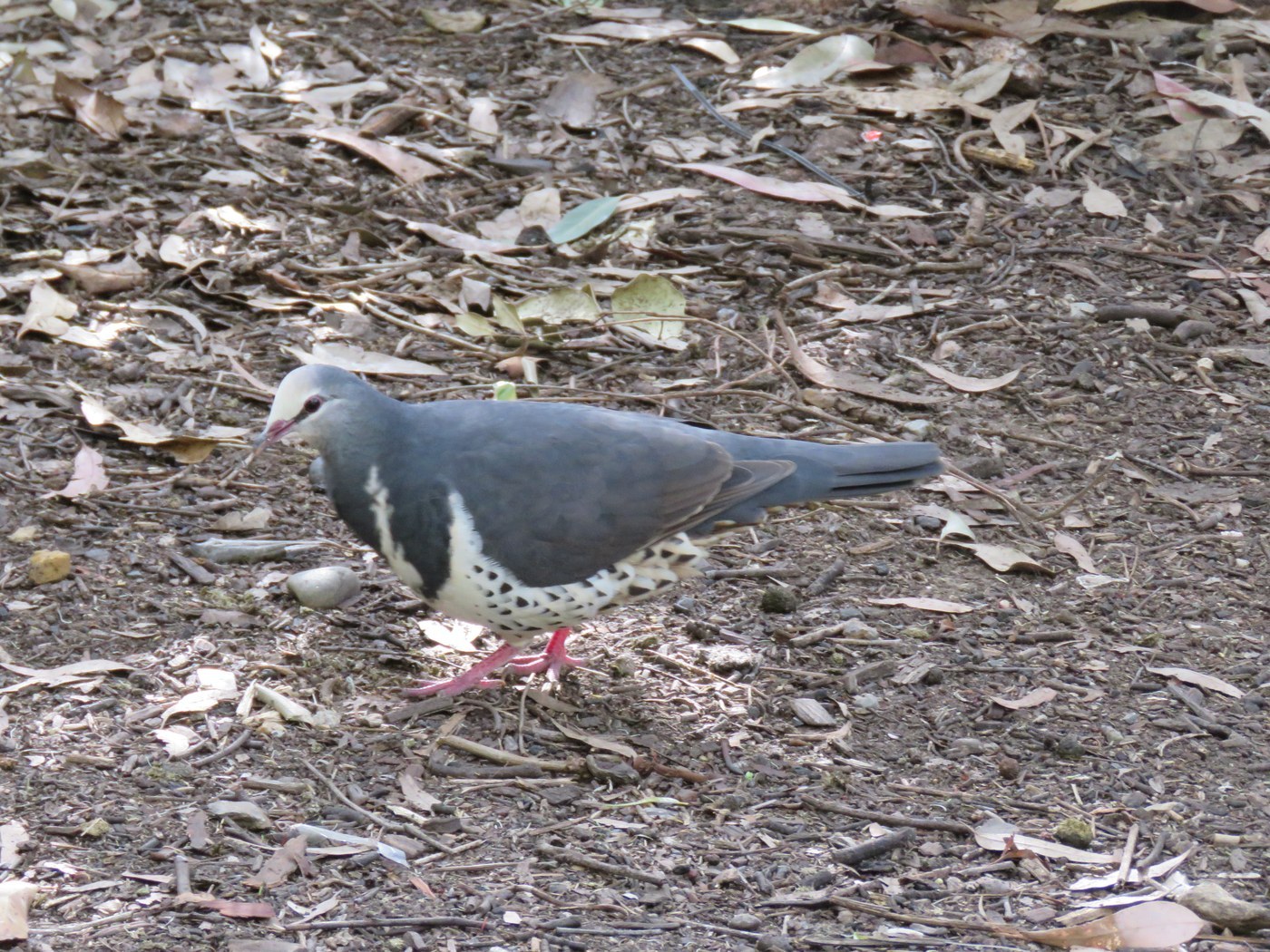
Wonga Pigeon
Dense, soft body contour feathers over a stocky frame

Squatter Pigeon
Dense, cryptic body contour feathers with a bold facial pattern

White-winged Dove
Broad, sturdy flight feathers with a bold white wing stripe

Western Crowned Pigeon
Rounded fan crest plumes over dense soft body feathers

Snow Pigeon
Dense insulating body contour feathers with a bold white rump and belly patch

Zebra Dove
Contour feathers with bold, extensive black-and-white barring

Scaly-naped Pigeon
Contour feathers with iridescent scaled nape pattern