

Tambourine Dove
Turtur tympanistria
The Tambourine Dove is a small forest dove with a strikingly white face and underparts set against brown upperparts marked with dark wing spots.
- Feather type
- Soft body contour feathers with a bright white face and underparts
- Colours
- White face and underparts, brown upperparts, with dark wing spotting
- Bird size
- Small dove, ~20-22 cm
Found a feather like this?
Identify any feather from a photo, free.
Overview
The Tambourine Dove is a small, forest-dwelling dove of sub-Saharan Africa, named for its rhythmic, drumming call. Its bright white face and underparts stand out against the shaded forest floor, though its shy habits often make it easier to hear than to see.
Identifying the Feather
The face, throat, and underparts are bright white, contrasting sharply with warm brown upperparts. The wing coverts show a scattering of small dark spots, useful for separating it from other white-breasted forest doves. Flight feathers are brown with darker primaries visible in flight. Tail feathers are brown, relatively short and rounded. The clean white face-and-underparts combined with dark wing spotting is the clearest identification feature.
Plumage & Molt
Males and females are similar, both showing the white face and underparts, though females can appear slightly duller. Juveniles show more mottled, buffy underparts that whiten with maturity, along with less distinct wing spotting. Molt is gradual, tied to the relatively stable equatorial forest climate across much of its range.
Habitat & Range
Found in dense lowland and montane forest, thicket, and forest edge across much of sub-Saharan Africa. It is largely resident within suitable forest habitat, with limited seasonal movement.
Behavior & Field Notes
Tambourine Doves forage on the forest floor for fallen seeds, typically alone or in pairs within dense cover. They build a flimsy stick nest low in a shrub or tree. Their call is a distinctive, accelerating series of hollow notes resembling a drum roll, which gives the species its name. Their preference for dense forest understorey makes them more often heard than observed.
Frequently asked questions
What identifies Tambourine Dove feathers?
A bright white face and underparts contrasting with brown upperparts marked by small dark wing spots.
Why is it called the Tambourine Dove?
Its accelerating, drum-like call resembles a rolling tambourine rhythm.
Where does it live?
In dense forest and thicket across much of sub-Saharan Africa.
Is the Tambourine Dove easy to see?
It is shy and forest-dwelling, more often heard calling than seen clearly.
Tambourine Dove guides
In-depth guides for identifying and understanding Tambourine Dove.

Other feathers you may enjoy

Victoria Crowned Pigeon
Large lace-like fan crest plumes over dense body contour feathers

Plain Pigeon
Contour feathers, plain and uniformly toned, with a white wing patch

Zenaida Dove
Contour and flight feathers, faint iridescent sheen on neck

Pink Pigeon
Soft contour feathers with graduated tail

Nicobar Pigeon
Long, hackle-like elongated neck feathers with iridescent sheen
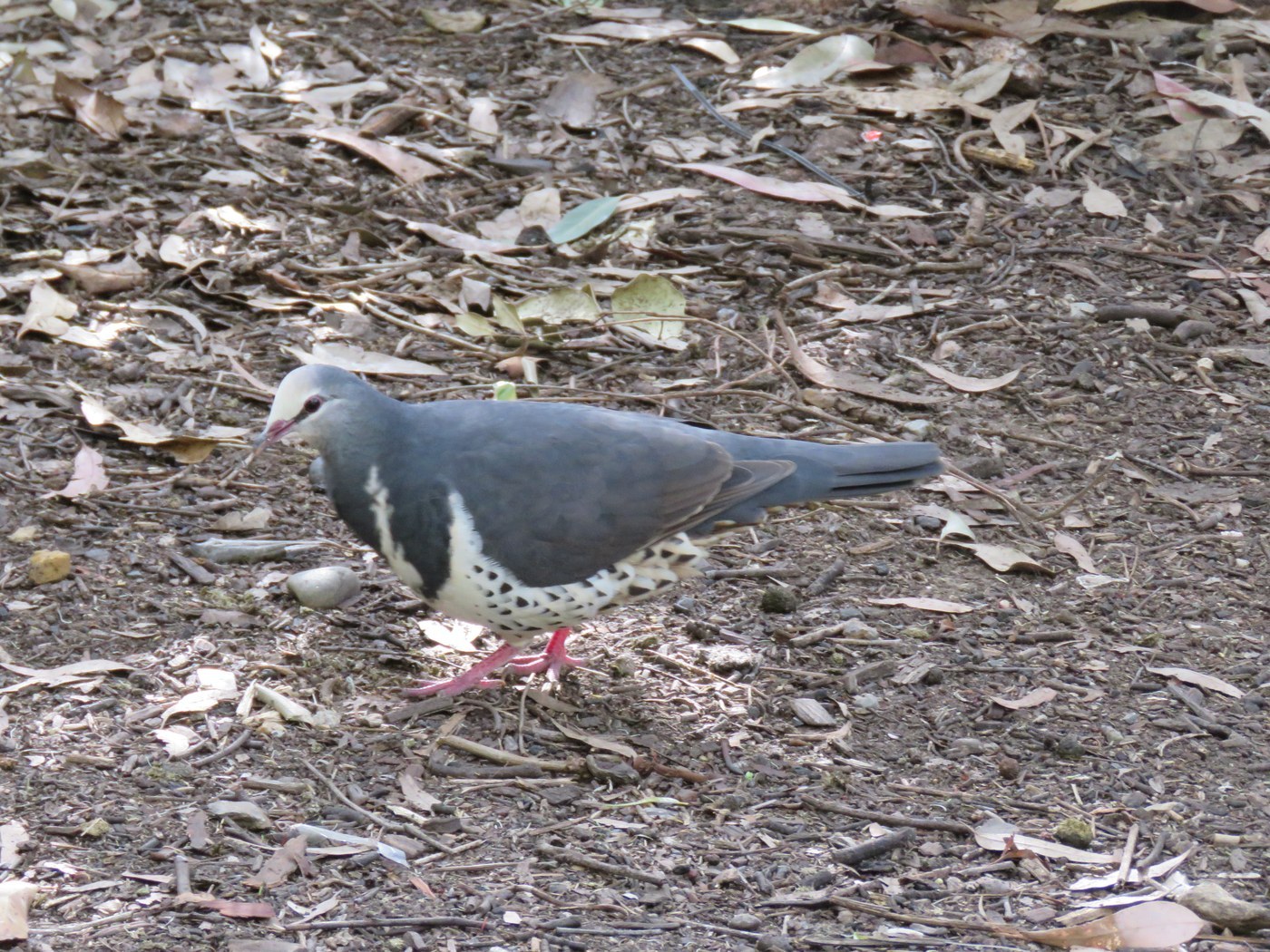
Wonga Pigeon
Dense, soft body contour feathers over a stocky frame

Squatter Pigeon
Dense, cryptic body contour feathers with a bold facial pattern

White-winged Dove
Broad, sturdy flight feathers with a bold white wing stripe

Western Crowned Pigeon
Rounded fan crest plumes over dense soft body feathers

Snow Pigeon
Dense insulating body contour feathers with a bold white rump and belly patch

Zebra Dove
Contour feathers with bold, extensive black-and-white barring

Scaly-naped Pigeon
Contour feathers with iridescent scaled nape pattern