

West Peruvian Dove
Zenaida meloda
A large coastal dove of western South America, similar to the Eared Dove but bigger and grayer, with a small dark mark below the eye and pale grey tail tips.
- Feather type
- Contour feathers with dark ear-mark and pale tail band
- Colours
- Greyish-brown with black wing spots and a dark facial crescent
- Bird size
- Medium-large dove, ~24-27 cm
Found a feather like this?
Identify any feather from a photo, free.
Overview
The West Peruvian Dove inhabits the arid Pacific coastal strip of Ecuador and Peru, where it is a common and familiar bird in both natural scrub and human settlements. It closely resembles its relative the Eared Dove but is noticeably larger and often shows a cooler, grayer overall tone.
Identifying the Feather
Body plumage is greyish-brown, tinged with a subtle pinkish cast on the breast, and marked with scattered black spots across the wing coverts. A small dark crescent-shaped mark sits below and behind the eye, similar to that of the Eared Dove but on a larger bird. The tail shows a pale grey terminal band across the outer feathers, visible when fanned in flight. Compare with the Eared Dove, which is smaller and often warmer in tone, and note that range helps separate the two, as this species is restricted to the coastal desert belt.
Plumage & Molt
Sexes look alike, with subtle brightness differences in the neck iridescence, which is more pronounced in males. Juveniles are duller and more scaled in appearance before their first molt. Plumage remains consistent through the year without strong seasonal variation.
Habitat & Range
Resident along the arid Pacific coast of Ecuador and Peru, in desert scrub, dry woodland, agricultural oases, and urban areas, including city plazas and gardens. It does not undertake long migrations, remaining within its coastal range year-round.
Behavior & Field Notes
Forages on the ground for seeds and grain, often becoming quite tame around towns and cultivated areas. Its call is a low, mellow cooing. Nests are simple stick platforms built in trees, shrubs, or even structures in urban settings. It readily adapts to human-modified landscapes, often seen alongside people in city parks.
Frequently asked questions
What sets the West Peruvian Dove apart from the Eared Dove?
It is noticeably larger and often grayer, though both share the small dark facial crescent and black wing spotting.
Where does this dove live?
Along the arid Pacific coastal belt of Ecuador and Peru, in scrub, farmland, and towns.
Is it commonly seen around people?
Yes, it is quite tame and frequently found in urban parks and plazas within its range.
What does its tail look like in flight?
It shows a pale grey terminal band across the outer tail feathers.
West Peruvian Dove guides
In-depth guides for identifying and understanding West Peruvian Dove.

Other feathers you may enjoy

Victoria Crowned Pigeon
Large lace-like fan crest plumes over dense body contour feathers

Plain Pigeon
Contour feathers, plain and uniformly toned, with a white wing patch

Zenaida Dove
Contour and flight feathers, faint iridescent sheen on neck

Pink Pigeon
Soft contour feathers with graduated tail

Nicobar Pigeon
Long, hackle-like elongated neck feathers with iridescent sheen
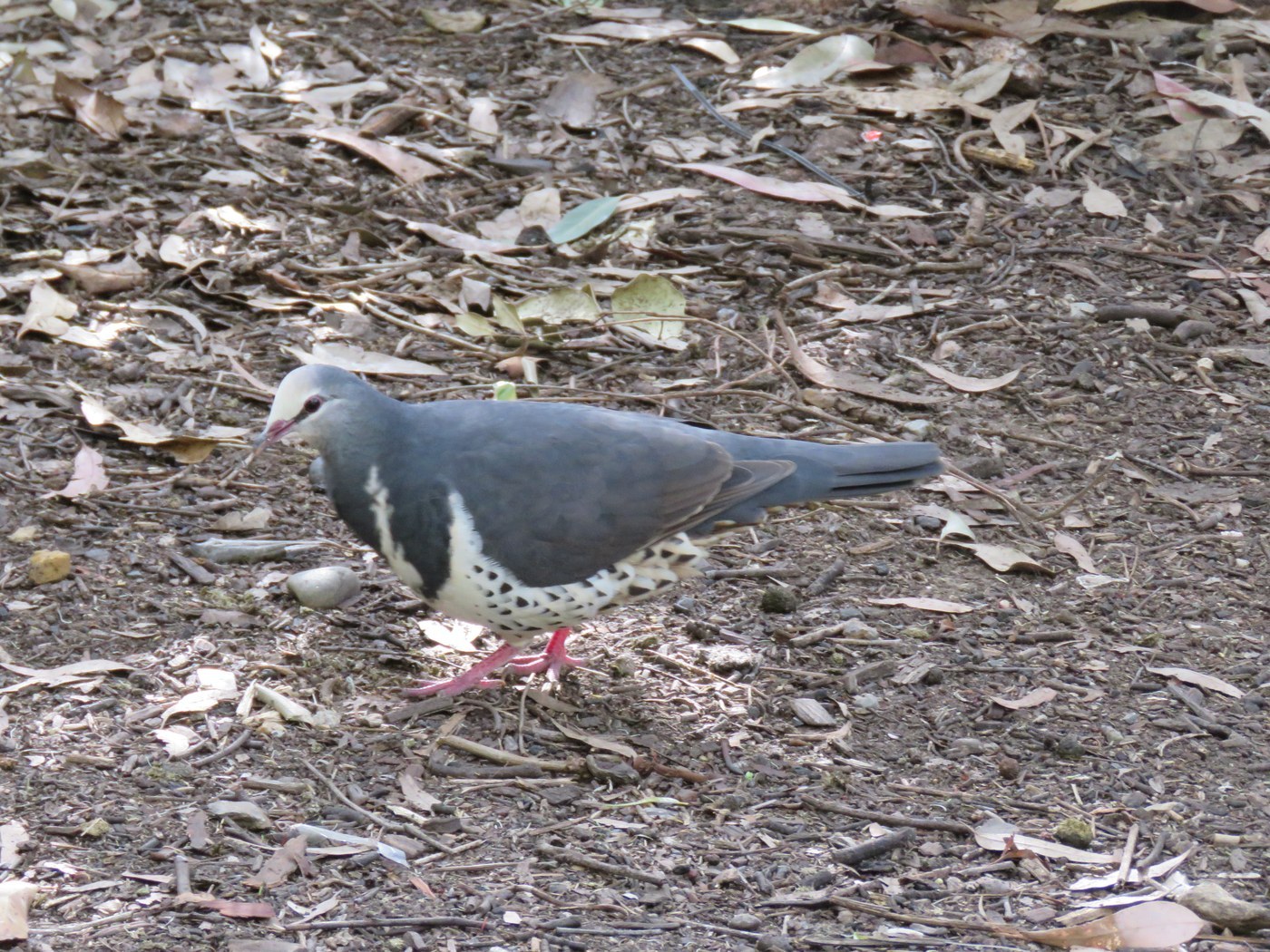
Wonga Pigeon
Dense, soft body contour feathers over a stocky frame

Squatter Pigeon
Dense, cryptic body contour feathers with a bold facial pattern

White-winged Dove
Broad, sturdy flight feathers with a bold white wing stripe

Western Crowned Pigeon
Rounded fan crest plumes over dense soft body feathers

Snow Pigeon
Dense insulating body contour feathers with a bold white rump and belly patch

Zebra Dove
Contour feathers with bold, extensive black-and-white barring

Scaly-naped Pigeon
Contour feathers with iridescent scaled nape pattern