
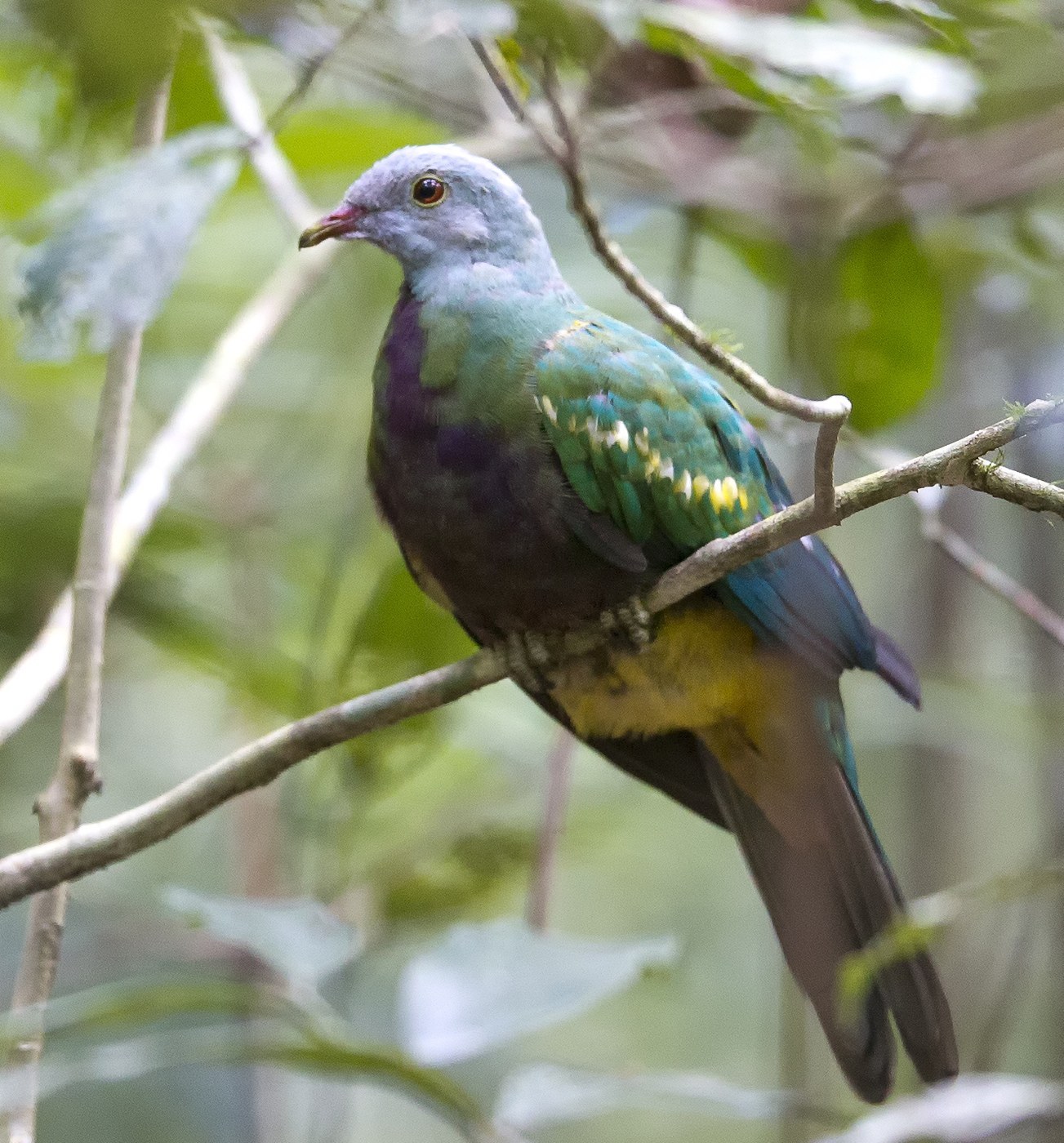
Wompoo Fruit Dove
Ptilinopus magnificus
The Wompoo Fruit Dove is one of the largest and most colorful fruit doves, showing bold blocks of grey, purple, green, and yellow across its plumage.
- Feather type
- Large, soft body contour feathers with a bold color-blocked pattern
- Colours
- Green upperparts, grey head, purple breast band, and yellow-orange belly
- Bird size
- Large fruit dove, ~35-45 cm
Found a feather like this?
Identify any feather from a photo, free.
Overview
The Wompoo Fruit Dove is a large, strikingly patterned fruit dove named for its distinctive booming call. It moves through the rainforest canopy feeding on fruit, its bold color blocks helping observers separate it readily from smaller, more uniformly green fruit doves.
Identifying the Feather
The head and nape feathers are soft grey, the breast crossed by a broad purple-maroon band, and the belly a rich yellow-orange, while the back and wings remain solid green. This bold, sharply divided color-block pattern is unlike the more subtly patterned smaller fruit doves. Flight feathers are broad and green with a faint yellow wing bar visible in flight. The combination of grey head, purple breast band, and yellow belly is diagnostic among Australian fruit doves.
Plumage & Molt
Sexes are similar, both showing the grey head, purple breast, and yellow belly, though subspecies vary somewhat in the exact tone and extent of these color blocks across its range. Juveniles are duller and show a more mottled, less clearly divided pattern that sharpens with age. Molt is gradual, consistent with a mostly non-migratory tropical and subtropical lifestyle.
Habitat & Range
Found in rainforest, wet sclerophyll forest, and adjacent woodland along the eastern Australian coast and into New Guinea. Some populations undertake local seasonal movements tracking fruit abundance, while others remain resident.
Behavior & Field Notes
Wompoo Fruit Doves feed on fruit high in the rainforest canopy, often detected by their loud, distinctive 'wom-poo' call that gives the species its name. They build a flimsy stick platform nest in a tree. Their large size and canopy habits mean they are more frequently heard calling than observed clearly.
Frequently asked questions
How can you identify Wompoo Fruit Dove feathers?
Look for the grey head, broad purple breast band, green back, and yellow-orange belly in bold color blocks.
Why is it called the Wompoo Fruit Dove?
Its name imitates its loud, distinctive booming call.
Where does the Wompoo Fruit Dove live?
In rainforest and wet forest of eastern Australia and New Guinea.
Is the Wompoo Fruit Dove one of the larger fruit doves?
Yes, it is among the largest species in the fruit dove group.
Wompoo Fruit Dove guides
In-depth guides for identifying and understanding Wompoo Fruit Dove.
Other feathers you may enjoy

Victoria Crowned Pigeon
Large lace-like fan crest plumes over dense body contour feathers

Plain Pigeon
Contour feathers, plain and uniformly toned, with a white wing patch

Zenaida Dove
Contour and flight feathers, faint iridescent sheen on neck

Pink Pigeon
Soft contour feathers with graduated tail

Nicobar Pigeon
Long, hackle-like elongated neck feathers with iridescent sheen
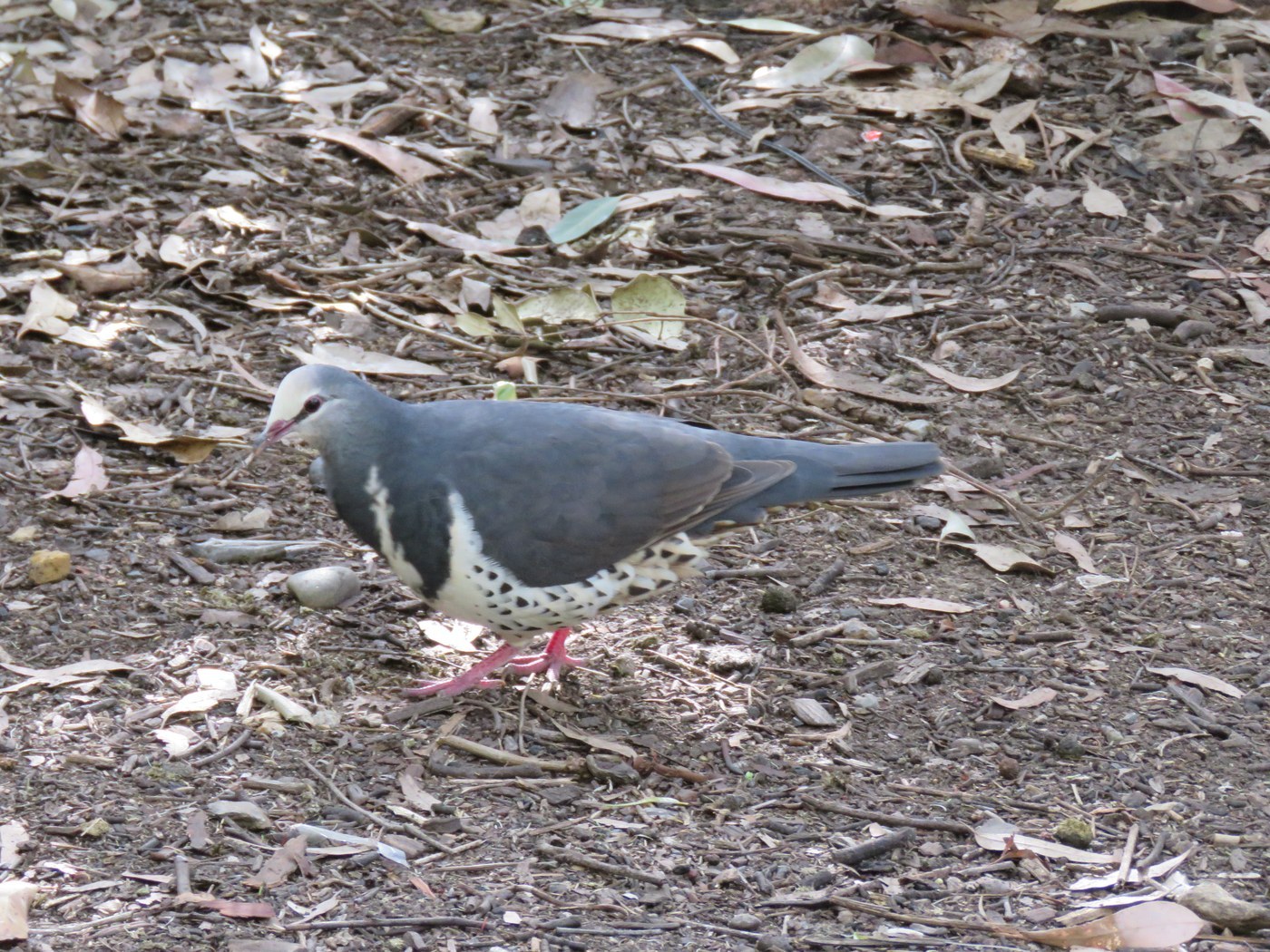
Wonga Pigeon
Dense, soft body contour feathers over a stocky frame

Squatter Pigeon
Dense, cryptic body contour feathers with a bold facial pattern

White-winged Dove
Broad, sturdy flight feathers with a bold white wing stripe

Western Crowned Pigeon
Rounded fan crest plumes over dense soft body feathers

Snow Pigeon
Dense insulating body contour feathers with a bold white rump and belly patch

Zebra Dove
Contour feathers with bold, extensive black-and-white barring

Scaly-naped Pigeon
Contour feathers with iridescent scaled nape pattern