
How to Identify Wompoo Fruit Dove Feathers
How to identify the Wompoo Fruit Dove's feathers by its gray head, magenta throat patch, bright yellow belly band, and green wings dotted with yellow.
Read the full Wompoo Fruit Dove encyclopedia entry →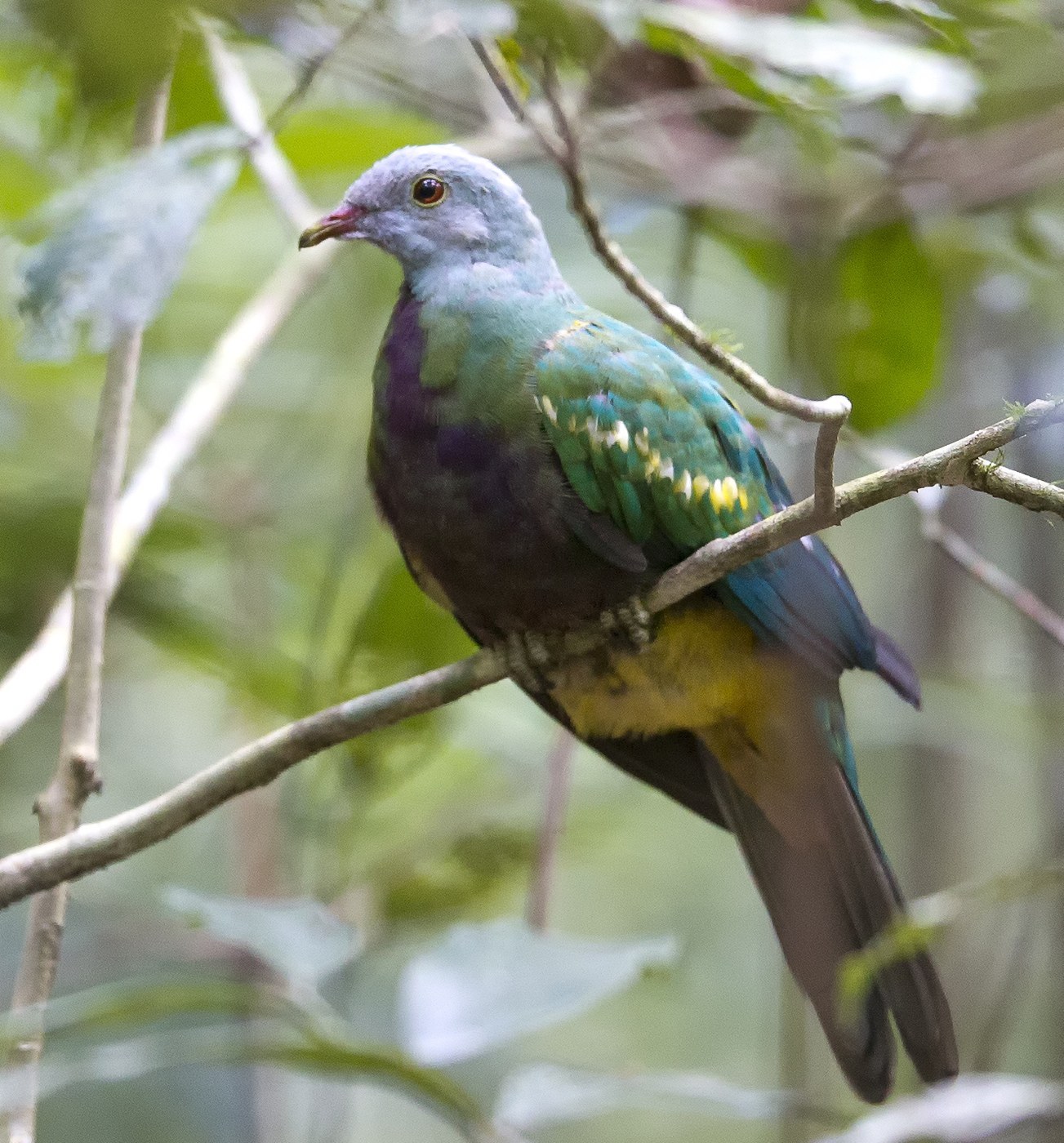
What Wompoo Fruit Dove's Feathers Look Like
The Wompoo Fruit Dove is one of the most colorful pigeons in its range, and its feathers show an unusual mix of soft pastel and bold saturated tones in one bird. Head and breast feathers are a soft blue-gray, with the throat marked by a striking magenta-to-purple patch that stands out sharply against the surrounding gray — this purple throat feather cluster is one of the most identifiable finds for this species. Lower underparts carry a bright yellow band across the belly, transitioning to green on the flanks and undertail area. Back and wing covert feathers are rich grass-green, dotted with small yellow spots or fringes on the wing coverts, giving the folded wing a speckled look rather than a solid green one. The tail is green above with a broad pale yellow or cream tip band across the underside of the tail feathers, visible as a two-toned green-to-yellow pattern along the tail's length. Overall feather texture is soft and full, typical of pigeons, and the size is notably large for a fruit dove, reflecting the species' status as one of the bigger fruit doves in the genus.
Step-by-Step: Is This Feather From a Wompoo Fruit Dove?
- Look for the magenta/purple throat feathers first. This jewel-toned patch against gray is essentially unique among fruit doves in the region and is the strongest single clue.
- Check for a yellow belly band paired with green flanks. The specific yellow-to-green transition low on the body is diagnostic.
- Examine wing coverts for yellow spotting. Small pale yellow dots or edges on otherwise green wing feathers support this species over plainer green pigeons.
- Check the tail tip. A broad pale yellow-cream band on the underside tip of a green tail feather is a strong match.
- Judge size. This is a comparatively large fruit dove (up to about 35 cm / 14 in), so feathers should be larger than those of small green pigeons.
Similar Species & How to Tell Them Apart
Other fruit doves in the same range, such as the Superb Fruit Dove and Rose-crowned Fruit Dove, are considerably smaller and show different head patterns — Superb Fruit Dove males have a small orange crown patch and a purple nape band rather than a full gray head and magenta throat, while Rose-crowned Fruit Dove shows a pink-and-yellow crown rather than a solid gray head. None of these relatives combine a gray head, magenta throat patch, and yellow belly band the way the Wompoo Fruit Dove does, making that three-part combination the most reliable way to separate it from smaller, more numerous fruit dove relatives.
Where & When You'll Find Them
Wompoo Fruit Doves inhabit rainforest, monsoon forest, and dense vine scrub of northern and eastern Australia and New Guinea, feeding largely in the forest canopy on fruiting trees and vines. Feathers are most likely found beneath fruiting fig trees and other canopy fruit sources where the birds feed and preen, with molt and feather loss occurring largely after the breeding season (spring through summer in Australia), and can also turn up near display or roosting perches in dense forest interior year-round given the species' largely sedentary habits.
Frequently asked questions
What is the single most distinctive feather of this species?
A magenta or purple throat feather set against blue-gray head plumage is essentially unmistakable among fruit doves in its range.
How can I tell Wompoo apart from smaller fruit doves in the same forest?
Check size (Wompoo is notably larger) and look for the specific gray head plus yellow belly band combination, which smaller relatives like Superb and Rose-crowned Fruit Doves don't share.
Do the wing feathers have any special markings?
Yes, look for small yellow spots or fringes scattered across otherwise green wing covert feathers.
Where in the forest should I search for shed feathers?
Beneath fruiting fig and canopy trees, since the species feeds heavily in the canopy and rarely comes to the ground.