
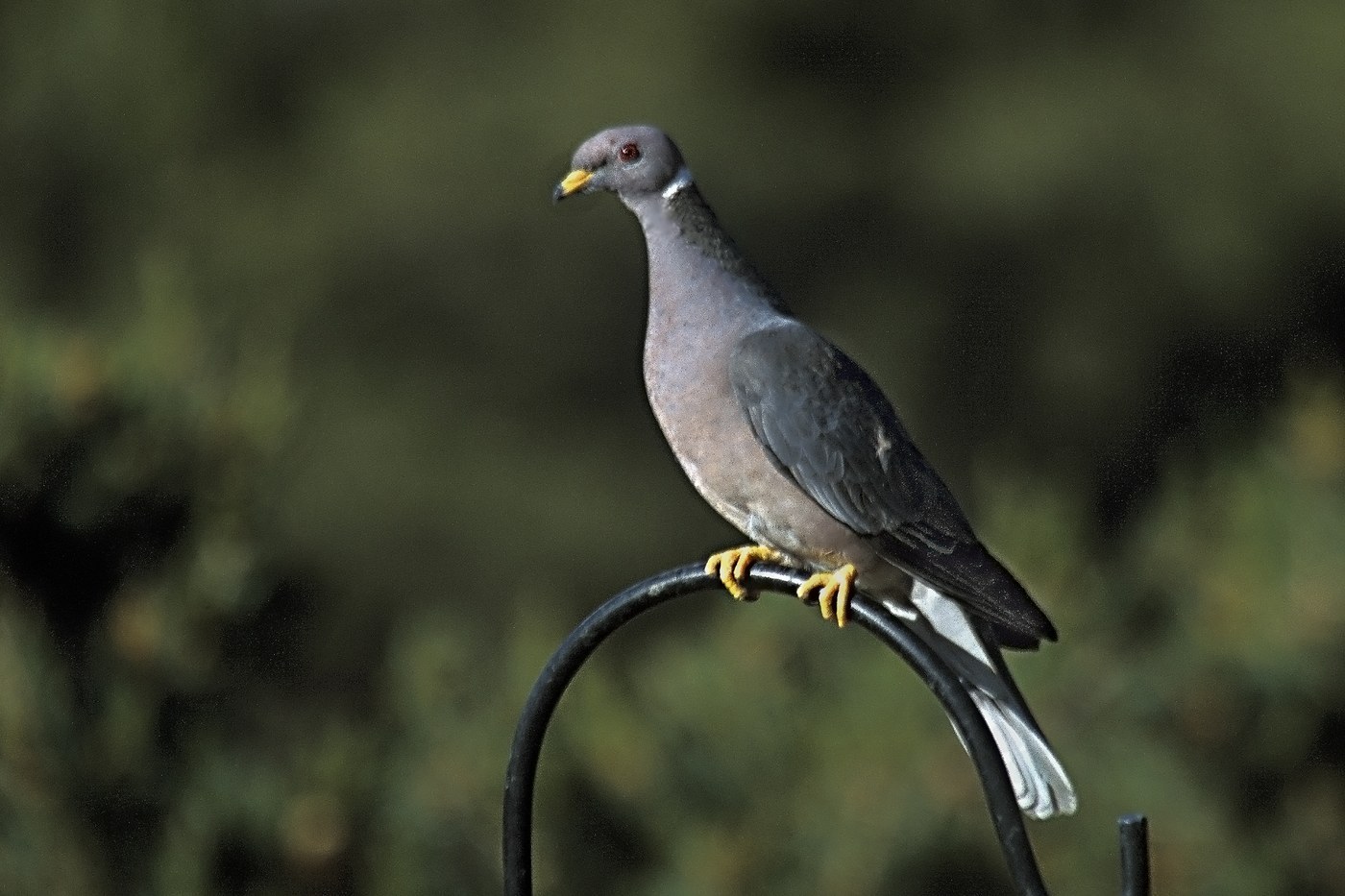
Band-tailed Pigeon
Patagioenas fasciata
A large forest pigeon of the western mountains, identified by a crescent-shaped white patch on the nape and a broad pale band across the tip of an otherwise dark tail.
- Feather type
- Broad, sturdy flight and tail feathers typical of pigeons
- Colours
- Gray-blue overall with a white nape crescent and pale tail band
- Bird size
- Large pigeon, ~33-38 cm
Found a feather like this?
Identify any feather from a photo, free.
Overview
The Band-tailed Pigeon is a large native pigeon of western North America, closely tied to coniferous and oak forests from British Columbia to Central America. It is often seen in flocks moving between feeding areas, and its name comes from the pale gray band that crosses the tip of its otherwise darker tail.
Identifying the Feather
Flight feathers: broad and rounded, gray with a faint iridescent sheen on the coverts. Tail feathers: dark gray at the base with a distinct, contrasting pale grayish band near the tip, the key identifying feature for a shed tail feather. Body feathers: overall soft gray-blue, with a distinctive white crescent-shaped band across the back of the nape, bordered below by iridescent greenish or purplish feathers, and a yellow bill with a dark tip. This banded tail and white nape crescent readily separate Band-tailed Pigeon feathers from other North American pigeons and doves.
Plumage & Molt
Sexes look similar, though males may show slightly more vivid iridescence on the nape. Adults have gray-blue body plumage, a white crescent on the nape underlined by iridescent green-purple feathers, and a tail with a broad pale band near the tip. Juveniles lack the white nape crescent and iridescence, appearing more uniformly gray-brown until their first full molt. There is no strong seasonal plumage variation in adults.
Habitat & Range
Band-tailed Pigeons inhabit coniferous and oak forests along the Pacific coast and interior mountains from British Columbia south through the western United States, Mexico, and into Central America. Northern populations are migratory, moving to lower elevations or farther south in winter, while southern populations tend to be more resident.
Behavior & Field Notes
This pigeon feeds mainly on seeds, berries, and acorns, foraging both in trees and on the ground, and is known to gather in large flocks at productive feeding sites and mineral springs. It builds a simple platform nest of twigs in a tree. Its voice includes a low, owl-like double-hoot, and flocks produce a distinctive whistling or clapping sound with their wings when taking flight.
Frequently asked questions
What feather feature confirms a Band-tailed Pigeon identification?
The broad pale gray band crossing the tip of an otherwise darker tail, combined with a white crescent-shaped patch on the nape, is diagnostic for this species.
How do juvenile feathers differ from adult feathers?
Juveniles lack the white nape crescent and iridescent green-purple sheen found in adults, appearing more plainly gray-brown until after their first full molt.
Can Band-tailed Pigeon feathers be confused with Rock Pigeon feathers?
The distinct pale tail band and white nape crescent are not found on Rock Pigeons, which show much more variable plumage patterns overall.
Where would this species typically be found?
In coniferous and oak forests along the Pacific coast and interior mountains from British Columbia through Mexico and Central America.
Band-tailed Pigeon guides
In-depth guides for identifying and understanding Band-tailed Pigeon.
Other feathers you may enjoy

Victoria Crowned Pigeon
Large lace-like fan crest plumes over dense body contour feathers

Plain Pigeon
Contour feathers, plain and uniformly toned, with a white wing patch

Zenaida Dove
Contour and flight feathers, faint iridescent sheen on neck

Pink Pigeon
Soft contour feathers with graduated tail

Nicobar Pigeon
Long, hackle-like elongated neck feathers with iridescent sheen
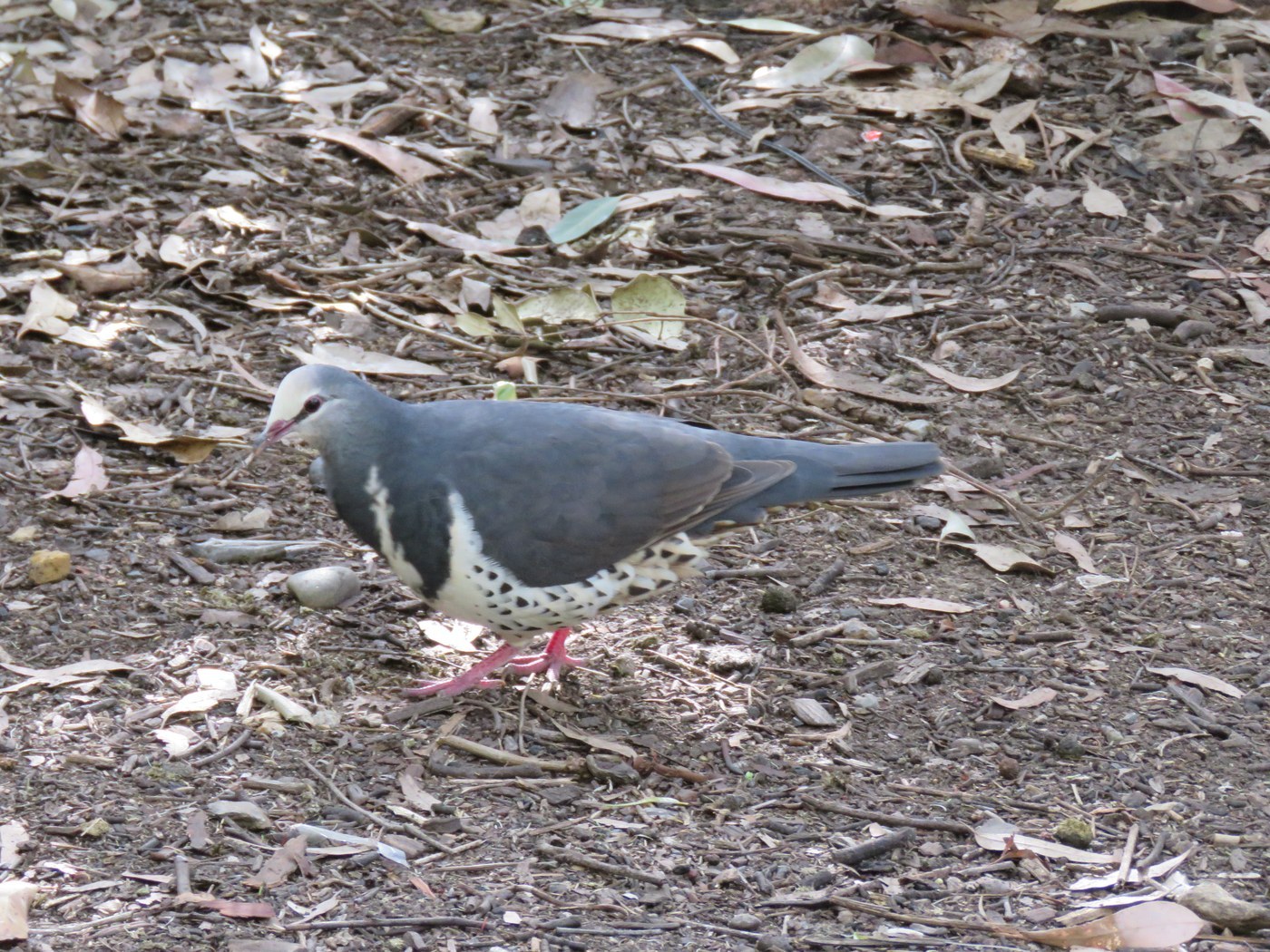
Wonga Pigeon
Dense, soft body contour feathers over a stocky frame

Squatter Pigeon
Dense, cryptic body contour feathers with a bold facial pattern

White-winged Dove
Broad, sturdy flight feathers with a bold white wing stripe

Western Crowned Pigeon
Rounded fan crest plumes over dense soft body feathers

Snow Pigeon
Dense insulating body contour feathers with a bold white rump and belly patch

Zebra Dove
Contour feathers with bold, extensive black-and-white barring

Scaly-naped Pigeon
Contour feathers with iridescent scaled nape pattern