

Orange Dove
Ptilinopus victor
A Fijian fruit dove in which males glow a vivid, almost flame-like orange from head to tail, while females remain camouflaged in typical fruit-dove green.
- Feather type
- Soft, dense contour feathers, unusually pigmented in males
- Colours
- Vivid orange body (male) with olive-yellow head, or green overall (female)
- Bird size
- Small-medium dove, ~23 cm
Found a feather like this?
Identify any feather from a photo, free.
Overview
The Orange Dove of Fiji is remarkable among fruit doves for the male's near-total departure from the green camouflage typical of the genus, instead displaying a vivid, saturated orange plumage rarely seen in forest birds. Females, by contrast, retain the leaf-green coloring standard among Ptilinopus fruit doves, creating one of the most extreme examples of sexual dimorphism in the pigeon family.
Identifying the Feather
Males are essentially unmarked with rich orange body plumage, offset by an olive-yellow head and nape, making them almost unmistakable within their range. Females are entirely green, closely resembling other female Ptilinopus fruit doves, with paler yellowish tones on the belly. Wing and tail feathers in males show the orange coloring extending through most of the plumage rather than being confined to a patch. Compare with other Fijian fruit doves, none of which show this fully orange male plumage, making males of this species readily distinguishable while females require more careful comparison.
Plumage & Molt
This species shows extreme sexual dimorphism: males are vivid orange with an olive-yellow head, while females are green throughout, much like females of related fruit dove species. Juveniles resemble females initially, with young males gradually acquiring orange coloring through successive molts as they mature. There is no notable seasonal plumage change beyond this age-related transition.
Habitat & Range
Endemic to Fiji, found in rainforest and forest edge habitats across several of the larger islands. It is a forest-dependent resident, moving locally between fruiting trees rather than migrating long distances.
Behavior & Field Notes
Feeds on small fruits in the canopy and subcanopy, often located by its low, resonant cooing calls before being seen. Nests are simple twig platforms built in trees. The male's vivid orange plumage is thought to play a role in courtship display, standing out sharply against the green forest canopy despite the general expectation of camouflage in forest birds.
Frequently asked questions
Why do male and female Orange Doves look so different?
Males have evolved vivid orange plumage, likely for display purposes, while females retain the green camouflage typical of fruit doves.
What does a female Orange Dove look like?
She is green overall, closely resembling females of other Ptilinopus fruit dove species.
Where is this species found?
It is endemic to Fiji, living in rainforest and forest-edge habitat.
Do young males start out orange?
No, juvenile males resemble females and gradually acquire orange plumage as they mature through successive molts.
Orange Dove guides
In-depth guides for identifying and understanding Orange Dove.

Other feathers you may enjoy

Victoria Crowned Pigeon
Large lace-like fan crest plumes over dense body contour feathers

Plain Pigeon
Contour feathers, plain and uniformly toned, with a white wing patch

Zenaida Dove
Contour and flight feathers, faint iridescent sheen on neck

Pink Pigeon
Soft contour feathers with graduated tail

Nicobar Pigeon
Long, hackle-like elongated neck feathers with iridescent sheen
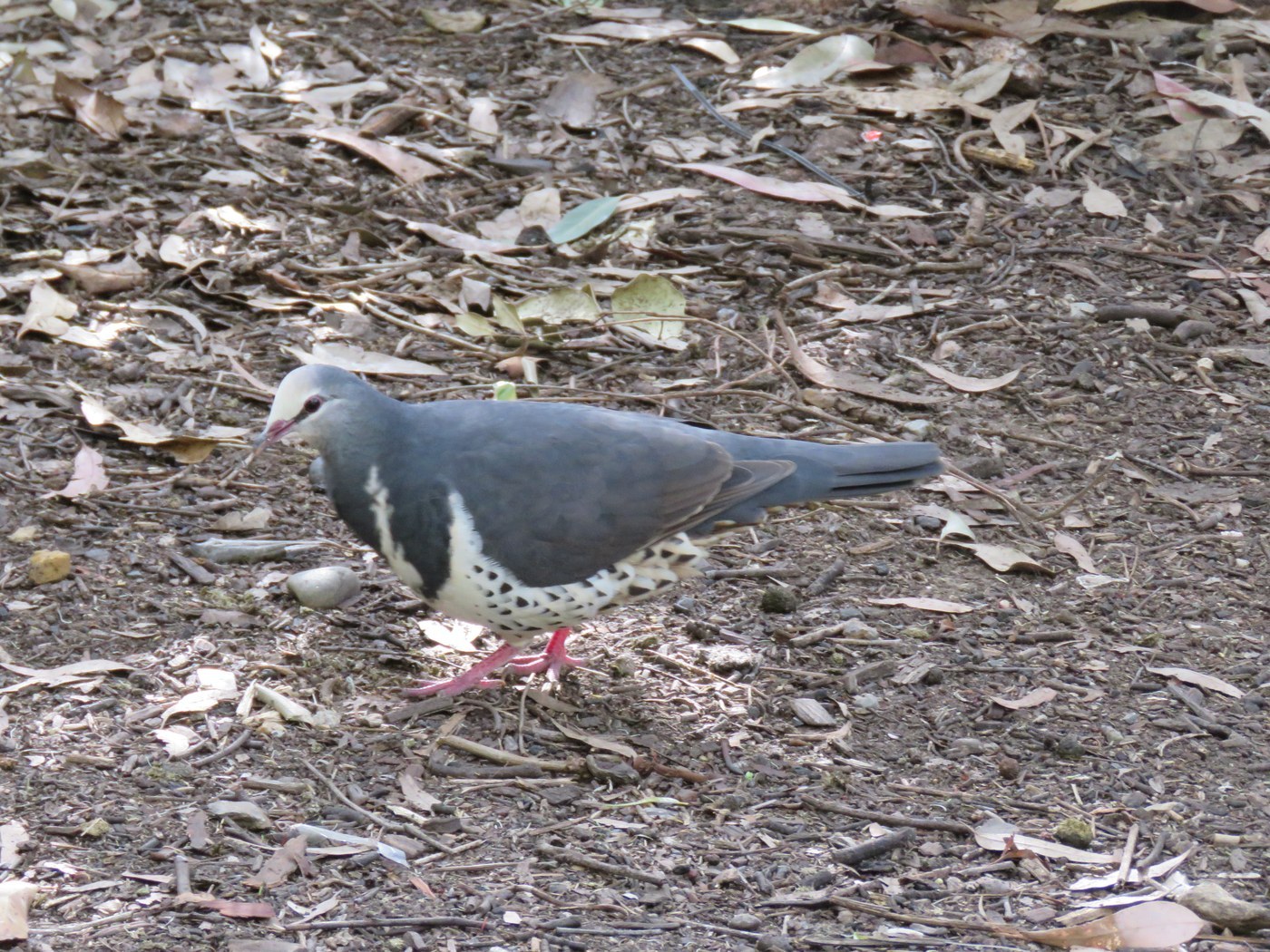
Wonga Pigeon
Dense, soft body contour feathers over a stocky frame

Squatter Pigeon
Dense, cryptic body contour feathers with a bold facial pattern

White-winged Dove
Broad, sturdy flight feathers with a bold white wing stripe

Western Crowned Pigeon
Rounded fan crest plumes over dense soft body feathers

Snow Pigeon
Dense insulating body contour feathers with a bold white rump and belly patch

Zebra Dove
Contour feathers with bold, extensive black-and-white barring

Scaly-naped Pigeon
Contour feathers with iridescent scaled nape pattern