

Mourning Collared Dove
Streptopelia decipiens
A widespread African dove with a pale grey head, warm pinkish-brown breast, and a crisp black half-collar edged in white across the back of the neck.
- Feather type
- Contour feathers with black-and-white half-collar
- Colours
- Pale grey head, pinkish-brown breast, black-and-white neck patch
- Bird size
- Medium dove, ~25-28 cm
Found a feather like this?
Identify any feather from a photo, free.
Overview
The Mourning Collared Dove is a common dove across sub-Saharan Africa, often found near water in riverine woodland and savanna. Its pale head, warm breast tone, and neat black-and-white neck collar make it a familiar and readily identifiable species across much of its wide range.
Identifying the Feather
The crown and face are pale grey, contrasting with a warmer pinkish-brown wash across the breast. A black half-collar edged in white crosses the back of the neck, sharply defined against the paler surrounding feathers. A narrow red-orange orbital ring surrounds the eye. Compare with the Dusky Turtle Dove, which is overall darker and lacks the pale grey head, and the African Mourning Dove more broadly resembles related collared doves but is distinguished by this combination of pale head and crisp neck collar.
Plumage & Molt
Sexes are similar, both showing the pale grey head and black-and-white collar, with males sometimes appearing marginally richer in breast tone. Juveniles lack the neck collar initially, developing it after their first molt, and are duller and more scaled in appearance when young. Seasonal plumage change is minimal in this largely non-migratory species.
Habitat & Range
Widespread across sub-Saharan Africa, particularly favoring riverine woodland, savanna, and areas near water, including well-wooded gardens and farmland. It is largely resident, with some local movement tied to water and food availability.
Behavior & Field Notes
Forages on the ground for seeds and grain, often near water sources, and is frequently seen in pairs or small groups. Its call is a distinctive, mournful cooing, giving rise to its common name. Nests are simple stick platforms built in trees. It is a familiar and vocal presence in many African woodland and riverside habitats.
Frequently asked questions
What identifies a Mourning Collared Dove?
A pale grey head, pinkish-brown breast, and a crisp black-and-white half-collar on the back of the neck.
Where does it live?
Across sub-Saharan Africa, especially in riverine woodland and savanna near water.
Why is it called 'mourning'?
Its call is a distinctive, mournful cooing sound, which gives the species its common name.
How is it told apart from the Dusky Turtle Dove?
The Dusky Turtle Dove is darker overall and lacks the pale grey head seen in the Mourning Collared Dove.
Mourning Collared Dove guides
In-depth guides for identifying and understanding Mourning Collared Dove.

Other feathers you may enjoy

Victoria Crowned Pigeon
Large lace-like fan crest plumes over dense body contour feathers

Plain Pigeon
Contour feathers, plain and uniformly toned, with a white wing patch

Zenaida Dove
Contour and flight feathers, faint iridescent sheen on neck

Pink Pigeon
Soft contour feathers with graduated tail

Nicobar Pigeon
Long, hackle-like elongated neck feathers with iridescent sheen
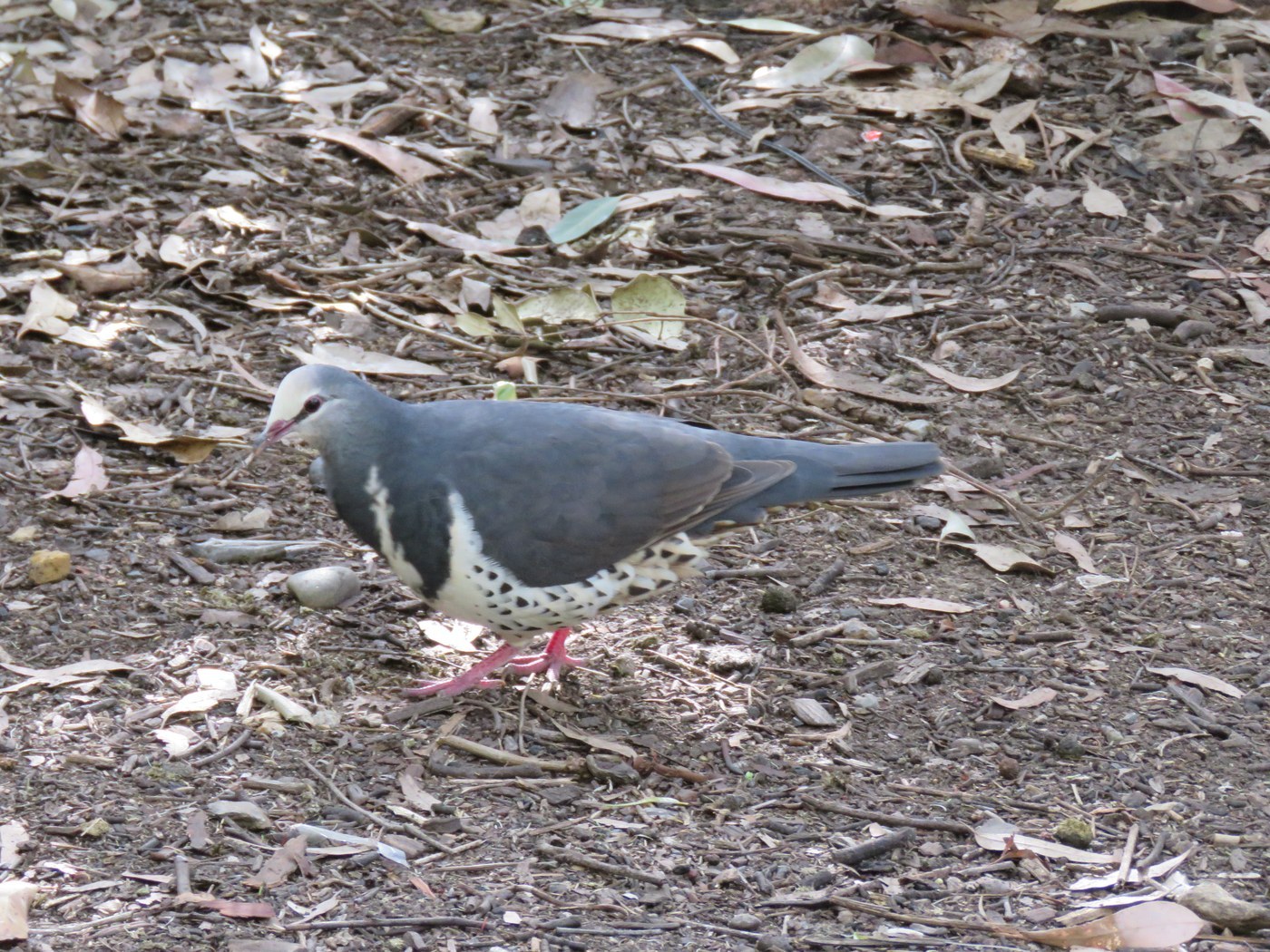
Wonga Pigeon
Dense, soft body contour feathers over a stocky frame

Squatter Pigeon
Dense, cryptic body contour feathers with a bold facial pattern

White-winged Dove
Broad, sturdy flight feathers with a bold white wing stripe

Western Crowned Pigeon
Rounded fan crest plumes over dense soft body feathers

Snow Pigeon
Dense insulating body contour feathers with a bold white rump and belly patch

Zebra Dove
Contour feathers with bold, extensive black-and-white barring

Scaly-naped Pigeon
Contour feathers with iridescent scaled nape pattern