

Mountain Imperial Pigeon
Ducula badia
The Mountain Imperial Pigeon is a large, heavy-bodied forest pigeon with pale grey underparts contrasting against a deep maroon-brown back and wings.
- Feather type
- Large, dense body contour feathers with a plain grey-and-maroon pattern
- Colours
- Grey head and underparts with a deep maroon-brown back and wings
- Bird size
- Large pigeon, ~43-51 cm
Found a feather like this?
Identify any feather from a photo, free.
Overview
The Mountain Imperial Pigeon is a large, powerfully built pigeon found across forested regions of South and Southeast Asia. It is often seen flying above the canopy with slow, deep wingbeats, its pale head and underparts contrasting with the darker back visible from below and above respectively.
Identifying the Feather
The head, neck, and underparts are pale grey, while the back, wings, and tail are a rich maroon-brown, creating a two-toned pattern visible both perched and in flight. Flight feathers are broad and heavy, built for strong, direct flight above the canopy. The tail is broad with a darker terminal band. This grey-and-maroon two-tone pattern, combined with large size, distinguishes it from smaller imperial pigeons sharing its range.
Plumage & Molt
Sexes are similar, both showing the grey-and-maroon pattern. Juveniles are duller with less contrast between the grey and maroon areas, sharpening with maturity. Molt is gradual, consistent with a largely non-migratory forest lifestyle across its range.
Habitat & Range
Found in lowland, hill, and montane forest across the Himalayan foothills, South Asia, and Southeast Asia. Some populations undertake seasonal altitudinal movements, descending to lower elevations outside the breeding season.
Behavior & Field Notes
Mountain Imperial Pigeons feed on fruit high in the canopy, often traveling in small flocks between fruiting trees. They build a stick platform nest in a tall tree. Their call is a deep, resonant booming sound. Their large size and strong, direct flight above the canopy make them conspicuous even at a distance.
Frequently asked questions
What identifies Mountain Imperial Pigeon feathers?
A pale grey head and underparts contrasting with a deep maroon-brown back, wings, and tail.
Where does it live?
In lowland to montane forest across South and Southeast Asia.
Does it move seasonally?
Some populations make altitudinal movements to lower elevations outside the breeding season.
How does it fly?
With slow, deep, powerful wingbeats characteristic of large imperial pigeons.
Mountain Imperial Pigeon guides
In-depth guides for identifying and understanding Mountain Imperial Pigeon.

Other feathers you may enjoy

Victoria Crowned Pigeon
Large lace-like fan crest plumes over dense body contour feathers

Plain Pigeon
Contour feathers, plain and uniformly toned, with a white wing patch

Zenaida Dove
Contour and flight feathers, faint iridescent sheen on neck

Pink Pigeon
Soft contour feathers with graduated tail

Nicobar Pigeon
Long, hackle-like elongated neck feathers with iridescent sheen
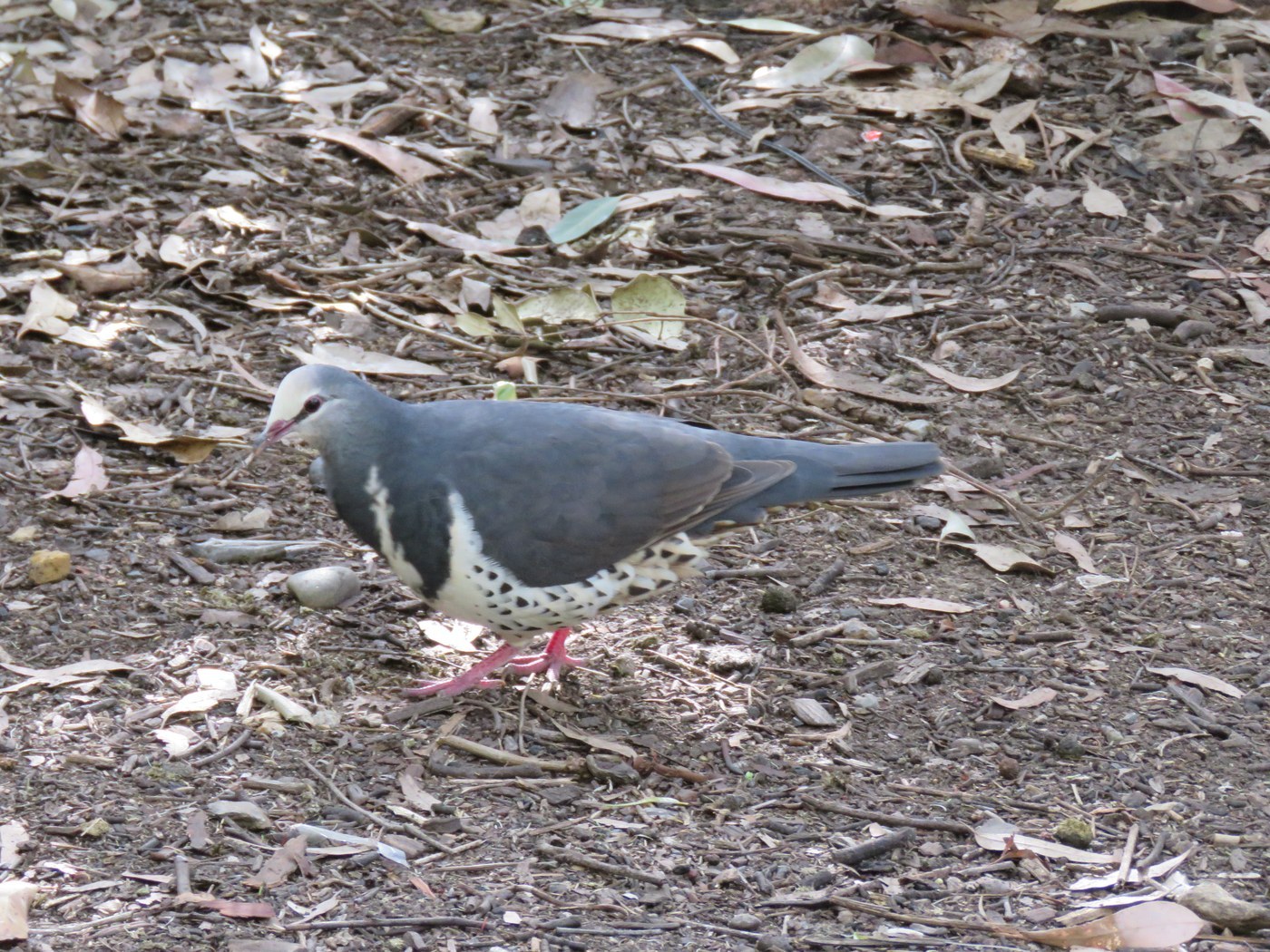
Wonga Pigeon
Dense, soft body contour feathers over a stocky frame

Squatter Pigeon
Dense, cryptic body contour feathers with a bold facial pattern

White-winged Dove
Broad, sturdy flight feathers with a bold white wing stripe

Western Crowned Pigeon
Rounded fan crest plumes over dense soft body feathers

Snow Pigeon
Dense insulating body contour feathers with a bold white rump and belly patch

Zebra Dove
Contour feathers with bold, extensive black-and-white barring

Scaly-naped Pigeon
Contour feathers with iridescent scaled nape pattern