

Madagascar Turtle Dove
Nesoenas picturatus
A grey-brown dove of Madagascar and nearby islands, easily told by the neat black-and-white striped patch on the sides of its neck.
- Feather type
- Contour feathers with barred neck patch
- Colours
- Grey-brown with a black-and-white striped neck patch
- Bird size
- Medium dove, ~28-30 cm
Found a feather like this?
Identify any feather from a photo, free.
Overview
The Madagascar Turtle Dove is a widespread dove of Madagascar and the Mascarene Islands, inhabiting a range of wooded and open habitats. Its most distinctive feature is a small patch of black-and-white barred feathers on the neck, a pattern shared with several other turtle dove species but distinct in its exact placement and contrast on this bird.
Identifying the Feather
The body is a warm grey-brown, palest on the underparts and slightly darker above. On each side of the neck sits a small patch of feathers barred in black and white, standing out clearly against the plain surrounding plumage. The tail shows subtle pale tips to the outer feathers. Compare with the Eurasian Collared Dove, which has a solid black half-collar rather than a barred patch, making the Madagascar Turtle Dove's striped neck marking a clear point of difference.
Plumage & Molt
Sexes are similar in plumage, both showing the barred neck patch, though it may be slightly less defined in females. Juveniles lack the neck patch entirely, developing it gradually after their first molt. There is minimal seasonal plumage variation in this tropical island resident.
Habitat & Range
Native to Madagascar and the Mascarene Islands (including Mauritius and Réunion), where it has also been introduced to other Indian Ocean islands, occupying forest edge, scrub, and cultivated land. It is largely resident, without significant migratory movement.
Behavior & Field Notes
Forages on the ground for seeds and small plant matter, often in pairs or small groups. Its call is a soft, repetitive cooing typical of turtle doves. Nests are simple stick platforms built in trees or shrubs. It adapts well to disturbed and cultivated habitats, making it a familiar bird across much of its island range.
Frequently asked questions
What is the signature mark of the Madagascar Turtle Dove?
A small patch of black-and-white barred feathers on each side of the neck, distinct from a solid collar.
Where does this species occur?
Native to Madagascar and the Mascarene Islands, with introduced populations on other Indian Ocean islands.
How does it differ from the Eurasian Collared Dove?
Its neck patch is barred black-and-white rather than forming a solid black half-collar.
What habitats does it use?
Forest edge, scrub, and cultivated or disturbed land across its island range.
Madagascar Turtle Dove guides
In-depth guides for identifying and understanding Madagascar Turtle Dove.

Other feathers you may enjoy

Victoria Crowned Pigeon
Large lace-like fan crest plumes over dense body contour feathers

Plain Pigeon
Contour feathers, plain and uniformly toned, with a white wing patch

Zenaida Dove
Contour and flight feathers, faint iridescent sheen on neck

Pink Pigeon
Soft contour feathers with graduated tail

Nicobar Pigeon
Long, hackle-like elongated neck feathers with iridescent sheen
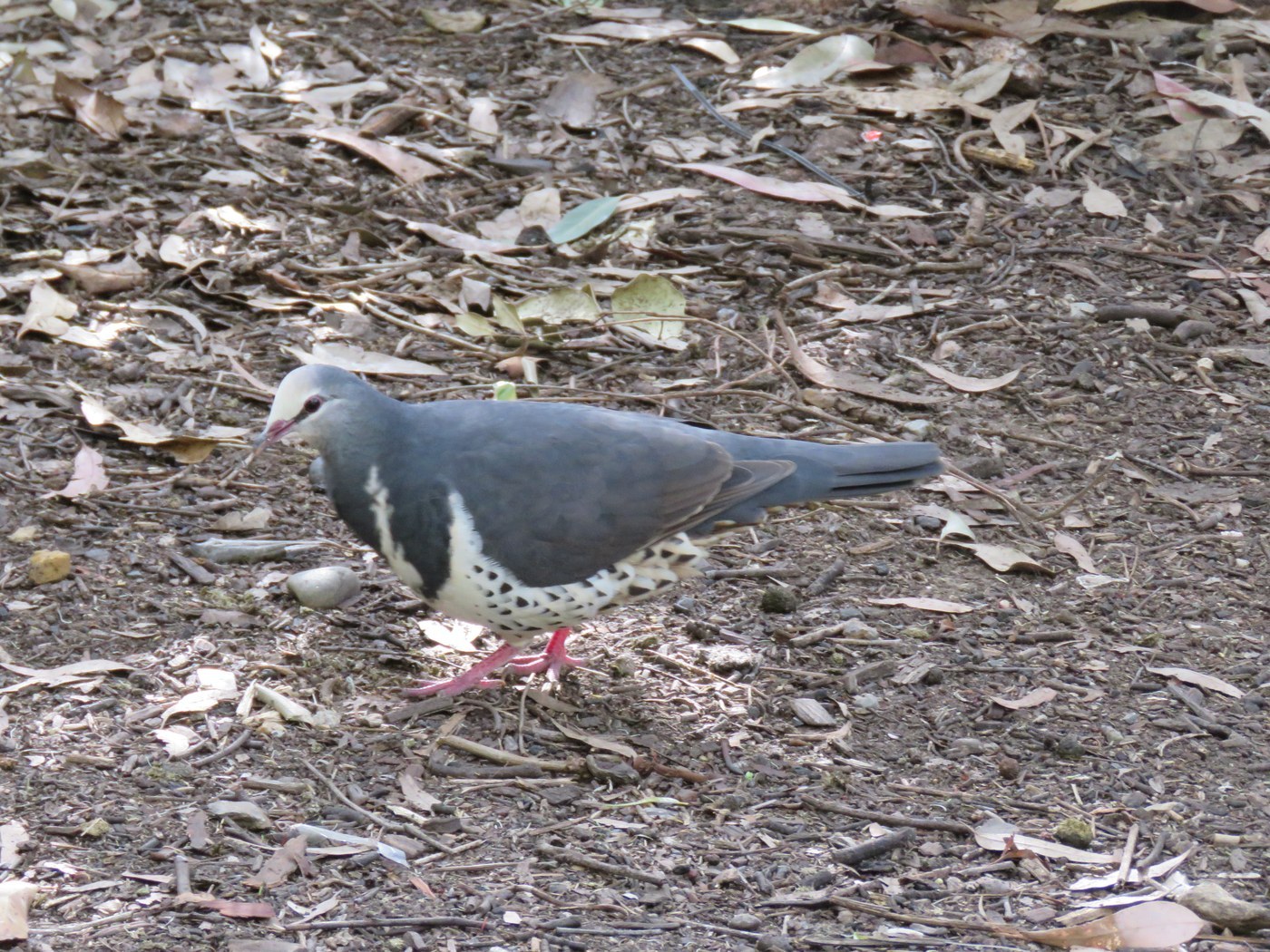
Wonga Pigeon
Dense, soft body contour feathers over a stocky frame

Squatter Pigeon
Dense, cryptic body contour feathers with a bold facial pattern

White-winged Dove
Broad, sturdy flight feathers with a bold white wing stripe

Western Crowned Pigeon
Rounded fan crest plumes over dense soft body feathers

Snow Pigeon
Dense insulating body contour feathers with a bold white rump and belly patch

Zebra Dove
Contour feathers with bold, extensive black-and-white barring

Scaly-naped Pigeon
Contour feathers with iridescent scaled nape pattern