
Kentish Plover
Charadrius alexandrinus
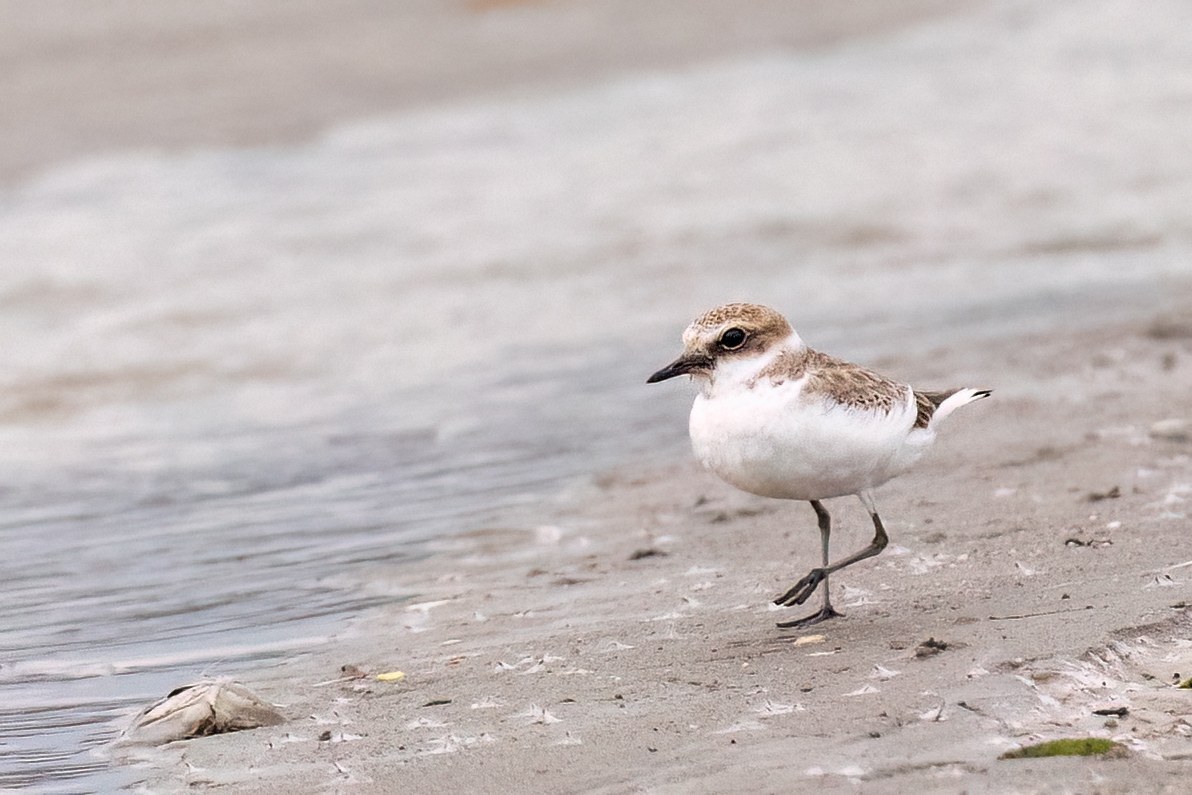
A small, pale Old World plover of sandy and saline flats, closely resembling the Snowy Plover of the Americas, with dark side-breast patches rather than a complete band.
- Feather type
- Small, pale body feathers and short rounded flight feathers
- Colours
- Pale sandy-brown upperparts, white underparts, and small dark patches at the sides of the breast
- Bird size
- Small plover, ~15-17 cm
Found a feather like this?
Identify any feather from a photo, free.
Overview
The Kentish Plover is a small, pale shorebird found across sandy and saline habitats of Europe, Asia, and Africa, and is considered the Old World counterpart to the Snowy Plover of the Americas, which some taxonomists have historically treated as part of the same species complex. Like its American relative, it lacks a complete breast band, instead showing small, isolated dark patches at the sides of the upper breast.
Its overall pale sandy coloration provides effective camouflage on the open beaches, salt pans, and saline lake margins it favors for both foraging and nesting. Dark, blackish legs and a thin black bill complete its understated but distinctive appearance.
A very pale, sandy-toned plover feather with small isolated dark breast patches, found near a saline coastal flat, salt pan, or inland saline lake in Europe, Asia, or Africa, is a good indicator of this species.
Identifying the Feather
Shape and Size
Body feathers are small, fine, and pale, with short, rounded flight feathers, consistent with one of the smaller ringed plovers of its range.
Color and Pattern
- Upperparts are pale sandy-brown, closely matching the pale, saline substrate of its habitat.
- Underparts are white, with small dark patches at the sides of the upper breast rather than a continuous band.
- A dark line crosses behind the eye, and males in breeding condition show a rufous wash on the crown.
- Flight feathers show a narrow white wing stripe.
Shaft and Vane
Shafts are pale throughout, matching the species' overall light coloration.
Distinguishing from Similar Species
Kentish Plover is essentially the Old World counterpart to the Snowy Plover, sharing very similar pale coloration and incomplete breast patches; range separates the two, with Kentish Plover occurring across Europe, Asia, and Africa and Snowy Plover restricted to the Americas. Compared to Common Ringed Plover, Kentish Plover is paler and lacks a complete breast band.
Plumage & Molt
Adults show pale sandy-brown upperparts, white underparts with small dark side-breast patches, and dark legs and bill. Breeding males often show a rufous tinge to the crown and a black forehead bar. Females and non-breeding birds are duller, lacking the rufous crown wash. Juveniles are paler still with faint or reduced breast patches. Molt occurs mainly after breeding, refreshing body feathers before the next nesting season.
Habitat & Range
The Kentish Plover breeds across a broad range spanning Europe, Africa, and Asia, favoring sandy and saline coastal flats, salt pans, and inland saline or alkaline lakes. Northern and inland populations are migratory, wintering along milder coasts, while populations in warmer parts of the range are largely resident.
Behavior & Field Notes
This plover forages on open sand and saline flats, taking small invertebrates using a characteristic run-stop-peck technique. It often nests in loose association with other shorebirds on open salt pans or sandy flats. Its call is a short, sharp whistled note. Nests are shallow scrapes on bare sand or salt-crusted ground, often placed in very open, exposed locations. For feather finders, a very pale sandy-toned feather with small isolated dark breast patches found near a saline flat or salt pan across Europe, Asia, or Africa is a good indicator of this species.
Frequently asked questions
Is the Kentish Plover related to the Snowy Plover?
Yes, the two are closely related and were historically sometimes treated as a single species; Kentish Plover occurs in the Old World while Snowy Plover is restricted to the Americas.
Does the Kentish Plover have a complete breast band?
No, it shows small isolated dark patches at the sides of the upper breast rather than a continuous band.
What habitat does this species favor?
Sandy and saline coastal flats, salt pans, and inland saline or alkaline lakes across Europe, Africa, and Asia.
Do breeding males look different from females?
Yes, breeding males often show a rufous tinge on the crown and a black forehead bar, while females and non-breeding birds are duller.
Kentish Plover guides
In-depth guides for identifying and understanding Kentish Plover.
Other feathers you may enjoy
Southern Lapwing
Body, flight, and tail feathers

Jack Snipe
Body and flight feathers

Far Eastern Curlew
Body, flight, and tail feathers

Terek Sandpiper
Body and flight feathers

Wilson's Phalarope
Body and flight feathers
Long-billed Curlew
Body, flight, and tail feathers

Upland Sandpiper
Body, flight, and tail feathers

Red Phalarope
Body and flight feathers

Eurasian Dotterel
Body feathers
Masked Lapwing
Body, flight, and tail feathers
Eurasian Curlew
Body, flight, and tail feathers
Solitary Sandpiper
Contour and flight feathers