
How to Identify Kentish Plover Feathers
How to identify the pale sandy-brown feathers and incomplete breast band of the Kentish Plover, and separate it from Snowy and Semipalmated Plover feathers.
Read the full Kentish Plover encyclopedia entry →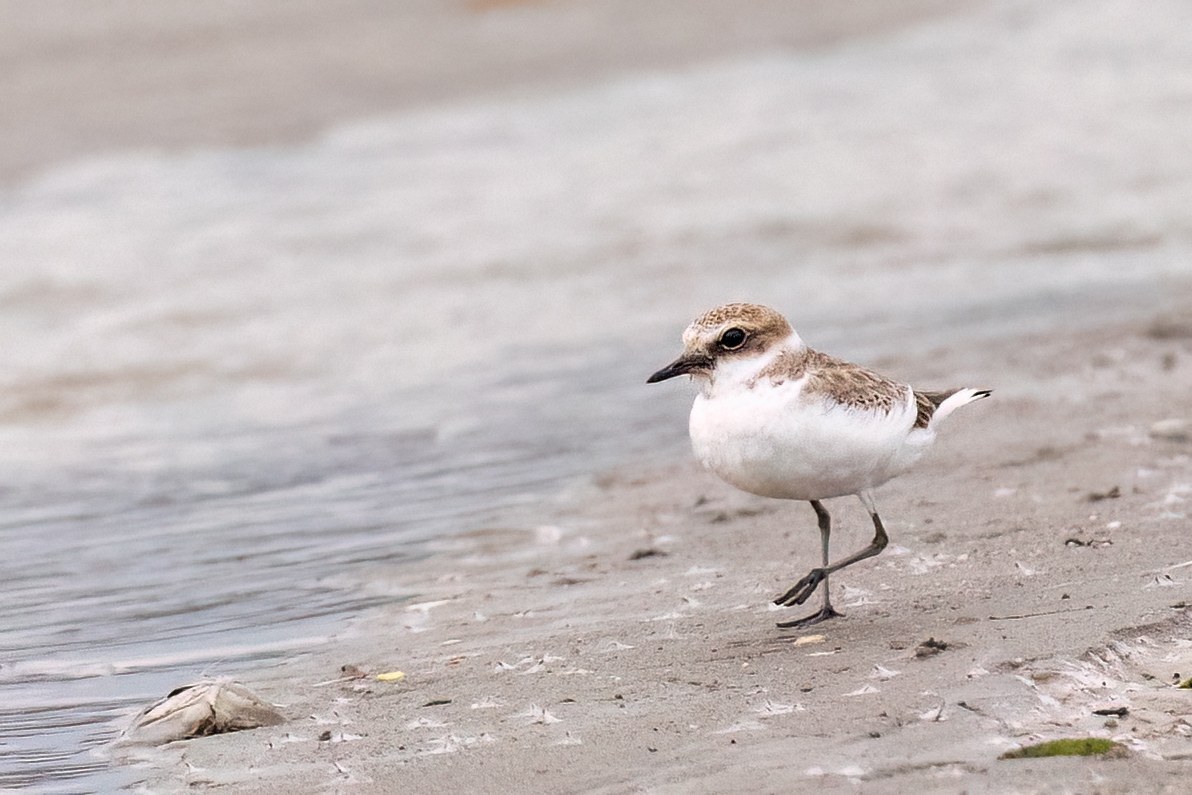
What Kentish Plover Feathers Look Like
Kentish Plover feathers run pale and sandy, matching the open beach and salt-flat habitats this small shorebird favors. Back, crown, and wing covert feathers are a soft sandy-brown to grayish-buff, unmarked by bold spotting or barring, while underparts feathers are clean white. The key diagnostic pattern involves the breast: rather than a single continuous dark band across the chest (as in many plovers), Kentish Plover shows dark patches only at the sides of the breast, leaving the center white — so a breast-area feather from this species will either be a plain dark side patch feather or plain white center feather, never a feather that would fit into a complete solid band. Males in breeding condition show a neat black bar across the forehead and dark ear patches, so a small blackish feather from the crown/face area with sharp edges (rather than smudgy) fits a breeding male. Flight feathers are grayish-brown with a fairly modest white wing stripe, and the tail shows white outer feathers contrasting with darker central ones. Legs are dark gray to blackish, a helpful note if any leg-adjacent feathering is present.
Step-by-Step: Is This Feather From a Kentish Plover?
- Check the breast pattern. A feather that would sit at the side of the chest as an isolated dark patch (not part of a continuous band) fits Kentish Plover; a feather clearly designed to complete a solid ring around the chest does not.
- Assess overall paleness. Sandy-brown to pale grayish-buff upperparts with no bold spotting matches this open-habitat species.
- Look for a crisp black forehead bar feather. Sharp-edged black feathers from the crown/face (breeding male) support this species over duller, non-breeding individuals or females.
- Check the tail for white outer feathers. White outer tail feathers against darker central ones is a supporting clue.
- Match habitat. A pale plover feather found on open sandy beach, salt pan, or lagoon edge favors Kentish Plover in its Old World range.
Similar Species & How to Tell Them Apart
- Snowy Plover (New World counterpart, sometimes treated as the same species complex) is essentially identical in plumage and pattern; separation is by range (Snowy Plover in the Americas, Kentish Plover in Europe/Asia/Africa) rather than feather detail.
- Semipalmated Plover shows a complete, solid breast band, not the broken/incomplete pattern of Kentish Plover, and has orange-yellow legs rather than dark gray-black legs.
- Common Ringed Plover is similarly patterned with a full breast band and a bolder white forehead/eyebrow pattern, again differing mainly in the completeness of the chest band.
- Little Ringed Plover shows a full thin breast band too, plus a bright yellow eye-ring not reflected in body feather color but useful as a live-bird distinction if you're comparing photos.
Where & When You'll Find Them
Kentish Plovers breed on open sandy and shelly beaches, salt pans, and the margins of coastal lagoons across much of Europe, Asia, and Africa, with northern populations migrating south for winter while southern populations are largely resident. Feathers are most likely to be found during the breeding season (spring through mid-summer) near nest scrapes on bare sand or gravel, and again during the late-summer post-breeding molt when adults refresh worn plumage before migration or the non-breeding season. Check open beach flats, salt pan edges, and estuary margins, particularly areas with minimal vegetation that this species favors for nesting.
Frequently asked questions
What's the single best diagnostic for a Kentish Plover breast feather?
It comes from a broken, incomplete breast pattern — dark patches only at the sides with a white center — rather than a continuous solid band across the chest.
How does leg color help even without leg feathers?
Kentish Plover has dark gray-black legs, versus the brighter orange-yellow legs of Semipalmated and some Ringed Plovers, useful context if you're comparing a live or photographed bird alongside a feather find.
Can feather alone separate Kentish Plover from Snowy Plover?
Not reliably — they're extremely similar and effectively separated by geography, with Snowy Plover in the Americas and Kentish Plover across Europe, Asia, and Africa.
When are Kentish Plover feathers most likely to turn up?
During the spring-to-summer breeding season near nest scrapes, and again in late summer during the post-breeding molt.
What habitat should I check?
Open sandy or shelly beaches, salt pans, and lagoon or estuary margins with sparse vegetation, the species' preferred nesting and foraging habitat.