

Eared Dove
Zenaida auriculata
One of South America's most abundant doves, recognized by a small dark crescent below the eye and neat black spots scattered across its warm pinkish-brown wings.
- Feather type
- Contour feathers with dark wing spotting and rounded tail
- Colours
- Pinkish-brown with black wing spots and a small dark ear-mark
- Bird size
- Medium dove, ~22-23 cm
Found a feather like this?
Identify any feather from a photo, free.
Overview
The Eared Dove is an extremely common and widespread dove found across nearly all of South America, from open farmland to scrubby woodland edges. Its name comes from a small, dark comma-shaped mark below and behind the eye, resembling a tiny ear, which sets it apart from similar Zenaida doves.
Identifying the Feather
Body plumage is a warm pinkish-brown, with a scattering of small, solid black spots across the wing coverts. The distinctive dark auricular mark below the eye is a key identifier separate from the plumage itself. The tail is rounded rather than sharply pointed, with pale grey tips to the outer feathers visible when fanned. Compare with the Mourning Dove of North America, which has a more sharply pointed tail, and the West Peruvian Dove, which is larger and found along the Pacific coast rather than broadly across the continent.
Plumage & Molt
Sexes look broadly similar, though males often show a brighter pinkish wash on the breast and a touch of iridescence on the neck sides compared to duller females. Juveniles are scalier and more buff-toned overall until their first complete molt. There is no strong seasonal plumage change, though feather wear can dull the pink breast tone between molts.
Habitat & Range
Found from Colombia and Venezuela south through virtually all of South America to Tierra del Fuego, in open woodland, farmland, savanna, and urban parks. It is partly migratory in the southern part of its range, with populations shifting seasonally in response to breeding and food availability, while remaining resident in warmer regions.
Behavior & Field Notes
Forages on the ground for seeds, often in large flocks that can number in the hundreds where food is abundant, such as harvested grain fields. Its call is a soft, repeated cooing. Nests are simple stick platforms built in trees or shrubs, sometimes in loose colonies. It is highly adaptable and thrives in agricultural and urban landscapes throughout its range.
Frequently asked questions
What is the key identification mark of an Eared Dove?
A small, dark crescent-shaped mark below and behind the eye, combined with black spots scattered across pinkish-brown wings.
How large do flocks get?
Eared Doves can gather in large flocks, sometimes numbering in the hundreds, especially around abundant grain or seed sources.
Where does it live?
Across nearly all of South America, in open country, farmland, and urban parks.
How is it different from the Mourning Dove?
The Eared Dove has a more rounded tail, while the Mourning Dove's tail comes to a sharper point.
Eared Dove guides
In-depth guides for identifying and understanding Eared Dove.

Other feathers you may enjoy

Victoria Crowned Pigeon
Large lace-like fan crest plumes over dense body contour feathers

Plain Pigeon
Contour feathers, plain and uniformly toned, with a white wing patch

Zenaida Dove
Contour and flight feathers, faint iridescent sheen on neck

Pink Pigeon
Soft contour feathers with graduated tail

Nicobar Pigeon
Long, hackle-like elongated neck feathers with iridescent sheen
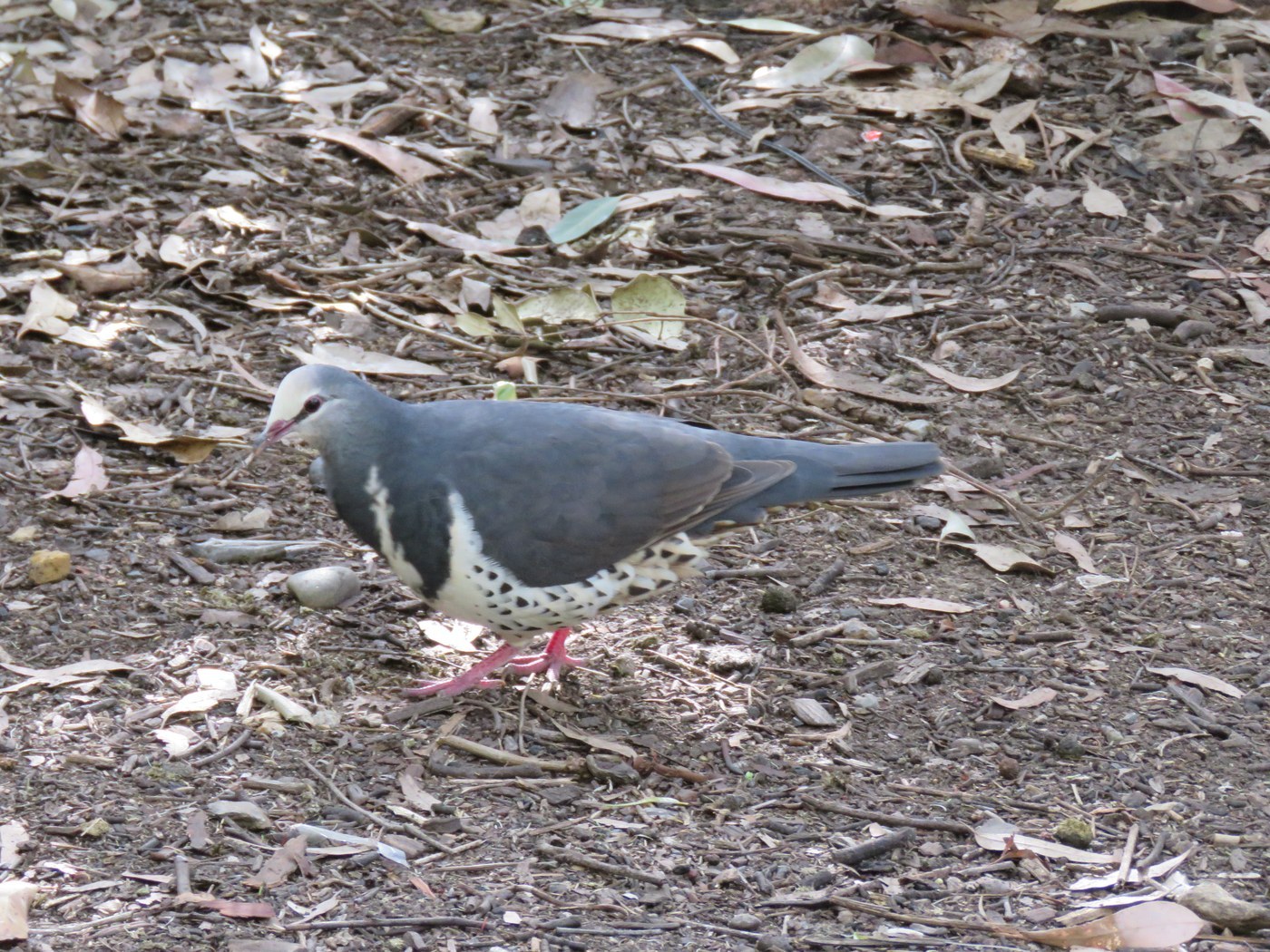
Wonga Pigeon
Dense, soft body contour feathers over a stocky frame

Squatter Pigeon
Dense, cryptic body contour feathers with a bold facial pattern

White-winged Dove
Broad, sturdy flight feathers with a bold white wing stripe

Western Crowned Pigeon
Rounded fan crest plumes over dense soft body feathers

Snow Pigeon
Dense insulating body contour feathers with a bold white rump and belly patch

Zebra Dove
Contour feathers with bold, extensive black-and-white barring

Scaly-naped Pigeon
Contour feathers with iridescent scaled nape pattern