

Blue Ground Dove
Claravis pretiosa
A small, strikingly dimorphic dove-pale powder-blue in males, warm rufous-brown in females-both patterned with bold blackish spots across the wings.
- Feather type
- Contour feathers with dark wing spotting
- Colours
- Pale blue-grey (male) or rufous-brown (female) with blackish wing markings
- Bird size
- Small dove, ~17-19 cm
Found a feather like this?
Identify any feather from a photo, free.
Overview
The Blue Ground Dove is a small, low-flying dove of Neotropical forest edges and clearings, notable for one of the most pronounced sexual plumage differences among ground-doves. Males are a soft, pale blue-grey, while females are warm cinnamon-brown, but both sexes share the same bold pattern of dark spots across the wing coverts, making the species identifiable regardless of sex.
Identifying the Feather
Males show pale blue-grey body plumage set off by two or three rows of blackish-purple spots on the wing coverts and often a dark bar near the wingtip. Females replace the blue-grey tone with a warm rufous-brown, but retain the same dark wing spotting pattern, making the spots the most reliable mark across both sexes. The tail is short and rounded with little contrasting pattern. Compare with the Ruddy Ground Dove, which lacks the bold blackish wing spots and shows a more uniformly rufous or cinnamon plumage.
Plumage & Molt
This species shows marked sexual dimorphism: males are pale blue-grey overall with a slightly paler face, while females are rufous-brown throughout. Juveniles resemble females but appear scalier, with buff-edged feathers on the back and wings before their first molt. There is no strong seasonal plumage variation; differences seen are primarily due to age and sex rather than time of year.
Habitat & Range
Ranges from southern Mexico through Central America and much of tropical South America, favoring forest edges, clearings, riverine growth, and scrubby second growth rather than deep closed-canopy forest. It is a resident species across most of its range, without long-distance migration.
Behavior & Field Notes
Feeds on the ground and in low vegetation on small seeds, moving with quick, low hops. Its call is a soft, repeated cooing, often given from a low, exposed perch. Nests are flimsy stick platforms built low in shrubs or vine tangles. Pairs are often seen together, with the male's pale coloring making him conspicuous against darker foliage.
Frequently asked questions
Why do male and female Blue Ground Doves look so different?
The species shows strong sexual dimorphism, with males pale blue-grey and females warm rufous-brown, though both share the same dark wing-spot pattern.
What is the best identification feature for both sexes?
Bold blackish spots across the wing coverts are present in both males and females, unlike similarly sized ground-doves that lack this pattern.
Where does it typically live?
In forest edges, clearings, and scrubby second growth across Central and South America, rather than deep unbroken forest.
How does it differ from the Ruddy Ground Dove?
The Ruddy Ground Dove lacks the bold blackish wing spotting and is more uniformly rufous or cinnamon in color.
Blue Ground Dove guides
In-depth guides for identifying and understanding Blue Ground Dove.

Other feathers you may enjoy

Victoria Crowned Pigeon
Large lace-like fan crest plumes over dense body contour feathers

Plain Pigeon
Contour feathers, plain and uniformly toned, with a white wing patch

Zenaida Dove
Contour and flight feathers, faint iridescent sheen on neck

Pink Pigeon
Soft contour feathers with graduated tail

Nicobar Pigeon
Long, hackle-like elongated neck feathers with iridescent sheen
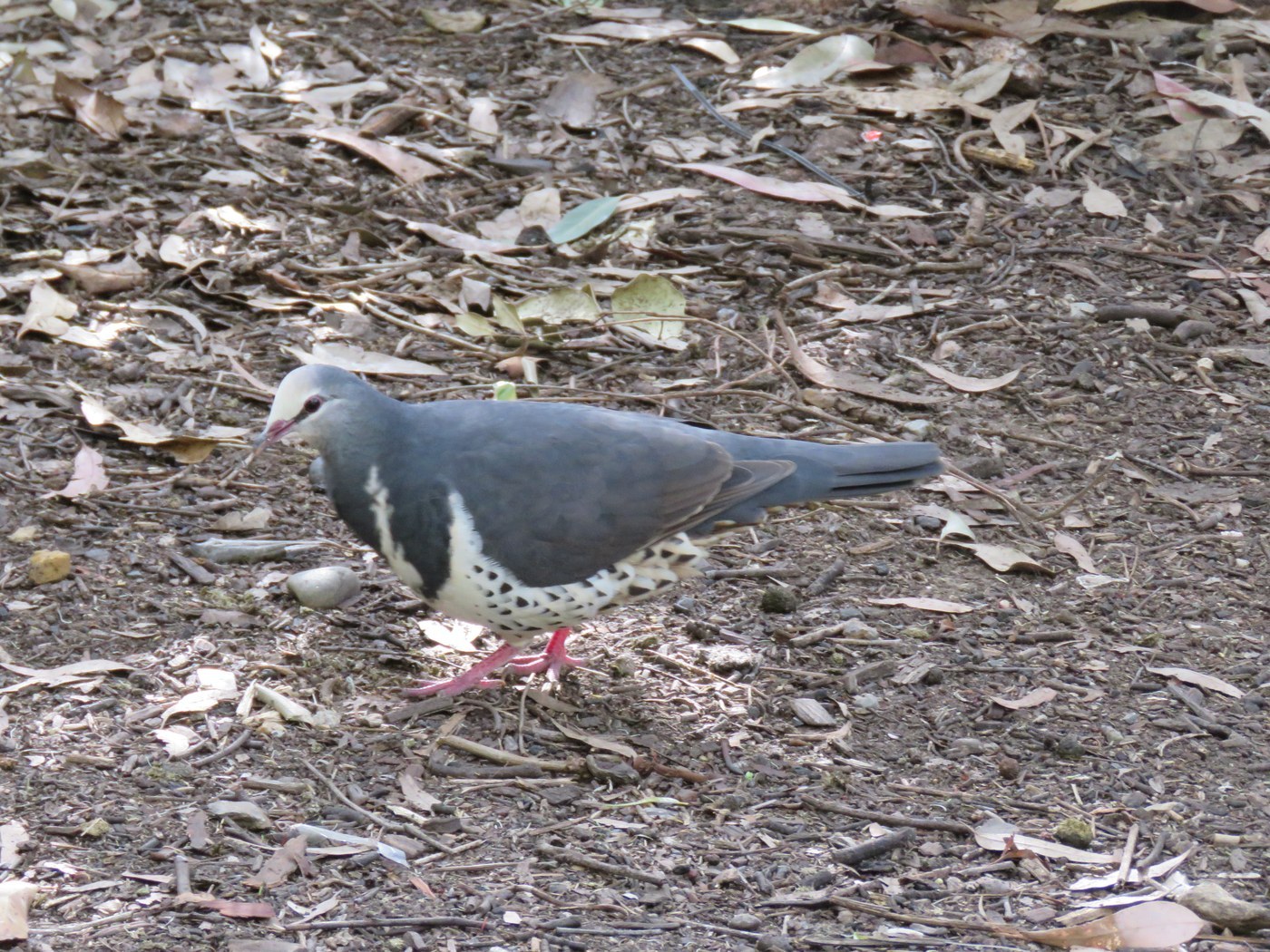
Wonga Pigeon
Dense, soft body contour feathers over a stocky frame

Squatter Pigeon
Dense, cryptic body contour feathers with a bold facial pattern

White-winged Dove
Broad, sturdy flight feathers with a bold white wing stripe

Western Crowned Pigeon
Rounded fan crest plumes over dense soft body feathers

Snow Pigeon
Dense insulating body contour feathers with a bold white rump and belly patch

Zebra Dove
Contour feathers with bold, extensive black-and-white barring

Scaly-naped Pigeon
Contour feathers with iridescent scaled nape pattern