
American Wigeon
Mareca americana
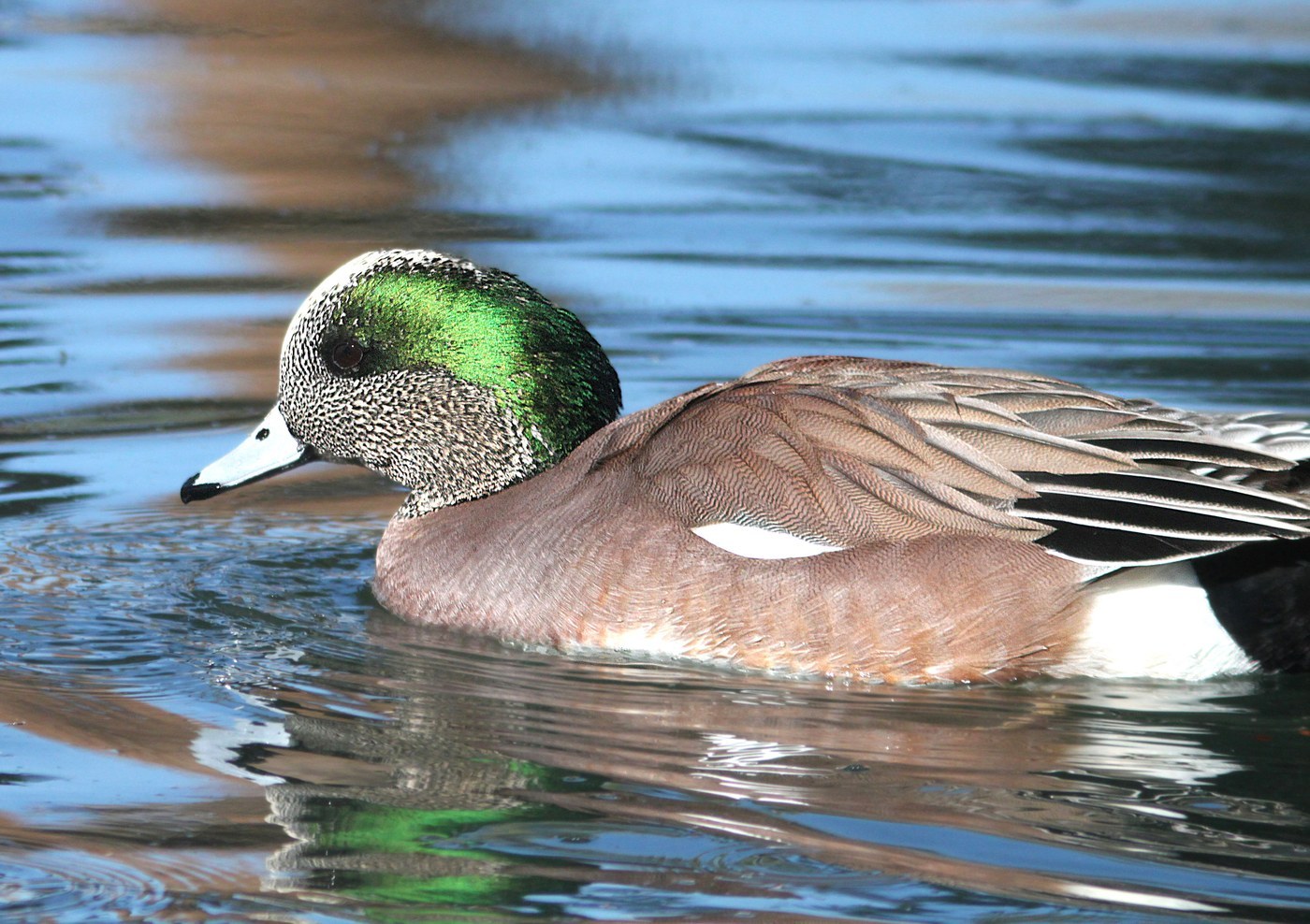
A medium dabbling duck named 'baldpate' for the male's pale cream crown, which contrasts with an iridescent green face patch and a large white shoulder patch visible in flight.
- Feather type
- Cream crown feathers; green face-patch feathers; white upperwing covert feathers; green speculum feathers
- Colours
- Cream crown, green face patch, pinkish-brown body (male); warm brown overall (female)
- Bird size
- Medium dabbling duck, ~42-56 cm
Found a feather like this?
Identify any feather from a photo, free.
Overview
The American Wigeon is a medium-sized dabbling duck breeding across northern and western North America and wintering widely across the continent's lakes, marshes, and coastal wetlands. Its old nickname, baldpate, refers to the male's pale, almost white-cream crown, likened to a bald head.
Behind the eye, males show an iridescent green patch that can flash brightly in good light, set against a warm pinkish-brown body. In flight, a bold white patch on the upper wing coverts is one of the most conspicuous field marks in the entire duck family.
Feathers of this species can be recognized by the combination of a pale cream crown patch, green face-patch feathers, and, in flight feathers, a large white forewing patch bordered by a green speculum.
Identifying the Feather
Size and shape
- Medium-sized dabbling-duck contour and flight feathers
- Distinctly large white patch of upperwing covert feathers, more extensive and brighter white than in most other dabbling ducks
Color and pattern
- Male crown feathers pale cream to whitish, contrasting with a darker head
- Iridescent green feathers form a patch running back from the eye in males
- Male body feathers warm pinkish-brown on the breast and flanks, with a white belly
- Upperwing covert feathers white in males (and duller grey-white in females), forming a bold patch in flight
- Speculum feathers green, bordered with black
Distinguishing from similar species
- The bold white upperwing patch combined with a green speculum is a strong combination not shared by most other dabbling ducks
- Compare with Eurasian Wigeon: American Wigeon has white axillary (armpit) feathers, while Eurasian Wigeon shows grey axillaries, a useful distinction if underwing feathers are available
Plumage & Molt
Breeding males show a cream crown, dark green eye patch, pinkish-brown body, and white flank patch, with a grey-blue bill tipped black. Females are warm brown overall with a greyish head, lacking the bold face pattern of males, but sharing the same distinctive bill color and shape. Males undergo an eclipse molt after breeding, temporarily resembling females. All undergo a flightless period during wing molt.
Habitat & Range
Breeds across the northern prairies, parklands, and boreal wetlands of North America, favoring lakes, ponds, and marshes with abundant submerged vegetation. Winters widely across the United States, Mexico, and Central America, on lakes, reservoirs, flooded fields, and coastal marshes. Most populations are migratory.
Behavior & Field Notes
Feeds by grazing on aquatic vegetation, often stealing food brought to the surface by diving ducks and coots, as well as grazing on land in fields and short grass. Nests on the ground, typically well concealed in grass or shrub cover near water. Voice includes a distinctive whistled call in males, quite different from the typical quack of many dabbling ducks. The large white wing patch and cream crown make this one of the more readily identifiable dabbling ducks from feather material alone.
Frequently asked questions
Why is the American Wigeon called 'baldpate'?
The male's pale, cream-white crown resembles a bald head, giving rise to this old nickname.
How can I tell American Wigeon feathers from Eurasian Wigeon feathers?
American Wigeon has white underwing (axillary) feathers, while Eurasian Wigeon shows grey axillaries; American Wigeon also typically shows a cleaner white crown versus the Eurasian's buffier crown stripe.
What is the most distinctive wing feature of this species?
A large, bold white patch on the upperwing coverts, bordered by a green speculum, visible in both sexes though brighter in males.
Does the American Wigeon graze on land?
Yes, it commonly grazes on grasses and agricultural fields in addition to feeding on aquatic vegetation in the water.
American Wigeon guides
In-depth guides for identifying and understanding American Wigeon.
Other feathers you may enjoy

Mallard
Wing (speculum), body, and tail feathers

Spectacled Eider
Large sea-duck body feathers with distinctive eye-ring patches

Canada Goose
Body and flight feathers
Mute Swan
Body (contour) and flight feathers

Wood Duck
Iridescent crest feathers; ornate scapular and flank feathers; white teardrop facial feathers (female)
Whooper Swan
Contour and flight feathers

White-winged Scoter
Large sea-duck body feathers with a white wing patch

Ruddy Duck
Stiff tail feathers and compact body plumage

Ross's Goose
Contour and flight feathers

White-cheeked Pintail
Contour and elongated tail feathers

Torrent Duck
Dense, sleek contour feathers; stiff, pointed tail feathers used for bracing against rocks

Tundra Swan
Contour and flight feathers