
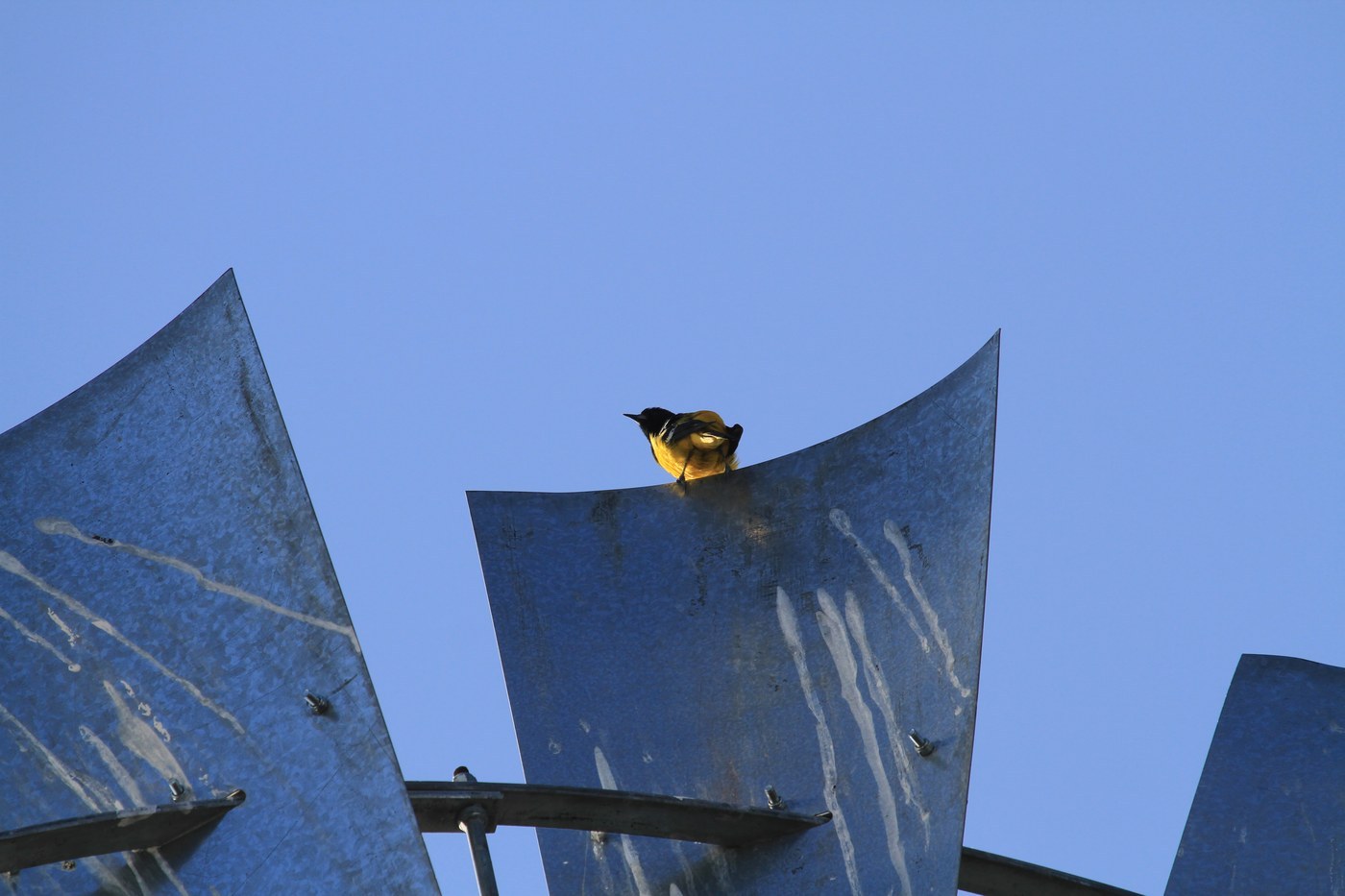
Scott's Oriole
Icterus parisorum
A bold desert oriole with adult males showing sharply contrasting lemon-yellow and black plumage, closely tied to yucca and agave habitats in the arid Southwest.
- Feather type
- Bold contrasting body feathers
- Colours
- Lemon yellow and black (male); olive-yellow and gray (female)
- Bird size
- Medium oriole, ~22-24 cm
Found a feather like this?
Identify any feather from a photo, free.
Overview
Overview
Scott's Oriole is a striking oriole of arid landscapes, with adult males displaying a bold pattern of lemon-yellow body plumage set against a solid black head, throat, back, and tail. It is closely associated with yucca and agave plants, which provide nesting sites, nectar, and foraging cover in its desert and dry woodland habitat.
Identifying the Feather
Feather Identification
- Adult male body feathers: Solid black head, throat, upper back, wings, and tail contrasting sharply with lemon-yellow underparts and rump
- Female feathers: Olive-yellow and grayish overall with a duller, more streaked back and less contrast than the male
- Wing feathers: White wing bars visible on both sexes
- Size: Larger and more robust than Hooded or Orchard Oriole
- Similar species: The bold black-and-yellow male pattern is distinctive among North American orioles; females can be confused with female Hooded Orioles but are grayer and less uniformly olive
Plumage & Molt
Plumage Details
Adult males show a solid black hood extending over the throat, back, wings, and tail, sharply contrasting with bright lemon-yellow underparts, rump, and shoulder patch, plus white wing bars. Females are duller, showing olive-yellow underparts and a grayish, streaked back with less defined contrast than males. Immatures resemble females, with young males gradually acquiring black hood feathering over subsequent molts.
Habitat & Range
Habitat & Range
Scott's Oriole inhabits arid grasslands, desert scrub, yucca and agave stands, and pinyon-juniper woodlands across the southwestern United States and Mexico. Northern populations are migratory, wintering in Mexico, while some southern populations are resident.
Behavior & Field Notes
Behavior & Field Notes
Scott's Orioles forage for insects, nectar, and fruit, often visiting flowering yucca and agave plants. Males deliver a rich, whistled song from exposed perches on yucca stalks or trees. Nests are woven baskets often suspended from yucca leaves, providing protection in an otherwise sparse desert landscape.
Frequently asked questions
How can I recognize Scott's Oriole feathers?
Adult male feathers show a bold, sharply divided pattern of solid black on the head, back, wings, and tail against lemon-yellow underparts and rump.
Why is Scott's Oriole linked to yucca plants?
It relies on yucca and agave for nectar, insect foraging, and nesting sites, making these plants a key part of its desert habitat.
How do female Scott's Orioles differ from males?
Females are duller overall with olive-yellow underparts and a grayish, streaked back, lacking the male's solid black hood.
Where does Scott's Oriole live?
It is found in arid grasslands, desert scrub, and dry woodlands of the southwestern United States and Mexico.
Scott's Oriole guides
In-depth guides for identifying and understanding Scott's Oriole.
Other feathers you may enjoy

Yellow-breasted Bunting
Contour and flight feathers, chestnut-and-yellow breeding pattern

Sedge Wren
Tiny streaked crown and back feathers

Yellow-winged Cacique
Glossy black body feathers, yellow wing patch, shaggy crest

Yellow Warbler
Small contour and flight feathers

Yellow-throated Warbler
Small contour and flight feathers

Yellow-throated Vireo
Bright yellow throat and spectacle feathers; olive-green back feathers; two white wing-bar feathers

Yellow-rumped Warbler
Small contour and flight feathers

Yellow-hooded Blackbird
Contrasting hood and body feathers

Yellow-headed Blackbird
Glossy black body plumage with a bright yellow head and breast

Yellow-eyed Junco
Contour and flight feathers

Yellow-fronted Canary
Small, smooth body plumage

Yellow-breasted Greenfinch
Compact, smooth body plumage