
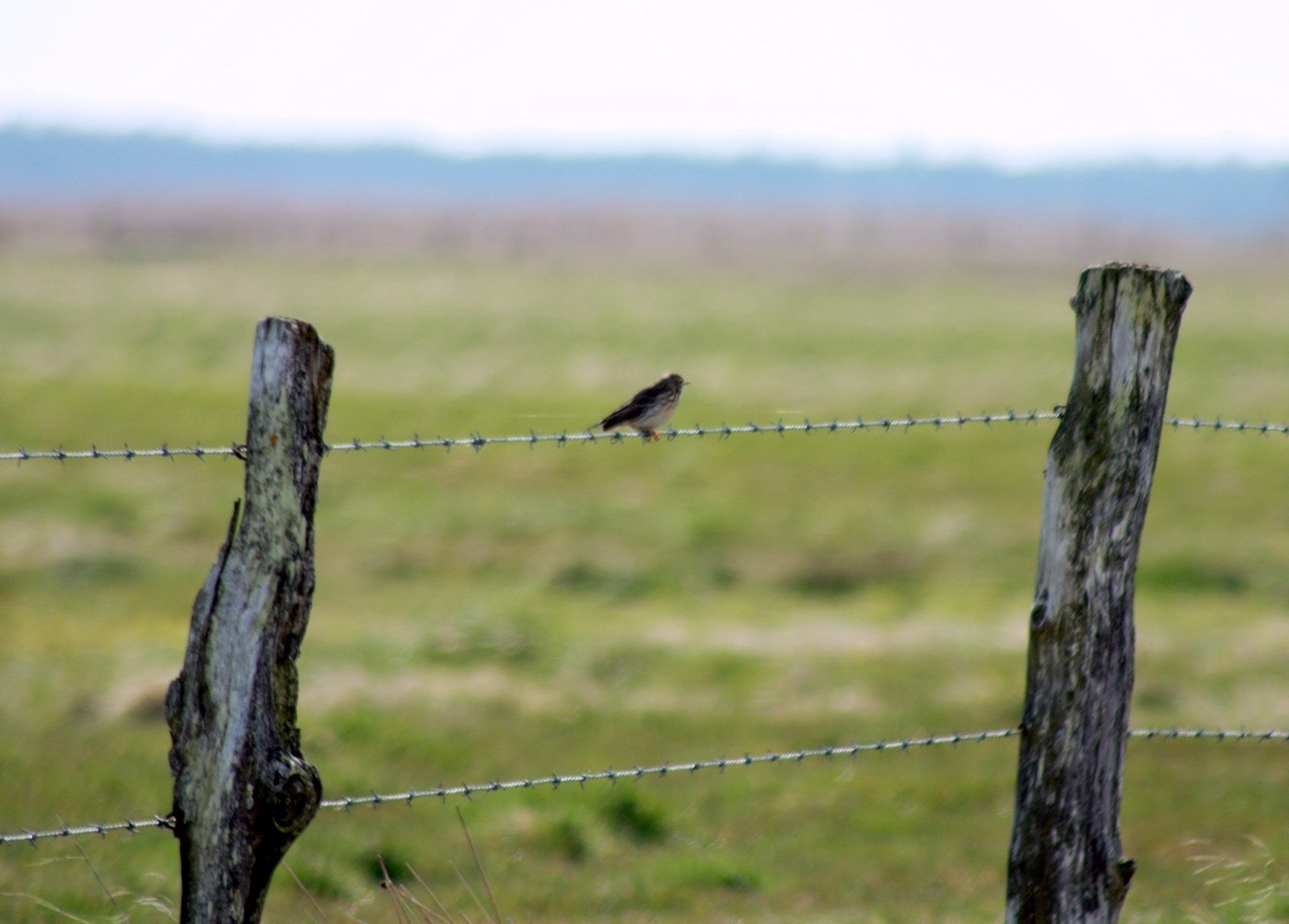
Meadow Pipit
Anthus pratensis
The Meadow Pipit is a small, streaky brown songbird of open country, its cryptic, heavily streaked feathers providing camouflage against grass and heather.
- Feather type
- Streaked, cryptic contour feathers; slim pointed wings; white-edged outer tail feathers
- Colours
- Brown, streaked with dark brown/black above; buff-white streaked underparts
- Bird size
- Small, ~14.5 cm
Found a feather like this?
Identify any feather from a photo, free.
Overview
The Meadow Pipit is one of the most numerous songbirds of open, upland, and coastal grassland habitats in Britain and northern Europe.
Its plumage is a subdued, heavily streaked brown, offering little color contrast but excellent camouflage in grass and heather.
Because it is so common in open country, its feathers are frequently found on moorland, rough pasture, and coastal grassland.
Identifying the Feather
Size & Shape
- Feathers are small and slender, reflecting the bird's slight build; outer tail feathers show white edges, visible as white flashes in flight.
- Wings are pointed but not especially long.
Color & Pattern
- Upperpart feathers: olive-brown to buff-brown with heavy dark streaking throughout the back and crown.
- Underpart feathers: buff-white with fine to bold dark streaking on the breast and flanks, fading to plainer white on the belly.
- Outer tail feathers show white edges, a useful field mark even on isolated feathers.
Similar Species
- Very similar to Tree Pipit and other pipits; Meadow Pipit tends to show finer, more even streaking and is best confirmed by habitat (open grassland/moorland rather than woodland edge) alongside feather pattern.
Plumage & Molt
Overall Plumage
Streaky olive-brown above, buff-white and streaked below, with white-edged outer tail feathers.
Sex & Age Differences
Sexes look alike. Juveniles show slightly bolder, more spotted breast streaking than adults before their first molt.
Molt
One complete molt after breeding in late summer; juveniles have a partial post-juvenile molt of body feathers.
Habitat & Range
Habitat
Moorland, heathland, rough grassland, saltmarsh, and upland pasture.
Range
Breeds widely across northern and western Europe, including much of Britain and Ireland.
Movements
Partially migratory; upland and northern breeders move to lowland fields and coasts, or further south into western Europe and North Africa, in winter.
Behavior & Field Notes
Behavior
Forages on the ground in open habitats, walking rather than hopping, and performing a distinctive parachuting song-flight display.
Diet
Feeds on small invertebrates and, outside the breeding season, some seeds picked from the ground.
Nesting
Builds a grass-lined nest on the ground, well concealed in vegetation such as heather or long grass.
Voice
A thin, repeated 'seep-seep-seep' call, often given in a rising and falling song-flight.
Field Notes
Feathers with even, fine dark streaking on a buff-brown ground, found on open moorland or grassland, are typical of this abundant species.
Frequently asked questions
What is the most distinctive feather feature of a Meadow Pipit?
Fine, even dark streaking on a buff-brown background across the back and breast, with white edges on the outer tail feathers.
Where are Meadow Pipit feathers most commonly found?
In open habitats such as moorland, rough grassland, and coastal pasture.
Is the Meadow Pipit migratory?
Partially; many move to lower ground or further south for winter, while some remain resident where conditions allow.
How does a Meadow Pipit feather differ from a sparrow's?
Meadow Pipit streaking is finer and more uniform, and the outer tail feathers show clean white edges, unlike most sparrows.
Meadow Pipit guides
In-depth guides for identifying and understanding Meadow Pipit.
Other feathers you may enjoy

Yellow-breasted Bunting
Contour and flight feathers, chestnut-and-yellow breeding pattern

Sedge Wren
Tiny streaked crown and back feathers

Yellow-winged Cacique
Glossy black body feathers, yellow wing patch, shaggy crest

Yellow Warbler
Small contour and flight feathers

Yellow-throated Warbler
Small contour and flight feathers

Yellow-throated Vireo
Bright yellow throat and spectacle feathers; olive-green back feathers; two white wing-bar feathers

Yellow-rumped Warbler
Small contour and flight feathers

Yellow-hooded Blackbird
Contrasting hood and body feathers

Yellow-headed Blackbird
Glossy black body plumage with a bright yellow head and breast

Yellow-eyed Junco
Contour and flight feathers

Yellow-fronted Canary
Small, smooth body plumage

Yellow-breasted Greenfinch
Compact, smooth body plumage