
Juniper Titmouse
Baeolophus ridgwayi
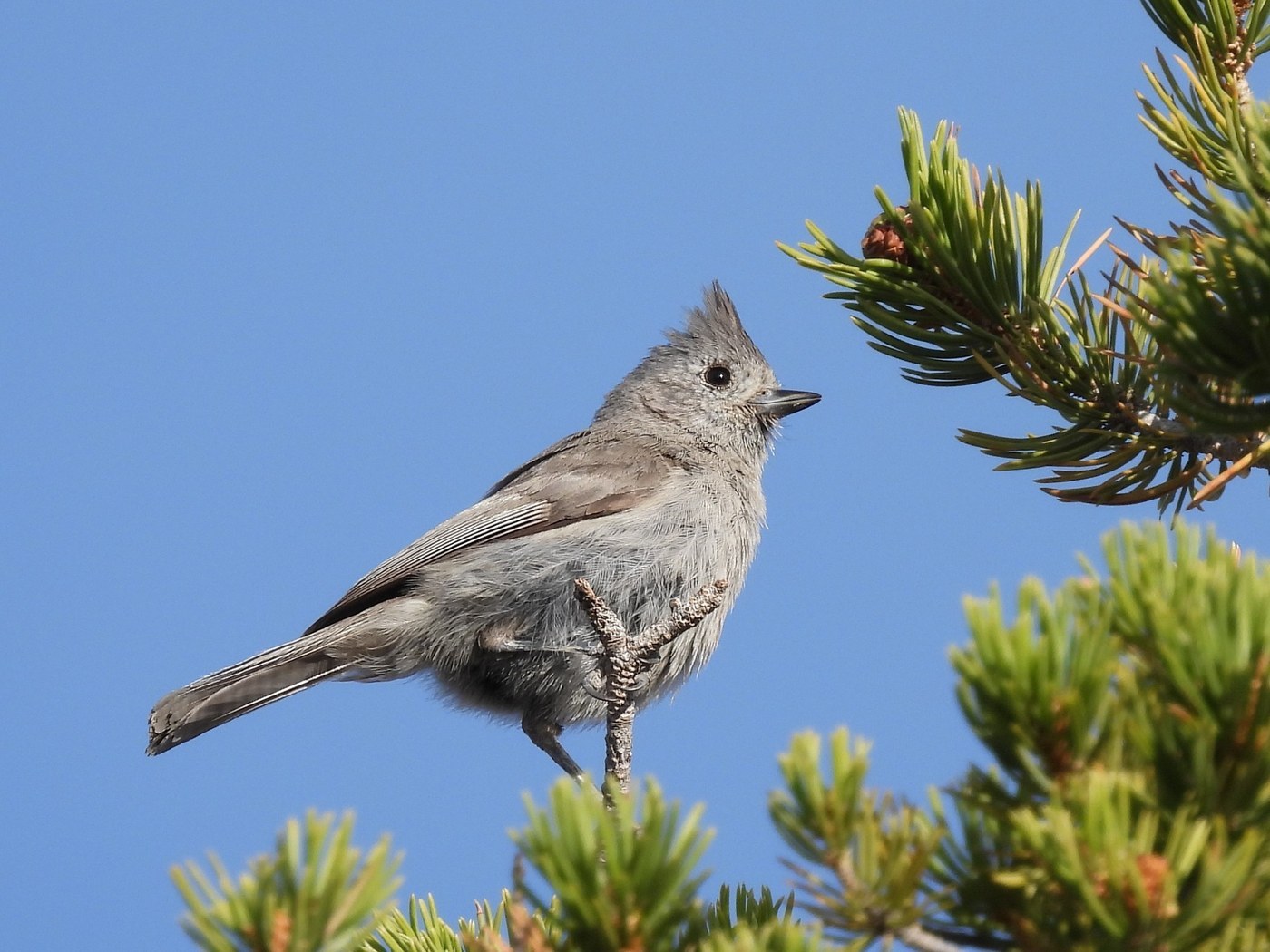
The Juniper Titmouse is a plain gray, crested songbird of the arid pinyon-juniper woodlands of the interior West, notable for its unmarked plumage and persistent, repetitive song.
- Feather type
- Plain, soft crested body plumage
- Colours
- Uniform gray overall with a small crest, paler below
- Bird size
- Small titmouse, ~13-14 cm
Found a feather like this?
Identify any feather from a photo, free.
Overview
Overview
The Juniper Titmouse is a nondescript, uniformly gray crested songbird closely tied to pinyon-juniper woodland across the interior western United States. It was once considered the same species as the Oak Titmouse but is now recognized separately based on range, voice, and subtle plumage differences.
- Plainest of the North American titmice, lacking bold markings
- Restricted to pinyon-juniper habitat of the Great Basin and Colorado Plateau
- Non-migratory year-round resident
Identifying the Feather
Feather Identification
Juniper Titmouse feathers are notably plain and lack strong contrast.
- Crest feathers: Gray, forming a short, pointed peak on the crown
- Body feathers: Uniform pale gray above, slightly paler grayish-white below, without streaking or barring
- Wing and tail feathers: Plain gray-brown, unmarked with no wing bars
- Face: Featureless gray with a plain dark eye standing out against the pale face
- The lack of any bold facial or body markings, combined with the small crest, helps separate Juniper Titmouse feathers from other crested songbirds
Plumage & Molt
Plumage, Sex & Age Differences
Sexes look alike, both plain gray overall with a modest crest and unmarked underparts. Juveniles are similarly plain but may show a slightly shorter crest and softer overall texture. There is a single complete molt after breeding, with no distinct seasonal plumage variation.
Habitat & Range
Habitat & Range
This species is a non-migratory resident of pinyon-juniper woodlands across the Great Basin, Colorado Plateau, and adjacent parts of the interior western United States, from southern Idaho and Oregon south through Nevada, Utah, Colorado, Arizona, and New Mexico. It rarely strays from this specific woodland type.
Behavior & Field Notes
Behavior, Voice & Field Notes
Juniper Titmice forage actively in juniper and pinyon pine canopy for insects and seeds, often hanging upside down on outer branches. Their song is a simple, repetitive, whistled phrase, delivered persistently from a perch. They nest in natural cavities or old woodpecker holes and remain paired on territory throughout the year.
Frequently asked questions
What does a Juniper Titmouse feather look like?
Plain uniform gray with no streaking, barring, or bold markings, typical of this understated species.
How can you tell Juniper Titmouse feathers from Oak Titmouse feathers?
The two are nearly identical in plumage; range is the most reliable clue, since Juniper Titmice occupy interior pinyon-juniper woodland while Oak Titmice occupy California oak woodland.
What habitat should you search for Juniper Titmouse feathers?
Pinyon-juniper woodland across the Great Basin and Colorado Plateau.
Do Juniper Titmice have bold wing bars?
No, their wings are plain gray-brown without wing bars or other markings.
Juniper Titmouse guides
In-depth guides for identifying and understanding Juniper Titmouse.
Other feathers you may enjoy

Yellow-breasted Bunting
Contour and flight feathers, chestnut-and-yellow breeding pattern

Sedge Wren
Tiny streaked crown and back feathers

Yellow-winged Cacique
Glossy black body feathers, yellow wing patch, shaggy crest

Yellow Warbler
Small contour and flight feathers

Yellow-throated Warbler
Small contour and flight feathers

Yellow-throated Vireo
Bright yellow throat and spectacle feathers; olive-green back feathers; two white wing-bar feathers

Yellow-rumped Warbler
Small contour and flight feathers

Yellow-hooded Blackbird
Contrasting hood and body feathers

Yellow-headed Blackbird
Glossy black body plumage with a bright yellow head and breast

Yellow-eyed Junco
Contour and flight feathers

Yellow-fronted Canary
Small, smooth body plumage

Yellow-breasted Greenfinch
Compact, smooth body plumage