
How to Identify Juniper Titmouse Feathers
How to identify the plain gray, crested body feathers of the Juniper Titmouse and separate them from Oak Titmouse and Tufted Titmouse feathers.
Read the full Juniper Titmouse encyclopedia entry →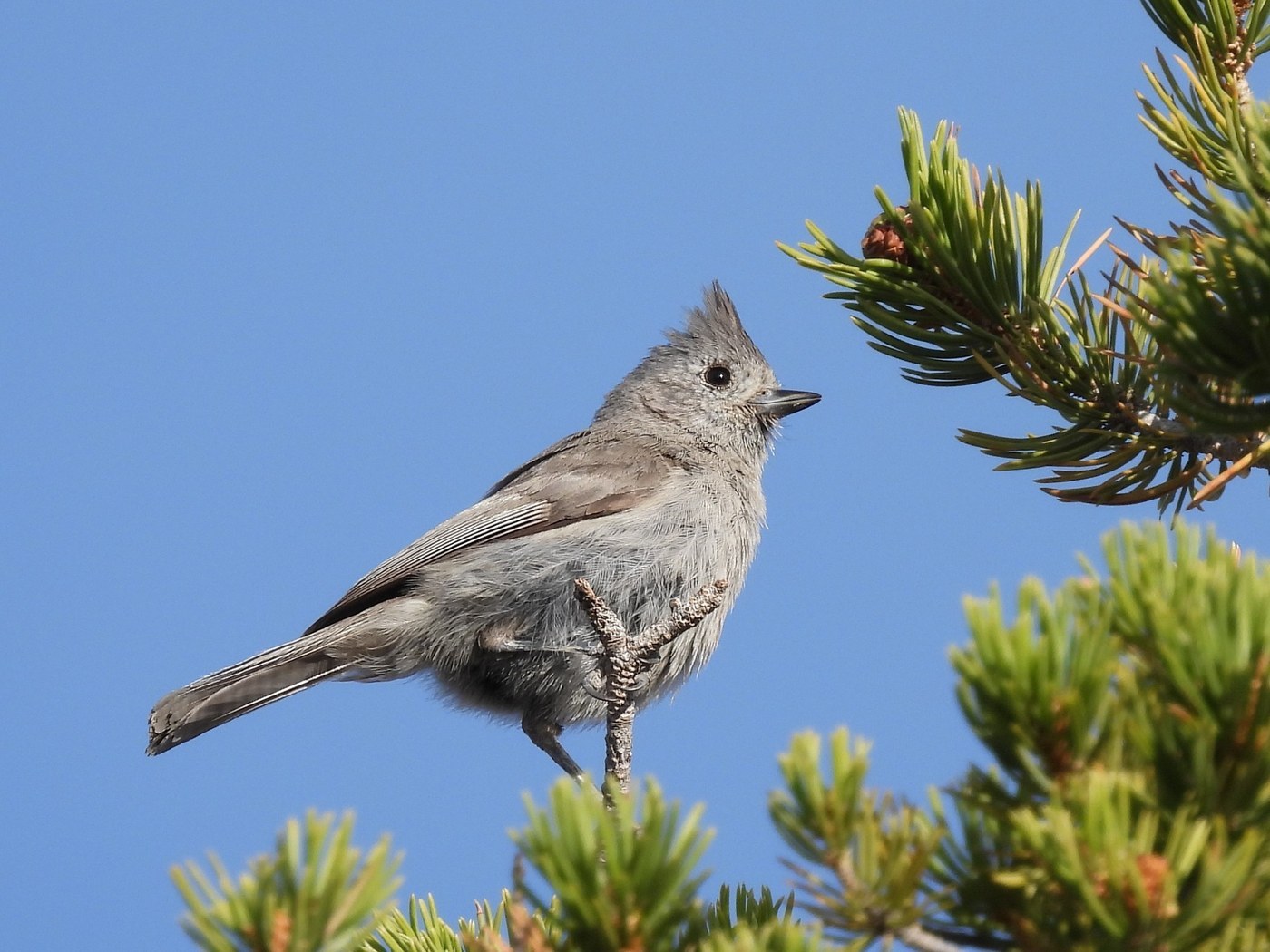
What Juniper Titmouse Feathers Look Like
Juniper Titmouse feathers are about as understated as songbird plumage gets: a uniform, slightly warm pale gray on the back, wings, and tail, fading to an even paler, almost whitish gray on the throat and belly. There is no strong contrast anywhere on the bird — no wing bars, no eye-ring, no colorful flanks, no distinct cap color different from the back. The one structural feature that carries into feather identification is the small crest: feathers from the crown are slightly elongated and can be found separately, distinguishable by their narrow, pointed shape and the same plain gray tone as the rest of the body, sometimes just a shade darker or grayer than the back. Flight feathers are unremarkable gray-brown with no white edging or wing bars, and the tail is squared with plain gray feathers showing no white outer tail feathers. Overall feather texture is soft and fine, typical of small woodland songbirds, and everything is small — body feathers well under 3 cm, primaries around 5-6 cm.
Step-by-Step: Is This Feather From a Juniper Titmouse?
- Confirm plainness first. No wing bars, no bold face pattern, no rufous flank patch, no strong two-tone contrast — a feather this featureless narrows things to a titmouse or similarly drab small songbird.
- Check the size. Small body feathers (under 3 cm) and short flight feathers fit a chickadee/titmouse-sized bird, ruling out larger jays or thrushes.
- Look for a crest-shaped crown feather. A slightly elongated, narrow gray feather from the crown supports a titmouse rather than a chickadee, which lacks a crest.
- Rule out rusty tones. No feather should show warm rufous or chestnut coloring; any rust-colored flank feather points to a different species.
- Match habitat and range. A plain gray crested feather found in piñon-juniper woodland in the interior US West strongly favors this species over its close relatives.
Similar Species & How to Tell Them Apart
- Oak Titmouse is nearly identical in plumage and feather appearance; the two species are best separated by range and habitat (Oak Titmouse favors oak woodland closer to the Pacific coast, Juniper Titmouse favors piñon-juniper woodland of the interior Southwest/Great Basin) rather than by any reliable feather-only feature.
- Tufted Titmouse shows a clean white belly with rusty-orange flanks and a black forehead patch — any rust or black-forehead feather rules out Juniper Titmouse, which lacks both.
- Black-crested Titmouse shows a black crest and pale forehead, a contrast Juniper Titmouse never shows since its crest matches its plain gray body.
- Chickadees (e.g., Mountain, Black-capped) have a distinct black cap and bib feather pattern, sharply different from the titmouse's uniform gray crown and lack of any bib.
Where & When You'll Find Them
Juniper Titmice are non-migratory residents of piñon-juniper woodland across the interior Great Basin and southern Rocky Mountain region, rarely straying from this specific habitat. Because they don't migrate, feathers can be found in any season, with a slight increase in loose body feathers during the late-summer post-breeding molt. Check around juniper and piñon pine stands, especially near cavity nest sites in dead limbs, feeders in nearby residential areas at woodland edges, and low shrub cover where these active, acrobatic foragers glean insects.
Frequently asked questions
What makes Juniper Titmouse feathers so hard to pin down?
Their plumage is almost entirely plain gray with no bold markings, so identification relies heavily on size, the small crest shape, and especially habitat/range rather than color pattern alone.
Can I reliably tell Juniper from Oak Titmouse by feather alone?
Not really — the two look essentially identical in plumage; location (piñon-juniper woodland of the interior West versus oak woodland nearer the Pacific coast) is the most practical distinguishing clue.
What rules out Tufted Titmouse?
Any rusty-orange flank feather or black forehead patch feather — Juniper Titmouse never shows either, staying uniformly plain gray throughout.
Is the crest visible in a single feather?
Only if you find one of the slightly elongated crown feathers; it's narrower and a bit longer than typical body feathers but shares the same plain gray color.
Do Juniper Titmouse feathers show any wing bars?
No — the wings are plain gray-brown with no white bars or edging, which helps rule out several other small songbirds with wing markings.