
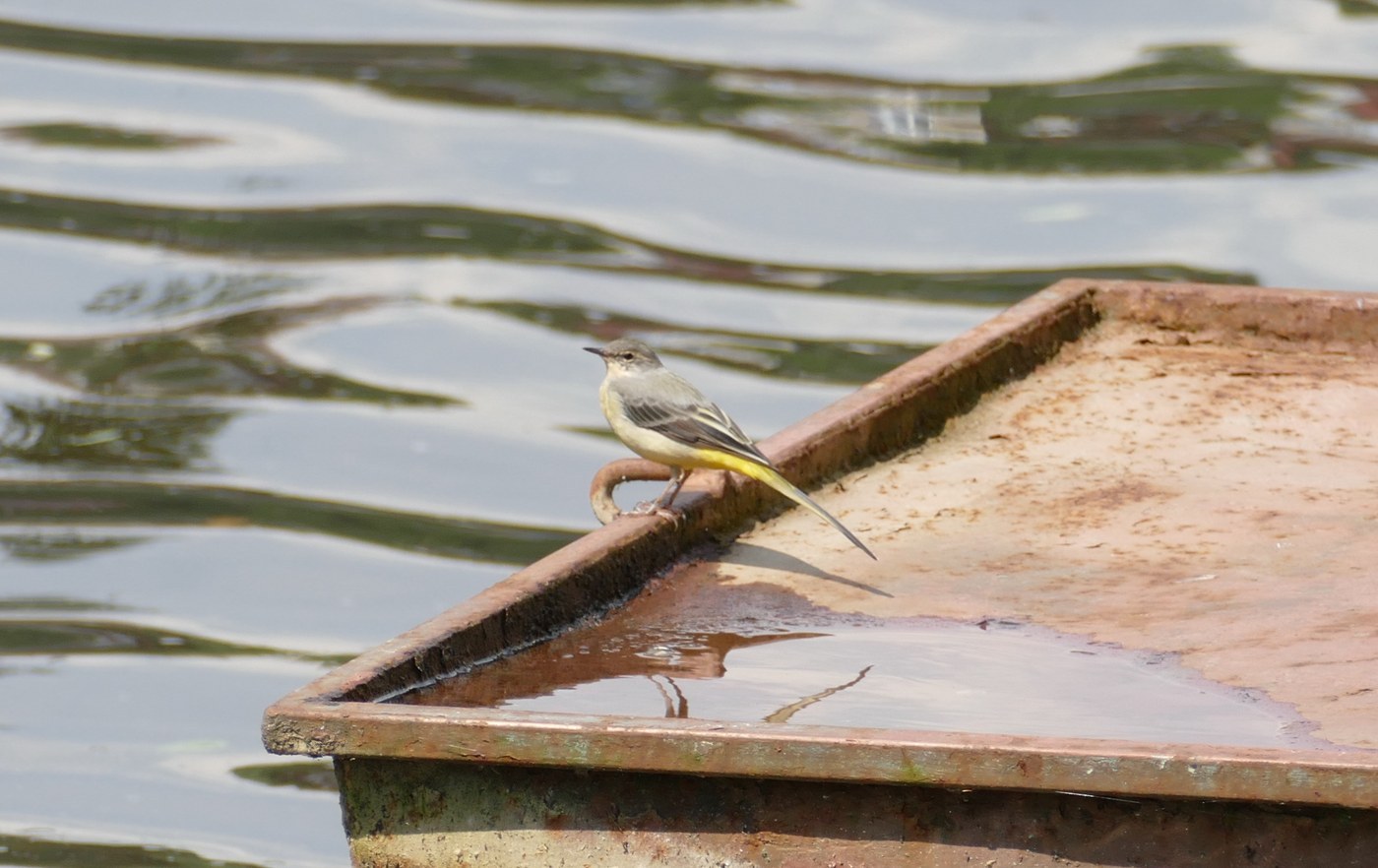
Grey Wagtail
Motacilla cinerea
The Grey Wagtail is a slender, long-tailed songbird whose lemon-yellow underpart feathers contrast with a blue-grey back, making it the most colorful of the European wagtails found along fast-flowing water.
- Feather type
- Long, constantly bobbing tail feathers (longest of the wagtails); slender pointed wings
- Colours
- Blue-grey back, bright yellow underparts (brightest in breeding males), white eyebrow
- Bird size
- Slim, ~18-19 cm including tail
Found a feather like this?
Identify any feather from a photo, free.
Overview
The Grey Wagtail is closely tied to fast-flowing streams and rivers, where it bobs along rocks and weirs catching insects.
Despite its name, its most striking feathers are bright yellow, especially on the underparts and undertail, contrasting with a slate-grey back.
It has the longest tail relative to body size of the European wagtails, an adaptation linked to its balance-dependent foraging on wet rocks.
Identifying the Feather
Size & Shape
- Tail feathers are the longest of the wagtails proportionally, black with white outer edges.
- Wings are slim and pointed for agile flight over water.
Color & Pattern
- Back and crown feathers: blue-grey, unmarked.
- Underpart feathers: bright lemon-yellow, most intense on the undertail coverts and brightest in breeding males, which also show a black throat patch.
- A white eyebrow and moustachial stripe frame the face.
- Wing feathers are dark grey-brown with a narrow pale wing-bar.
Similar Species
- Told from Yellow Wagtail by the grey (not olive/yellow-green) back and much longer tail; told from Pied Wagtail by the yellow underparts, which Pied Wagtail lacks.
Plumage & Molt
Overall Plumage
Blue-grey upperparts, bright yellow underparts, white eyebrow, and (in breeding males) a black throat patch.
Sex & Age Differences
Breeding males show a solid black throat and the brightest yellow underparts; females and non-breeding males have a paler or whitish throat and less vivid yellow. Juveniles are duller, with buffier underparts.
Molt
One complete molt after breeding in late summer; a partial spring molt in males sharpens the black throat patch before the breeding season.
Habitat & Range
Habitat
Fast-flowing rivers, streams, and weirs with rocky margins; increasingly found on urban waterways and sewage works.
Range
Breeds across Europe and temperate Asia.
Movements
Partially migratory; many move to lowland streams, ditches, and even urban car parks in winter when upland streams become inhospitable.
Behavior & Field Notes
Behavior
Forages along rocks and margins of fast water, bobbing its long tail and making agile flycatching sallies for aquatic insects.
Diet
Feeds on aquatic and waterside insects such as midges and mayflies.
Nesting
Builds a nest in a crevice near water, such as under a bridge, in a wall, or among tree roots on a stream bank.
Voice
A sharp, metallic 'chit-ick' call, similar to but distinct from Pied Wagtail's.
Field Notes
Feathers with strong yellow underparts and a grey (not olive) back near a stream or river point strongly to Grey Wagtail.
Frequently asked questions
What is the main color difference between Grey and Yellow Wagtail feathers?
Grey Wagtail has a blue-grey back with yellow underparts; Yellow Wagtail has an olive-yellow or greenish back with yellow underparts throughout.
Why does the Grey Wagtail have such a long tail?
Its long tail aids balance while foraging on wet rocks along fast-flowing streams.
Do male and female Grey Wagtails look different?
Breeding males have a black throat patch and brighter yellow underparts; females and winter males show a paler throat.
Where is a Grey Wagtail feather likely to be found?
Near fast-flowing rivers, streams, weirs, or urban waterways where the species forages.
Grey Wagtail guides
In-depth guides for identifying and understanding Grey Wagtail.
Other feathers you may enjoy

Yellow-breasted Bunting
Contour and flight feathers, chestnut-and-yellow breeding pattern

Sedge Wren
Tiny streaked crown and back feathers

Yellow-winged Cacique
Glossy black body feathers, yellow wing patch, shaggy crest

Yellow Warbler
Small contour and flight feathers

Yellow-throated Warbler
Small contour and flight feathers

Yellow-throated Vireo
Bright yellow throat and spectacle feathers; olive-green back feathers; two white wing-bar feathers

Yellow-rumped Warbler
Small contour and flight feathers

Yellow-hooded Blackbird
Contrasting hood and body feathers

Yellow-headed Blackbird
Glossy black body plumage with a bright yellow head and breast

Yellow-eyed Junco
Contour and flight feathers

Yellow-fronted Canary
Small, smooth body plumage

Yellow-breasted Greenfinch
Compact, smooth body plumage