
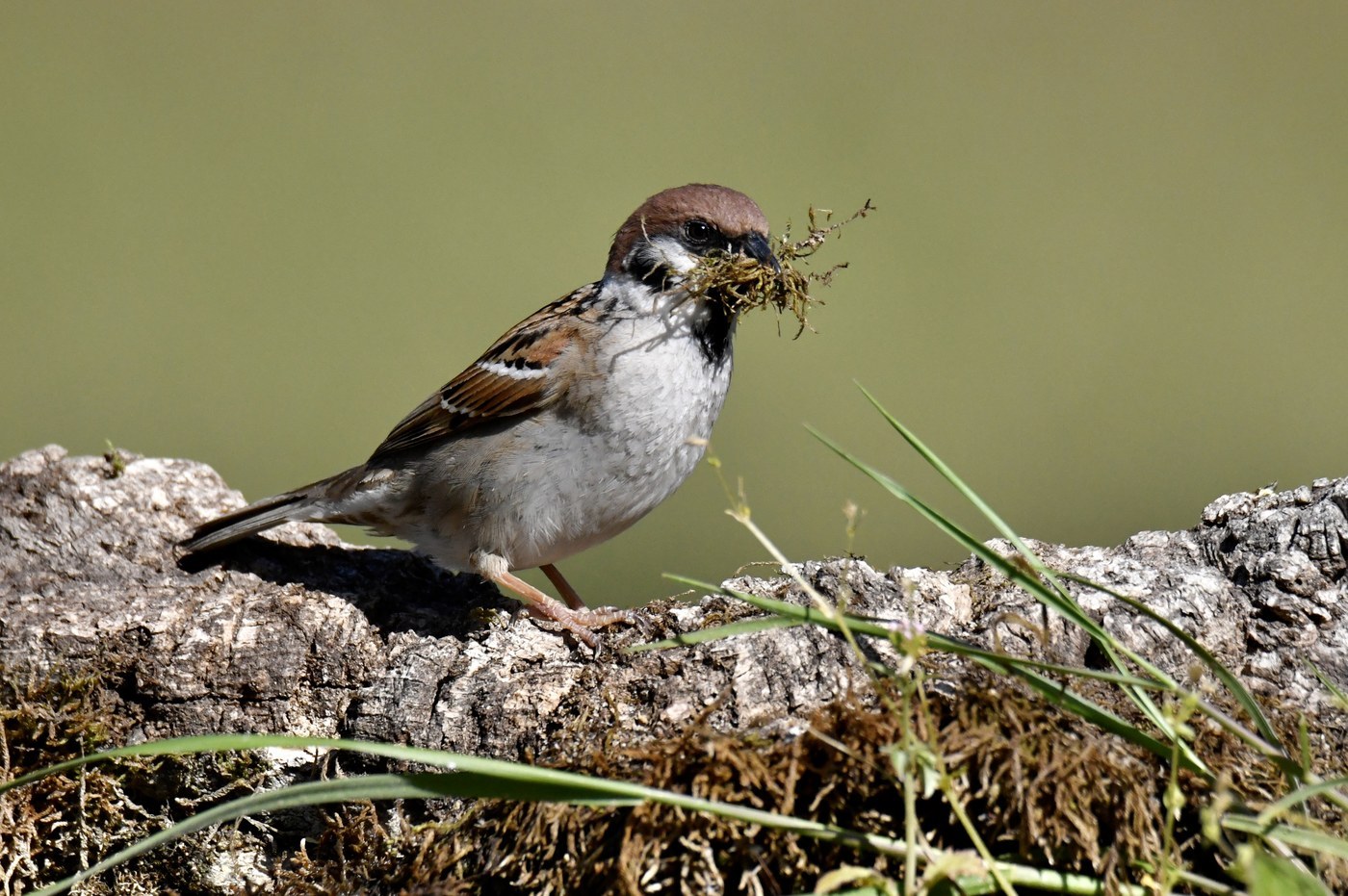
Eurasian Tree Sparrow
Passer montanus
A small farmland sparrow distinguished from its House Sparrow relative by a chestnut crown (rather than grey) and a distinct black spot on an otherwise white cheek.
- Feather type
- Small, soft brown streaked back feathers; chestnut crown feathers; black cheek spot feathers
- Colours
- Chestnut-brown crown, black cheek spot, white collar, brown-streaked back with black markings
- Bird size
- Small songbird, ~14 cm, slightly smaller than House Sparrow
Found a feather like this?
Identify any feather from a photo, free.
Overview
The Eurasian Tree Sparrow closely resembles the more familiar House Sparrow but is generally found in more rural, farmland-associated habitats and shows subtly different plumage markings that separate its feathers from its urban relative.
Both sexes look alike in this species, unlike the House Sparrow where males and females differ markedly — a useful fact when comparing feathers between the two.
A Tree Sparrow feather is best distinguished by its chestnut-brown crown color (rather than grey) and, on cheek feathers, a distinct black spot set against an otherwise clean white cheek — features not found on House Sparrow feathers.
Identifying the Feather
Crown and head feathers
- Crown feathers are chestnut-brown across the whole crown, distinct from the grey crown of a male House Sparrow.
- Cheek feathers are white with a small but distinct black spot, a pattern absent in House Sparrows.
Body feathers
- Back feathers are brown, streaked with black and buff, similar in general tone to House Sparrow but slightly smaller.
- A narrow white half-collar is present on the neck.
Size
- Slightly smaller and more compact than House Sparrow feathers.
Confusion species
House Sparrow males show a grey crown and lack the black cheek spot; House Sparrow females are plainer overall without the chestnut crown. The chestnut crown plus black cheek spot combination is diagnostic for Tree Sparrow.
Plumage & Molt
Both sexes of the Eurasian Tree Sparrow look alike, with a chestnut-brown crown, black cheek spot on an otherwise white face, a small black throat patch, and a brown, black-streaked back with a narrow white collar around the neck.
Juveniles are duller and browner overall, with a less distinct cheek spot, becoming more clearly marked after their first molt.
The species undergoes a complete post-breeding molt in late summer.
Habitat & Range
Tree Sparrows favor farmland, hedgerows, orchards, and open woodland edges, often nesting in cavities in old trees, hedgerow banks, or buildings in rural villages. They are generally less associated with dense urban centers than House Sparrows.
The species is resident across much of its Eurasian range, though some northern and eastern populations may move short distances in winter.
Behavior & Field Notes
Tree Sparrows feed mainly on seeds and grain, supplemented by invertebrates especially when feeding young, foraging on the ground and in low vegetation, often in small flocks.
They nest in cavities, sometimes in loose colonies, and give a call similar to but slightly sharper and higher-pitched than the House Sparrow's chirp.
A small, brown-streaked feather with a chestnut crown and hint of a black cheek spot, found in farmland or rural hedgerow habitat, points to Eurasian Tree Sparrow rather than House Sparrow.
Frequently asked questions
How can I tell a Tree Sparrow feather from a House Sparrow feather?
Look for a chestnut-brown crown feather and a cheek feather with a distinct black spot on white — both features that separate Tree Sparrow from House Sparrow, where males have a grey crown and no cheek spot.
Do male and female Tree Sparrows have different colored feathers?
No, unlike House Sparrows, male and female Tree Sparrows look alike, so feather color alone won't indicate sex.
What size difference exists between Tree Sparrow and House Sparrow feathers?
Tree Sparrow feathers are slightly smaller and more compact, matching its marginally smaller body size.
Where are Tree Sparrow feathers most likely to be found?
In farmland, hedgerows, orchards, and rural villages rather than dense city centers.
Are juvenile Tree Sparrow feathers different from adults?
Yes, juveniles are duller and browner with a less distinct black cheek spot until their first molt.
Eurasian Tree Sparrow guides
In-depth guides for identifying and understanding Eurasian Tree Sparrow.
Other feathers you may enjoy

Yellow-breasted Bunting
Contour and flight feathers, chestnut-and-yellow breeding pattern

Sedge Wren
Tiny streaked crown and back feathers

Yellow-winged Cacique
Glossy black body feathers, yellow wing patch, shaggy crest

Yellow Warbler
Small contour and flight feathers

Yellow-throated Warbler
Small contour and flight feathers

Yellow-throated Vireo
Bright yellow throat and spectacle feathers; olive-green back feathers; two white wing-bar feathers

Yellow-rumped Warbler
Small contour and flight feathers

Yellow-hooded Blackbird
Contrasting hood and body feathers

Yellow-headed Blackbird
Glossy black body plumage with a bright yellow head and breast

Yellow-eyed Junco
Contour and flight feathers

Yellow-fronted Canary
Small, smooth body plumage

Yellow-breasted Greenfinch
Compact, smooth body plumage