
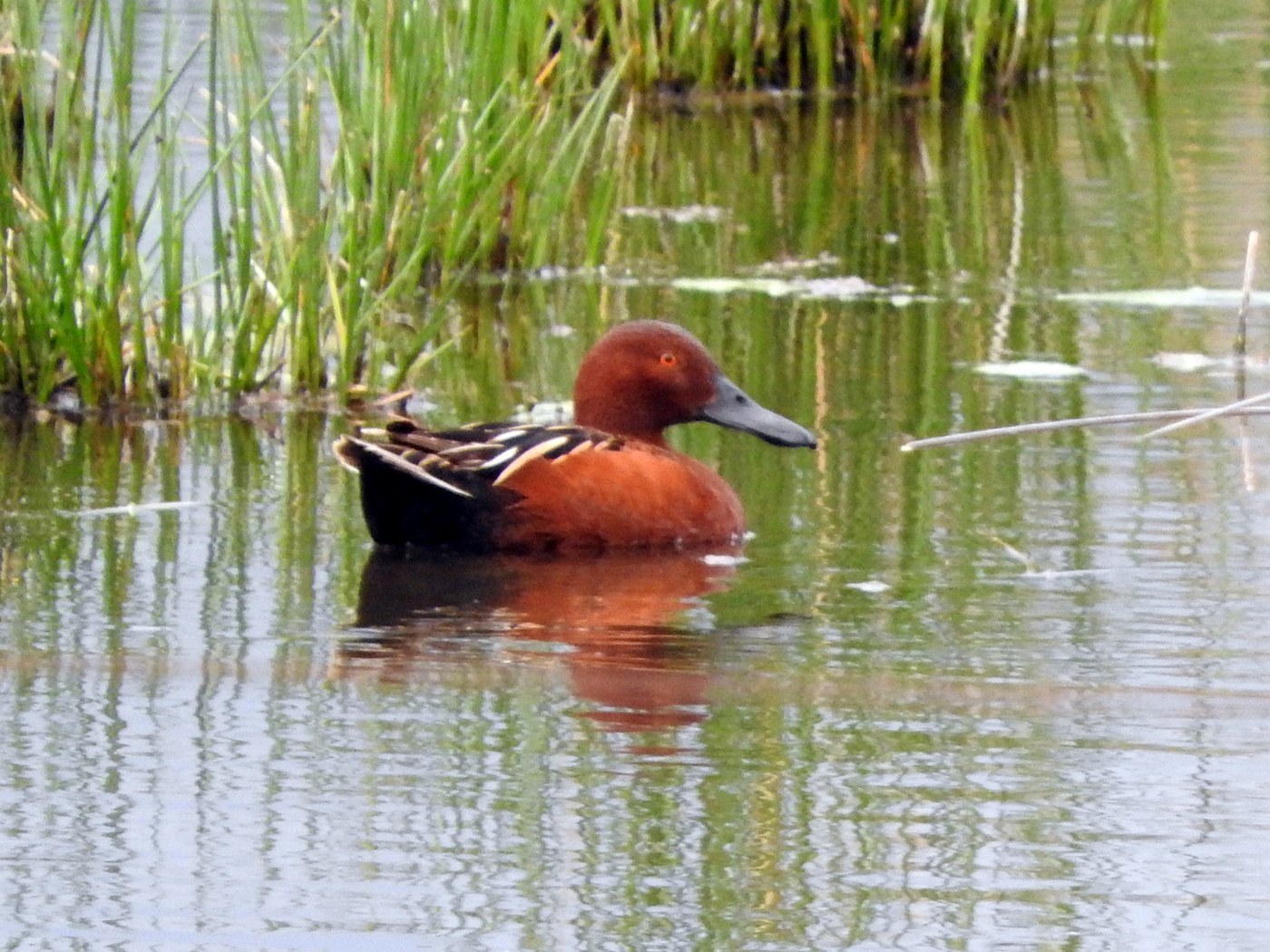
Cinnamon Teal
Spatula cyanoptera
A small dabbling duck whose male is a striking uniform cinnamon-red, sharing the same pale blue wing patch found in Blue-winged Teal and Northern Shoveler.
- Feather type
- Pale blue upperwing covert feathers; green speculum feathers; small dabbling-duck contour feathers
- Colours
- Deep cinnamon-red overall (male); mottled brown overall (female)
- Bird size
- Small dabbling duck, ~38-43 cm
Found a feather like this?
Identify any feather from a photo, free.
Overview
The Cinnamon Teal is a small dabbling duck found in two widely separated populations: one across western North America, and another across parts of South America. It is closely related to the Blue-winged Teal, with which it shares habitat and the same distinctive wing pattern in many areas.
Breeding males are unmistakable in life, a deep, uniform cinnamon-red across the head, neck, and body, with red eyes adding to the striking appearance, quite unlike the patterned heads of most other dabbling ducks.
Feathers can be recognized by their small size and, in males, an even reddish-cinnamon tone with the same pale blue upperwing patch and green speculum shared with its close relative, the Blue-winged Teal.
Identifying the Feather
Size and shape
- Small dabbling-duck contour and flight feathers, similar in size to Blue-winged Teal feathers
- Pale blue upperwing covert feathers, matching the pattern seen in Blue-winged Teal and Northern Shoveler
Color and pattern
- Male body and head feathers deep, uniform cinnamon-red to rufous, without the facial crescent or head pattern seen in Blue-winged Teal
- Female body feathers mottled brown overall, very similar to female Blue-winged Teal
- Speculum feathers green, bordered with a pale band, adjacent to the shared pale blue covert patch
Distinguishing from similar species
- Male Cinnamon Teal is told from male Blue-winged Teal by its solid cinnamon-red color, lacking the grey head and white facial crescent of the Blue-winged Teal
- Female Cinnamon Teal and female Blue-winged Teal are very similar, generally separated in the field by subtle differences in face pattern and bill shape rather than by feather color alone
Plumage & Molt
Breeding males are a deep, uniform cinnamon-red across the head, neck, and underparts, with a darker back and the same pale blue wing patch as their close relatives. Females are mottled brown overall, very similar to female Blue-winged Teal. Males undergo an eclipse molt after breeding, briefly resembling females. All undergo a flightless period during wing molt.
Habitat & Range
In North America, breeds across wetlands of the western United States and adjacent Canada and Mexico, wintering further south into Mexico and Central America. A separate population breeds and resides in wetlands across parts of South America. It favors shallow marshes, ponds, and alkaline wetlands. North American populations are migratory, while some South American populations are more sedentary.
Behavior & Field Notes
Feeds by dabbling in shallow water for seeds and aquatic invertebrates, often alongside Blue-winged Teal in shared habitat. Nests on the ground in dense vegetation near water. Voice includes soft calls, generally quiet compared to larger dabbling ducks. Because its range overlaps broadly with Blue-winged Teal, and females of the two species look so similar, confirming this species from feather material alone is easiest when a male's solid cinnamon-red body feathers are present.
Frequently asked questions
What is the easiest way to identify a male Cinnamon Teal feather?
Look for a deep, uniform cinnamon-red color across the head and body, without the grey head and white facial crescent shown by the similar Blue-winged Teal.
How can I tell female Cinnamon Teal and Blue-winged Teal feathers apart?
They are very similar mottled brown patterns, and reliable separation from feathers alone is difficult; range and associated males can help confirm identification.
Where does the Cinnamon Teal live?
It has two separate populations, one across western North America and another across parts of South America, both favoring shallow marshes and wetlands.
Does the Cinnamon Teal share the blue wing patch with other ducks?
Yes, it shows the same pale blue upperwing patch found in Blue-winged Teal and Northern Shoveler, all close relatives within the same genus.
Cinnamon Teal guides
In-depth guides for identifying and understanding Cinnamon Teal.
Other feathers you may enjoy

Mallard
Wing (speculum), body, and tail feathers

Spectacled Eider
Large sea-duck body feathers with distinctive eye-ring patches

Canada Goose
Body and flight feathers
Mute Swan
Body (contour) and flight feathers

Wood Duck
Iridescent crest feathers; ornate scapular and flank feathers; white teardrop facial feathers (female)
Whooper Swan
Contour and flight feathers

White-winged Scoter
Large sea-duck body feathers with a white wing patch

Ruddy Duck
Stiff tail feathers and compact body plumage

Ross's Goose
Contour and flight feathers

White-cheeked Pintail
Contour and elongated tail feathers

Torrent Duck
Dense, sleek contour feathers; stiff, pointed tail feathers used for bracing against rocks

Tundra Swan
Contour and flight feathers