
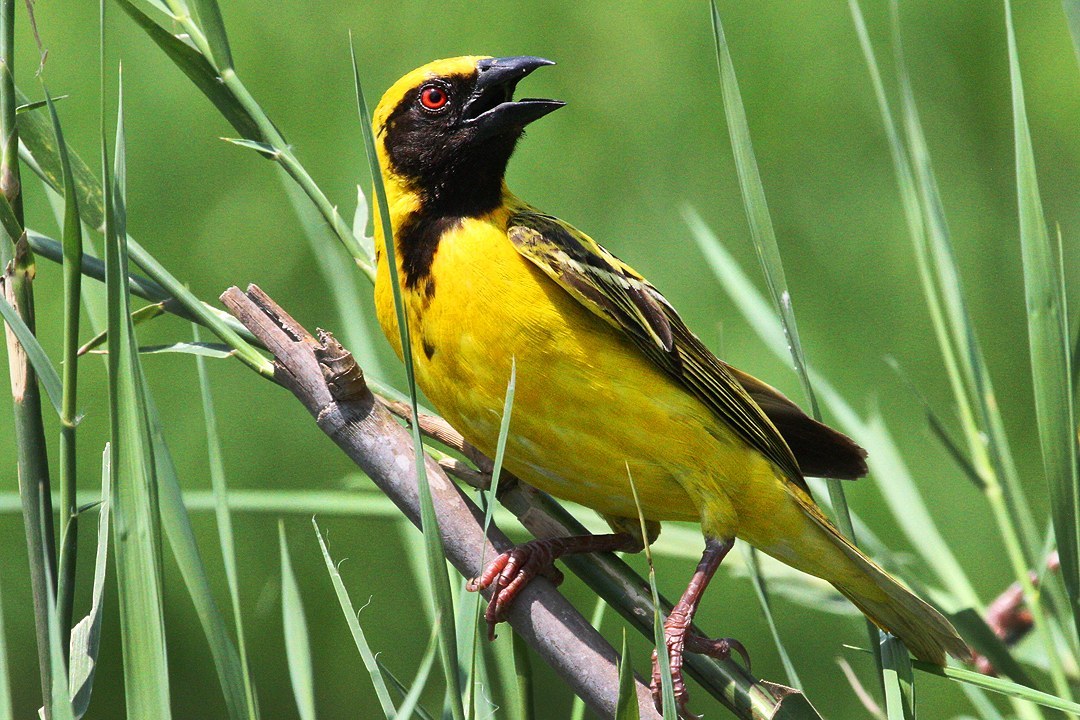
Village Weaver
Ploceus cucullatus
A social African weaverbird known for elaborate woven nests, breeding males showing bright yellow bodies with black heads and mottled backs.
- Feather type
- Soft contour feathers, strong breeding plumage contrast
- Colours
- Breeding male: yellow body, black head, mottled back; Female/non-breeding: dull olive-brown
- Bird size
- Sparrow-sized, ~15-17 cm
Found a feather like this?
Identify any feather from a photo, free.
Overview
Overview
The Village Weaver is a widespread and highly social songbird found across sub-Saharan Africa, renowned for the elaborate woven nests males construct to attract mates. Breeding males display bold yellow body plumage contrasted with a black head and mottled black-and-yellow back, while females and non-breeding males are considerably duller.
This species often breeds in large colonies, with numerous nests hanging from a single tree, and its social, active behavior makes colonies a lively and noisy spectacle.
Identifying the Feather
Feather Identification
- Breeding male head feathers: solid black, sharply contrasting with the yellow body
- Breeding male body feathers: bright yellow underparts with a mottled black-and-yellow back pattern
- Non-breeding/female feathers: dull olive-brown overall, lacking the bold black head and mottled back
- Flight feathers: dark with pale yellow-green edging in breeding males, duller and more uniform in females
- Distinguishing breeding males relies on the sharp black head and yellow body contrast, while females and non-breeding males require closer attention to overall dull olive tones for identification
Plumage & Molt
Plumage Notes
Breeding males show a striking black head and yellow body with mottled back plumage, while females and non-breeding males are dull olive-brown throughout. This seasonal plumage shift in males is one of the more pronounced examples among weaverbirds.
Molt into breeding plumage occurs before the nesting season, with males molting back to a duller non-breeding appearance once breeding activity ends.
Habitat & Range
Habitat & Range
Village Weavers are widespread across sub-Saharan Africa, inhabiting savanna, farmland, wetland edges, and areas near human settlement. They favor open habitats with trees suitable for colonial nesting.
The species is largely resident, though some local movement occurs in response to food and water availability.
Behavior & Field Notes
Behavior & Field Notes
Village Weavers feed on seeds, grains, and insects, often foraging in flocks. Males construct elaborate woven nests from grass and plant fibers, competing to attract females through nest quality and display.
Colonies can contain numerous nests in a single tree, creating a highly social and vocal breeding environment. Their calls are a mix of chattering, buzzing, and swizzling notes typical of colonial weaverbirds.
Frequently asked questions
How can I tell a breeding male Village Weaver from a female?
Breeding males show a black head and bright yellow body with a mottled back, while females and non-breeding males are dull olive-brown throughout.
Why do male Village Weavers change plumage seasonally?
Males molt into bold black-and-yellow breeding plumage to attract mates and then revert to duller olive-brown plumage once the breeding season ends.
Where do Village Weavers build their nests?
Males construct elaborate woven nests from grass and plant fibers, often in colonies with many nests hanging from a single tree.
What habitat do Village Weavers prefer?
They favor open habitats such as savanna, farmland, and wetland edges across sub-Saharan Africa.
Village Weaver guides
In-depth guides for identifying and understanding Village Weaver.
Other feathers you may enjoy

Yellow-breasted Bunting
Contour and flight feathers, chestnut-and-yellow breeding pattern

Sedge Wren
Tiny streaked crown and back feathers

Yellow-winged Cacique
Glossy black body feathers, yellow wing patch, shaggy crest

Yellow Warbler
Small contour and flight feathers

Yellow-throated Warbler
Small contour and flight feathers

Yellow-throated Vireo
Bright yellow throat and spectacle feathers; olive-green back feathers; two white wing-bar feathers

Yellow-rumped Warbler
Small contour and flight feathers

Yellow-hooded Blackbird
Contrasting hood and body feathers

Yellow-headed Blackbird
Glossy black body plumage with a bright yellow head and breast

Yellow-eyed Junco
Contour and flight feathers

Yellow-fronted Canary
Small, smooth body plumage

Yellow-breasted Greenfinch
Compact, smooth body plumage