
How to Identify Village Weaver Feathers
How to use the mottled black-and-yellow back and bright yellow body feathers to identify a Village Weaver feather.
Read the full Village Weaver encyclopedia entry →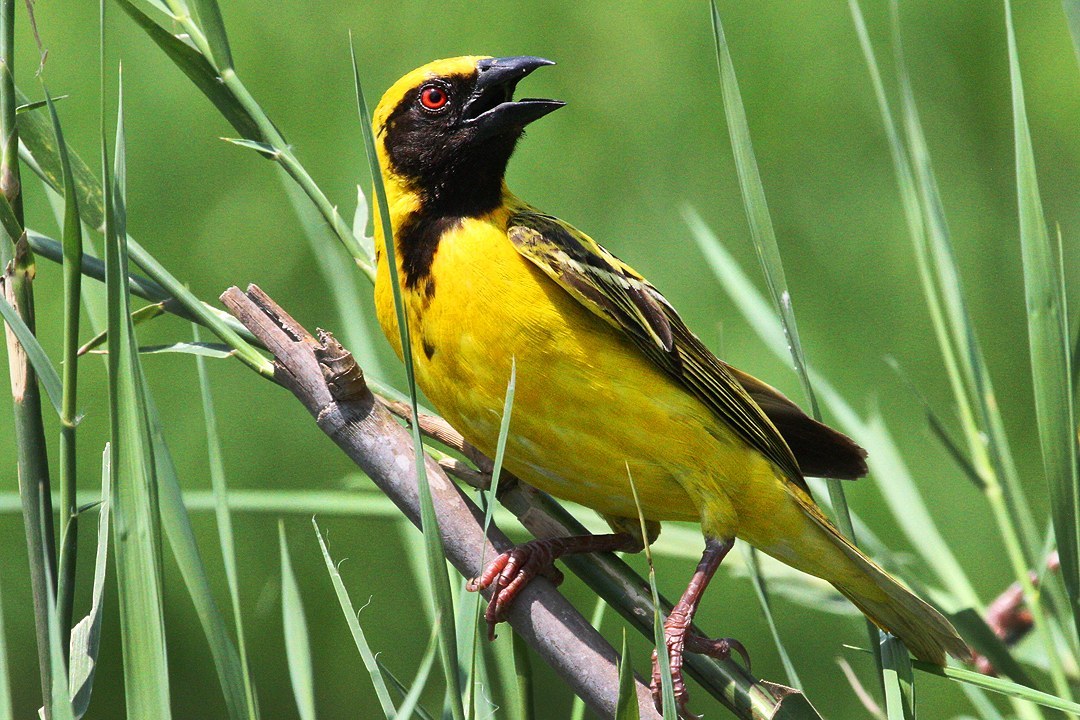
What Village Weaver Feathers Look Like
Village Weaver is a colonial-nesting African songbird, and breeding males in particular produce some of the most boldly patterned small-bird feathers you'll find in their range.
- Body/contour feathers (breeding male): bright yellow, with a sharply demarcated black hood covering the face and throat — feathers from the head region are solid glossy black, while breast and belly feathers are vivid yellow.
- Back feathers: a distinctive mottled black-and-yellow pattern, each feather black-centered with yellow-olive edges, creating a scaled, spotted look across the mantle that is unusual among weavers.
- Nape feathers: often washed with a warm chestnut tinge, forming a subtle collar effect below the black hood.
- Wing feathers: blackish with crisp yellow or olive fringes, producing bold pale edging along the folded wing.
- Female/nonbreeding feathers: much plainer — olive-yellow above with fine dusky streaking, lacking the black hood and mottled back entirely.
- Size: small songbird feathers, body contours 2-3 cm, consistent with a bird about 15-17 cm long.
Step-by-Step: Is This Feather From a Village Weaver?
- Look for the mottled back pattern first. A black-centered, yellow-edged feather from the mantle is one of the most distinctive marks among African weavers.
- Check for a sharp black hood. A solid black feather from the head/throat with a crisp (not gradual) border to yellow neighboring feathers suggests a breeding male weaver.
- Confirm the yellow is bright and warm, not pale lemon or washed-out — Village Weaver yellow tends to be a strong golden-yellow rather than pale.
- Note any chestnut wash on nape feathers, which helps separate breeding males from plainer all-yellow weaver species.
- If the feather is plain olive and streaky, it likely belongs to a female or nonbreeding bird — check for any hint of the mottled back pattern, which can still show faintly.
Similar Species & How to Tell Them Apart
- Southern Masked Weaver: has a black face mask but a much more uniform, unmottled olive-yellow back, lacking the scaled black-and-yellow mottling of Village Weaver.
- Golden Palm Weaver / other Ploceus weavers: often show a fully yellow head without the sharply cut black hood, or lack the chestnut nape wash.
- Red Bishop or Euplectes species: show red or orange in the plumage rather than yellow-and-black, and their feathers lack the mottled back pattern.
- Female weavers of multiple species: notoriously similar streaky olive-yellow patterns; the mottled-back trace and overall size are the best clues when hood feathers aren't available.
Where & When You'll Find Them
Village Weavers are colonial nesters found across much of sub-Saharan Africa, typically near water, in savanna, farmland, and villages, where dozens of woven nests hang from a single tree. Because colonies are dense and active, molted feathers — especially the bold black-and-yellow body feathers of breeding males — are commonly found on the ground directly beneath nesting trees, most abundantly just after the breeding season when adults molt into nonbreeding plumage.
Frequently asked questions
What's the most distinctive Village Weaver feather to look for?
A back feather with a black center and yellow-olive edge, giving a mottled or scaled pattern — this is unusual among African weavers and a strong diagnostic.
How do I know if a feather is from a male or female bird?
Bright yellow feathers with a sharply cut black hood indicate a breeding male; plain streaky olive-yellow feathers without a black hood usually indicate a female or nonbreeding male.
Can I tell Village Weaver apart from Southern Masked Weaver by feather alone?
Yes — check the back: Village Weaver shows mottled black-and-yellow feathers, while Southern Masked Weaver's back feathers are more uniformly olive-yellow without that scaled pattern.
Why would I find many weaver feathers in one spot?
Village Weavers nest colonially, often with dozens of nests in one tree, so molted feathers accumulate heavily on the ground beneath active colonies.
Does the chestnut nape wash appear on every bird?
It's variable and often subtle, so treat it as a supporting clue rather than a standalone diagnostic — the mottled back and black hood are more reliable.