
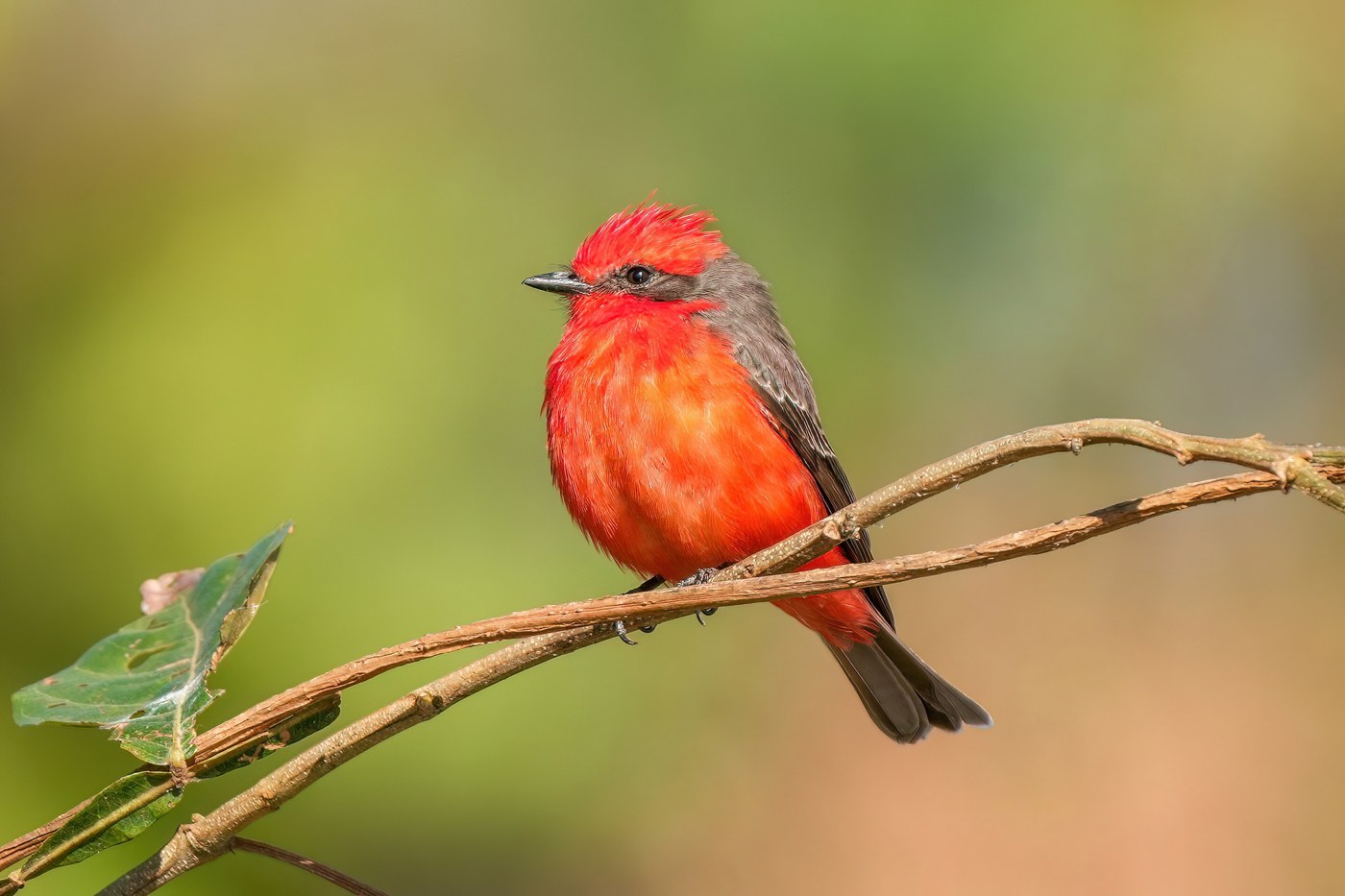
Vermilion Flycatcher
Pyrocephalus rubinus
A small flycatcher in which males show a strikingly brilliant red crown and underparts against dusky brown wings, while females are far more subdued.
- Feather type
- Contour, body plumage
- Colours
- Brilliant red crown/underparts (male), dusky brown wings/back; brownish-gray with peach wash (female)
- Bird size
- Sparrow-sized, ~14 cm
Found a feather like this?
Identify any feather from a photo, free.
Overview
Overview
The Vermilion Flycatcher is a small, strikingly colored flycatcher of arid and semi-arid habitats in the southwestern United States, Mexico, and much of South America, where males are among the most vividly colored flycatchers found north of the tropics. Their brilliant red plumage set against dusky brown wings makes them a favorite among birders wherever they occur, especially perched conspicuously near water in otherwise dry country.
Males show a bright red crown, face, and underparts contrasting with dusky brown to blackish wings, back, and a dark mask through the eye, while females are much more subdued, showing brownish-gray upperparts and a pale breast with a peachy or salmon wash on the belly.
Identifying the Feather
Feather ID Notes
Male Vermilion Flycatcher feathers are vivid red on the crown, face, throat, and underparts, sharply contrasting with dusky brown to blackish feathers on the back, wings, and a dark mask through the eye. Female feathers are far more muted, with brownish-gray upperparts, a streaked pale breast, and a peach or salmon wash restricted to the lower belly.
- Male crown/underpart feathers: brilliant red, unmistakable
- Male wing/back feathers: dusky brown to blackish, providing strong contrast
- Female upperpart feathers: brownish-gray, streaked breast
- Female belly feathers: pale with a peachy-salmon wash, much softer than the male's red Males are essentially unmistakable due to their vivid red plumage; females require more care and are best told from other small flycatchers by their streaked breast and salmon-tinged belly.
Plumage & Molt
Plumage Details
This species shows pronounced sexual dimorphism, with males displaying brilliant red plumage and females showing a much more subdued brownish-gray and streaked pattern. Juveniles resemble females initially, with young males gradually acquiring patches of red as they mature toward adult plumage over their first year. There is no distinct seasonal plumage change beyond this age-related transition in males.
Habitat & Range
Habitat & Range
Vermilion Flycatchers inhabit desert riparian corridors, open scrub, and agricultural areas near water sources across the southwestern United States, Mexico, and much of South America. Populations in the northern part of the range show some migratory movement, with birds shifting south in winter, while many populations farther south are largely resident year-round.
Behavior & Field Notes
Behavior & Field Notes
This species forages by sallying from a low, exposed perch to catch flying insects, often near open water or irrigated agricultural land. Diet consists mainly of flying insects. Nests are small, shallow cups placed in the fork of a tree branch, typically built by the female. Males perform a distinctive fluttering flight display, rising and hovering while singing a soft, twittering song, most often used to advertise territory and attract a mate.
Frequently asked questions
How do male and female Vermilion Flycatchers differ in plumage?
Males show brilliant red crown and underparts against dusky brown wings, while females are brownish-gray above with a streaked breast and pale salmon-washed belly.
Is the Vermilion Flycatcher easy to identify?
Males are essentially unmistakable due to their vivid red coloring; females require closer attention to breast streaking and belly wash.
Where does this species typically live?
In desert riparian areas, open scrub, and agricultural land near water across the southwestern United States, Mexico, and South America.
Do males perform any notable displays?
Yes, males perform a fluttering hover-flight display while singing to advertise territory and attract mates.
Vermilion Flycatcher guides
In-depth guides for identifying and understanding Vermilion Flycatcher.
Other feathers you may enjoy

Yellow-breasted Bunting
Contour and flight feathers, chestnut-and-yellow breeding pattern

Sedge Wren
Tiny streaked crown and back feathers

Yellow-winged Cacique
Glossy black body feathers, yellow wing patch, shaggy crest

Yellow Warbler
Small contour and flight feathers

Yellow-throated Warbler
Small contour and flight feathers

Yellow-throated Vireo
Bright yellow throat and spectacle feathers; olive-green back feathers; two white wing-bar feathers

Yellow-rumped Warbler
Small contour and flight feathers

Yellow-hooded Blackbird
Contrasting hood and body feathers

Yellow-headed Blackbird
Glossy black body plumage with a bright yellow head and breast

Yellow-eyed Junco
Contour and flight feathers

Yellow-fronted Canary
Small, smooth body plumage

Yellow-breasted Greenfinch
Compact, smooth body plumage