
How to Identify Vermilion Flycatcher Feathers
How to identify the bright red crown and underparts of a male Vermilion Flycatcher, contrasted with its dark brown mask, wings, and tail.
Read the full Vermilion Flycatcher encyclopedia entry →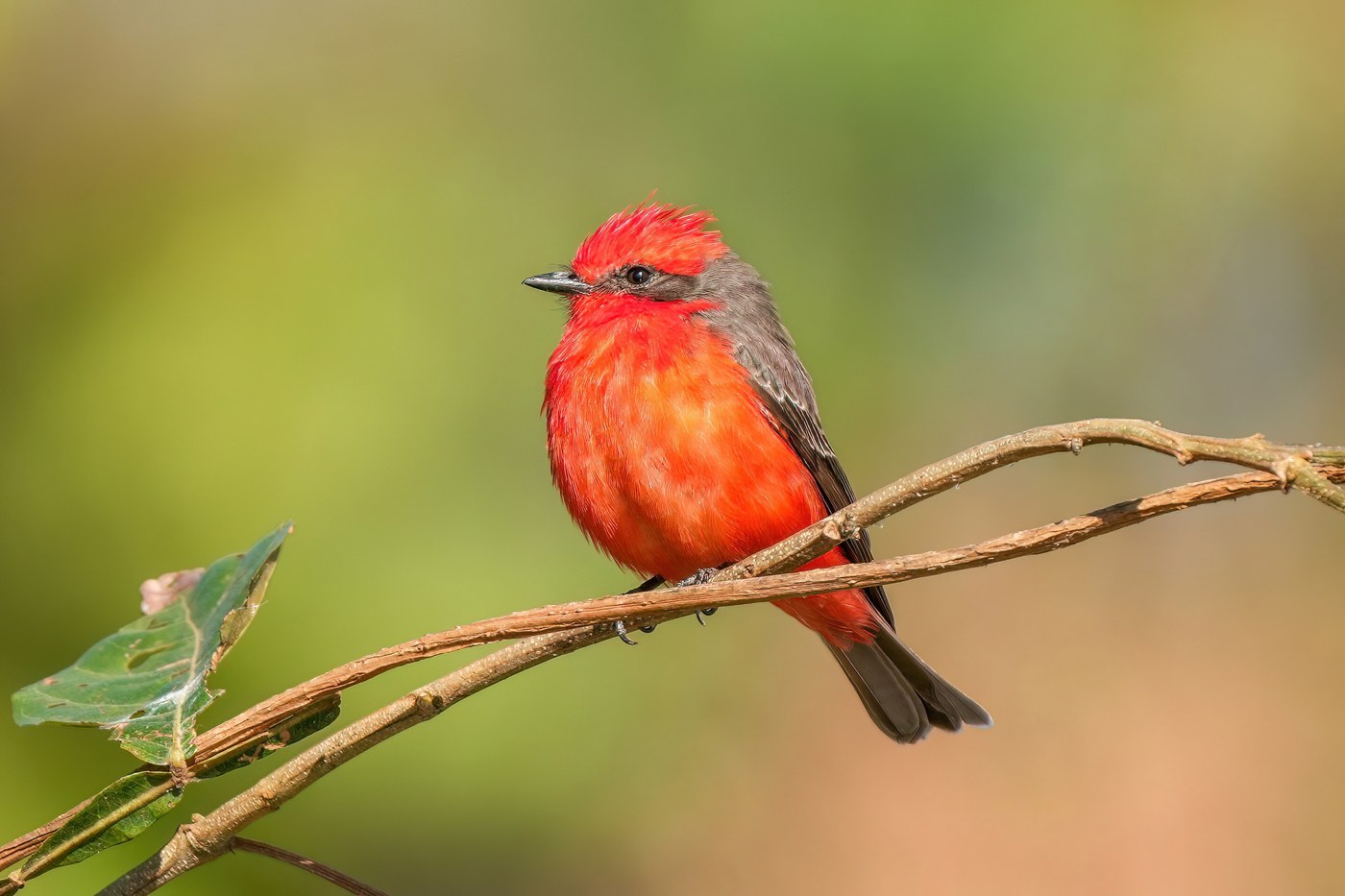
What Vermilion Flycatcher's Feathers Look Like
Vermilion Flycatcher is a small, dazzling flycatcher of arid open country, and adult males show one of the most vivid red-and-dark contrasts among North and South American songbirds.
- Crown and underparts feathers (male): brilliant vermilion-red, covering the crown, throat, breast, and belly — a saturated, almost fluorescent red rather than the deeper red of cardinals or tanagers.
- Mask, back, and wing feathers: contrastingly dark brown to blackish-brown, forming a mask through the eye and covering the back, wings, and tail — this sharp two-tone split between red underparts/crown and dark mask/upperparts is the single best identifying feature.
- Tail feathers: dark brown to blackish, unmarked, matching the wing tone rather than the red body.
- Female/immature feathers: mostly grayish-brown above with a pale, lightly streaked breast and a peachy-orange to yellowish wash on the belly — notably duller and lacking the male's vivid red crown.
- Size: small — body contour feathers run 1.5-2.5 cm, flight feathers 5-6.5 cm — consistent with a small flycatcher a bit smaller than an Eastern Phoebe.
- Shape: typical flycatcher feather structure, with fairly broad, notched-looking flight feathers suited to short aerial sallies after insects.
Step-by-Step: Is This Feather From a Vermilion Flycatcher?
- Check for vivid red plus dark brown contrast. A brilliant red feather (crown or underparts) found alongside dark brown/blackish feathers (mask, wings, tail) from the same bird is the clearest possible match.
- Assess the exact red tone. Vermilion Flycatcher's red is bright and almost glowing, distinct from the deeper brick-red of tanagers or cardinals.
- Consider duller feathers too. A grayish-brown feather with a peachy or yellowish wash on the belly may be a female or immature bird, so don't dismiss the species just because a feather lacks vivid red.
- Measure the feather. Small size (flight feathers under 6.5 cm) fits this compact flycatcher rather than a larger tanager or cardinal.
- Weigh the habitat. Feathers found in open arid country, streamside woodland, or scrubby desert edge from the southwestern U.S. through Mexico and into South America support this species.
Similar Species & How to Tell Them Apart
- Summer Tanager: entirely red with no dark mask or dark wings, unlike Vermilion Flycatcher's sharply contrasting red-and-dark pattern.
- Scarlet Tanager: shows black wings and tail too, but is notably larger overall with a heavier, less flycatcher-like feather shape.
- Painted Redstart: has red underparts but combined with bold white wing patches, a pattern Vermilion Flycatcher lacks.
- House Finch (red morph male): shows red confined mainly to the head and breast with streaked brown flanks and back, a more muted and less uniformly red look than Vermilion Flycatcher.
Where & When You'll Find Them
Vermilion Flycatchers inhabit open arid and semi-arid country, streamside groves, and scrubby desert edges from the southwestern United States through Mexico, Central America, and much of South America. Northern populations may move short distances in winter while many populations are resident year-round. Molt occurs mainly after breeding, with timing varying by latitude — northern birds typically molt in late summer, while some populations closer to the equator can breed and molt on a less fixed calendar. Feathers are most often found near streamside perches, fence lines, and open scrub where this species commonly hunts from low perches.
Frequently asked questions
What's the fastest way to identify a Vermilion Flycatcher feather?
Look for vivid red plus dark brown contrast — a bright red crown or underparts feather alongside a dark brown mask, wing, or tail feather from the same bird is close to diagnostic.
I found a dull grayish-brown feather with an orange belly wash — could it be this species?
Yes, likely a female or immature — they lack the male's vivid red crown but often show a peachy-orange to yellowish tinge on the belly.
How do I rule out a Summer Tanager?
Summer Tanager is entirely red with no dark mask or dark wings, while Vermilion Flycatcher always shows a sharp contrast between red and dark brown/blackish feathers.
Would I find this feather in a dense, humid forest?
Unlikely — Vermilion Flycatchers favor open arid country and scrubby edges near water, not closed humid forest interiors.