
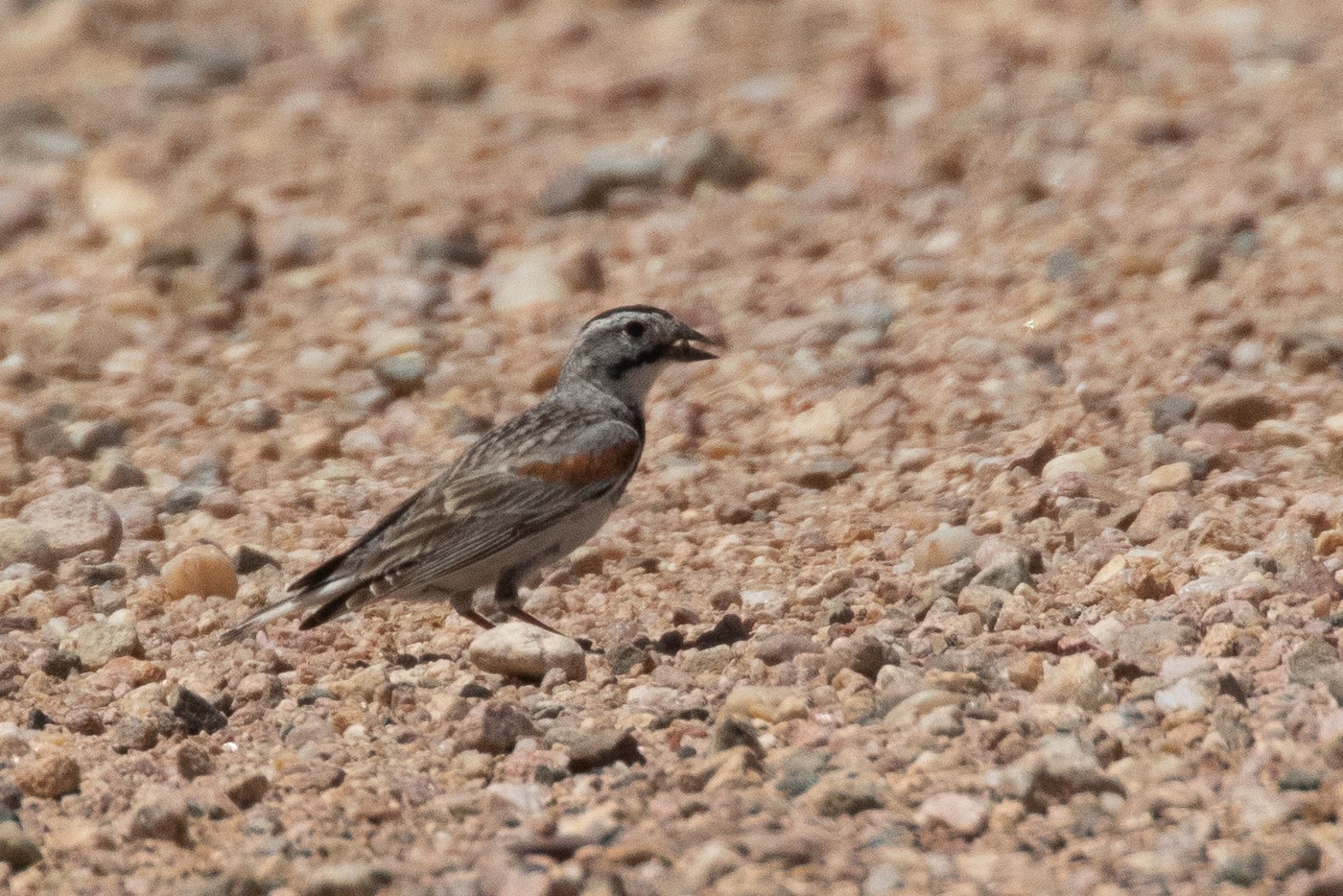
Thick-billed Longspur
Rhynchophanes mccownii
The Thick-billed Longspur is a shortgrass prairie songbird whose breeding males show a black cap and breast crescent set against gray-brown plumage, identified partly by its notably stout bill.
- Feather type
- Contour and flight feathers, gray-brown breeding pattern
- Colours
- Gray-brown streaked body with a black cap and breast crescent in breeding males
- Bird size
- Sparrow-sized, ~15 cm
Found a feather like this?
Identify any feather from a photo, free.
Overview
Overview
The Thick-billed Longspur, formerly known as McCown's Longspur, is a shortgrass prairie specialist distinguished among longspurs by its heavier, more conical bill and grayer overall tone.
- Family: Longspurs and snow buntings (Calcariidae)
- Genus: Rhynchophanes, distinct from the Calcarius longspurs, reflecting its stouter bill
- Renamed from McCown's Longspur to Thick-billed Longspur
Identifying the Feather
Feather Identification
Thick-billed Longspur feathers show gray-brown upperparts with breeding males displaying a black cap, a black crescent-shaped breast band, and a chestnut patch on the lesser wing coverts.
- Shape: Rounded contour feathers; tail shows a distinctive dark inverted-T pattern against white, useful for flight identification
- Size: Small, sparrow-sized feathers
- Color pattern: Breeding males show a black crown and breast crescent against gray underparts, with a chestnut patch on the wing; females and winter birds are streaked buff-brown overall
- Shaft: Pale, not diagnostic
- Vs. similar species: The tail pattern, an inverted black "T" on an otherwise white tail, distinguishes this species from Chestnut-collared Longspur's dark wedge pattern
Plumage & Molt
Plumage Details
Breeding males show a black cap, black crescent breast band, gray underparts, and a chestnut patch on the wing coverts; females and nonbreeding birds are streaked buff-brown.
- Sexes: Breeding males are strongly patterned; females are duller and streaked
- Juveniles: Streaked buffy-brown, similar to nonbreeding females
- Seasonal changes: Winter males show buff feather edges that obscure the black cap and breast crescent until worn away by spring
- Molt: Complete molt after the breeding season
Habitat & Range
Habitat & Range
Thick-billed Longspurs are tied to short, sparse grassland, often shorter and drier than that used by other prairie longspurs.
- Range: Breeds in the northern Great Plains of the US and southern Canada; winters in the southern Great Plains and northern Mexico
- Habitat: Very short, sparse shortgrass prairie, including heavily grazed pasture
- Migratory status: Medium-distance migrant between northern breeding grounds and southern wintering areas
Behavior & Field Notes
Behavior & Field Notes
Thick-billed Longspurs forage on bare or sparsely vegetated ground, favoring shorter grass than most other grassland songbirds.
- Diet: Insects during breeding season; seeds more prominent in winter
- Nesting: Builds a simple ground nest in a shallow scrape, often beside a small object like a clump of grass or dried dung
- Voice: A musical, tinkling song delivered in flight; calls include a dry rattle
- Field notes: Often found in the shortest, most heavily grazed grassland patches, sometimes alongside prairie dog colonies
Frequently asked questions
What is the key tail pattern for identifying Thick-billed Longspur in flight?
It shows a dark inverted-T shape against an otherwise white tail, differing from the dark wedge pattern of Chestnut-collared Longspur.
Why was McCown's Longspur renamed?
It was renamed Thick-billed Longspur, a name referring to its notably stout, conical bill rather than a historical figure.
What grassland conditions does this species prefer?
It favors very short, sparse grassland, often including heavily grazed pasture, shorter than habitat used by many other prairie birds.
Is the Thick-billed Longspur migratory?
Yes, it is a medium-distance migrant moving between northern plains breeding grounds and southern wintering grasslands.
Thick-billed Longspur guides
In-depth guides for identifying and understanding Thick-billed Longspur.
Other feathers you may enjoy

Yellow-breasted Bunting
Contour and flight feathers, chestnut-and-yellow breeding pattern

Sedge Wren
Tiny streaked crown and back feathers

Yellow-winged Cacique
Glossy black body feathers, yellow wing patch, shaggy crest

Yellow Warbler
Small contour and flight feathers

Yellow-throated Warbler
Small contour and flight feathers

Yellow-throated Vireo
Bright yellow throat and spectacle feathers; olive-green back feathers; two white wing-bar feathers

Yellow-rumped Warbler
Small contour and flight feathers

Yellow-hooded Blackbird
Contrasting hood and body feathers

Yellow-headed Blackbird
Glossy black body plumage with a bright yellow head and breast

Yellow-eyed Junco
Contour and flight feathers

Yellow-fronted Canary
Small, smooth body plumage

Yellow-breasted Greenfinch
Compact, smooth body plumage