
How to Identify Thick-billed Longspur Feathers
How to identify the sandy, streaked feathers and distinctive inverted-T tail pattern of a Thick-billed Longspur.
Read the full Thick-billed Longspur encyclopedia entry →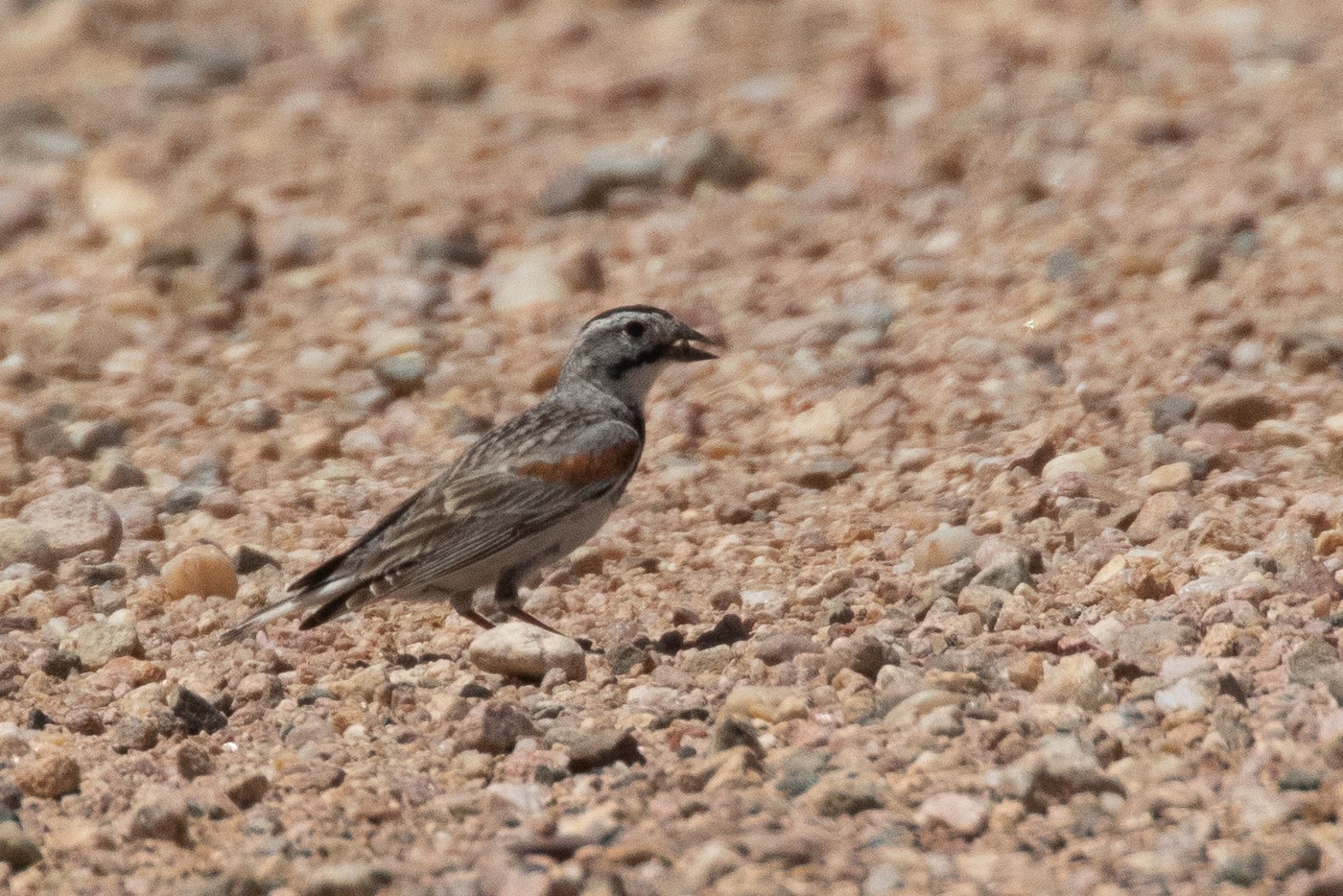
What Thick-billed Longspur's Feathers Look Like
Thick-billed Longspur (formerly McCown's Longspur) is a stocky grassland songbird whose feathers reflect a life spent on bare, dry shortgrass prairie.
- Tail feathers: the standout clue. Outer tail feathers are mostly white with a black terminal band, while the central pair is entirely dark — together this forms an inverted-T pattern when the tail is spread, but with the black restricted mainly to a narrow band near the tip (less extensive black than in Chestnut-collared or Lapland Longspur).
- Body/contour feathers: sandy buff to grayish-brown above with dark brown streaking on the back and scapulars, giving a soft, camouflaged look that matches bare soil and dry grass.
- Breeding male wing feathers: lesser wing coverts are chestnut-rufous, contrasting with otherwise gray-brown flight feathers — a small rufous patch at the shoulder is a useful clue if present.
- Underparts feathers: pale buffy-white to whitish, with little to no streaking on the belly, unlike some sparrows.
- Size: body contour feathers 2-3 cm, tail feathers 5-6 cm, in line with a chunky sparrow-sized bird slightly larger than a typical longspur.
- Bill note: while not a feather trait, the thick, pale conical bill (hence the name) often accompanies feathers found together at a carcass or molt site.
Step-by-Step: Is This Feather From a Thick-billed Longspur?
- Look at outer tail feathers first. White with a solid black band restricted to the tip is the fastest confirmation; measure how far the black extends — Thick-billed Longspur's black band is narrower than in Chestnut-collared Longspur.
- Check the central tail feathers. They should be entirely dark, contrasting sharply with the white-based outer feathers.
- Scan for chestnut on the wing. A rufous-chestnut patch on the lesser coverts points to a breeding male; its absence doesn't rule out the species (females and nonbreeding birds lack it).
- Note the overall tone. Sandy buff-brown with modest streaking fits shortgrass prairie camouflage; deep black-and-white contrast elsewhere suggests a different species.
- Consider location. Feathers found on bare, heavily grazed shortgrass or mixed-grass prairie in the western Great Plains support this ID.
Similar Species & How to Tell Them Apart
- Chestnut-collared Longspur: has a much more extensive black area on the tail (black covers roughly the outer two-thirds rather than just a terminal band) and a black belly patch in breeding males.
- Lapland Longspur: shows heavier, darker overall streaking and a different tail pattern with less pure white at the base.
- Chipping Sparrow: lacks any white in the tail at all, showing plain brownish tail feathers throughout.
- Horned Lark: has yellowish facial feathers and black tail feathers without the extensive white base seen in longspurs.
Where & When You'll Find Them
Thick-billed Longspurs breed on shortgrass and mixed-grass prairies of the northern Great Plains and southern Canadian prairies, favoring heavily grazed or barren ground. They winter in the southern Great Plains and northern Mexico in similar open, sparse habitat. Molt occurs mainly on the breeding grounds in late summer before migration, so worn breeding feathers are most likely to be found on prairie in July and August, while fresher winter-plumage feathers turn up on wintering grounds from late fall through winter.
Frequently asked questions
How do I tell this tail feather apart from a Chestnut-collared Longspur's?
Measure the black band — Thick-billed Longspur shows a narrower black terminal band with more white at the base, while Chestnut-collared's black extends much further up the feather.
Does a rufous wing patch confirm the species?
It strongly suggests a breeding male Thick-billed Longspur, but its absence doesn't rule the species out since females and nonbreeding birds lack it.
Would I find this feather in a forest?
No — Thick-billed Longspurs are shortgrass and bare-ground prairie specialists, so feathers turn up on open, heavily grazed rangeland, not woodland.
When are feathers most likely to be fresh versus worn?
Fresh feathers from post-breeding molt appear on the northern Great Plains breeding grounds in late summer; worn feathers can be found on wintering grounds farther south through winter.