
Summer Tanager
Piranga rubra
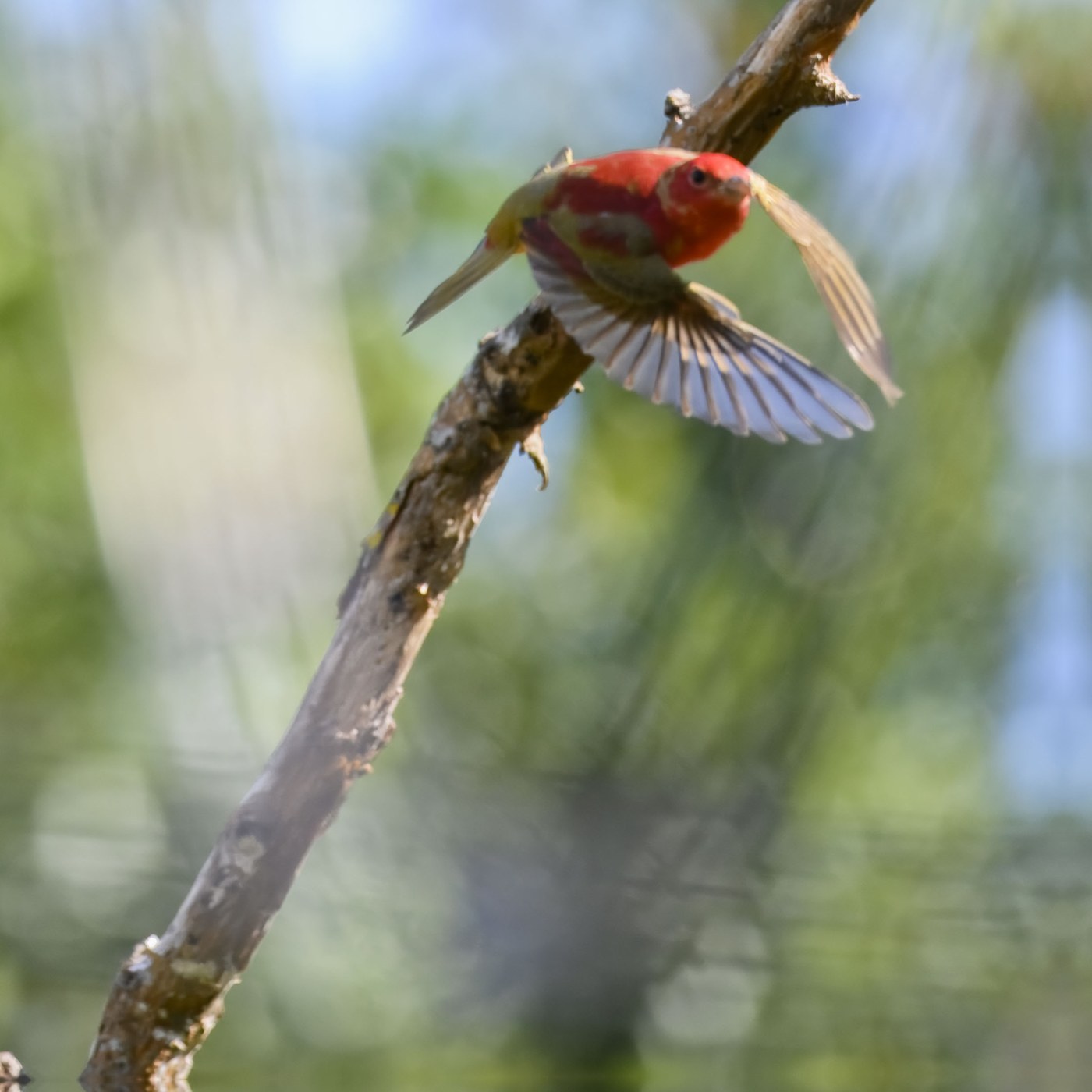
Unlike its scarlet cousin, the male Summer Tanager is rosy-red from head to tail with no contrasting black wings, a year-round trait unique among North American tanagers.
- Feather type
- Smooth, evenly colored contour feathers without contrasting wing patches
- Colours
- Rosy-red overall year-round in males; mustard to orange-yellow in females
- Bird size
- ~18-19 cm
Found a feather like this?
Identify any feather from a photo, free.
Overview
The Summer Tanager is a songbird of open woodland, riparian groves, and pine-oak forest across the southern United States, Mexico, and Central America. Adult males are unique among North American tanagers in being entirely rosy-red year-round, without the black wings shown by Scarlet or Western Tanager, giving them a more uniformly colored appearance. Females show a warm mustard-to-orange-yellow plumage, and immature males can show a striking, patchy mix of red and yellow feathers as they transition to adult plumage.
Identifying the Feather
Adult male body feathers are a uniform rosy-to-brick red across the head, back, wings, and underparts, lacking the contrasting black wing and tail feathers seen in Scarlet and Western Tanager, which is the single most reliable feature separating this species from its relatives. The bill is notably large and pale, slightly drooping, an additional useful field mark. Females show warm mustard-yellow to orange-yellow body feathers, generally without strong contrast between body and wing color, distinguishing them from the more olive-toned female Scarlet Tanager. Immature males often show a blotchy, patchwork mix of red and yellow feathers during their transition to adult plumage, a pattern not seen in this combination in other tanager species.
Plumage & Molt
Adult males retain the same all-red plumage throughout the year without a distinct seasonal change, unlike Scarlet Tanager which molts to a duller non-breeding plumage. Females maintain their mustard-yellow to orange coloring year-round. First-year and second-year males typically show a transitional, patchy red-and-yellow plumage before completing the shift to full adult red plumage over one or more molt cycles.
Habitat & Range
Summer Tanagers breed in open woodland, riparian corridors, and pine-oak forest across the southern United States, and occur through much of Mexico and Central America. Northern breeding populations are migratory, wintering from Mexico south through Central America and into northern South America, while more southerly populations can be resident.
Behavior & Field Notes
This species forages in the canopy and mid-story for large flying insects, which it often catches on the wing, along with fruit. The song is a rich, whistled series similar to an American Robin's but more fluid, and a distinctive sharp, staccato chattering call is a helpful clue to its presence. Nests are cup-shaped, built on a horizontal branch in the canopy or mid-story. The Summer Tanager's habit of catching large flying insects in the air is a notable foraging behavior among tanagers.
Frequently asked questions
How can you tell a Summer Tanager's feathers from a Scarlet Tanager's?
Summer Tanager males are rosy-red all over, including the wings, while Scarlet Tanager males have contrasting solid black wings against a scarlet body.
Do male Summer Tanagers change color seasonally?
No, unlike Scarlet Tanager, male Summer Tanagers remain rosy-red year-round without molting into a duller non-breeding plumage.
What do immature male Summer Tanagers look like?
They often show a blotchy, patchwork mix of red and yellow feathers as they transition from female-like plumage to full adult red.
What color are female Summer Tanagers?
Females show a warm mustard-yellow to orange-yellow plumage overall, without the male's red coloring.
Summer Tanager guides
In-depth guides for identifying and understanding Summer Tanager.
Other feathers you may enjoy

Yellow-breasted Bunting
Contour and flight feathers, chestnut-and-yellow breeding pattern

Sedge Wren
Tiny streaked crown and back feathers

Yellow-winged Cacique
Glossy black body feathers, yellow wing patch, shaggy crest

Yellow Warbler
Small contour and flight feathers

Yellow-throated Warbler
Small contour and flight feathers

Yellow-throated Vireo
Bright yellow throat and spectacle feathers; olive-green back feathers; two white wing-bar feathers

Yellow-rumped Warbler
Small contour and flight feathers

Yellow-hooded Blackbird
Contrasting hood and body feathers

Yellow-headed Blackbird
Glossy black body plumage with a bright yellow head and breast

Yellow-eyed Junco
Contour and flight feathers

Yellow-fronted Canary
Small, smooth body plumage

Yellow-breasted Greenfinch
Compact, smooth body plumage