
Ring Ouzel
Turdus torquatus
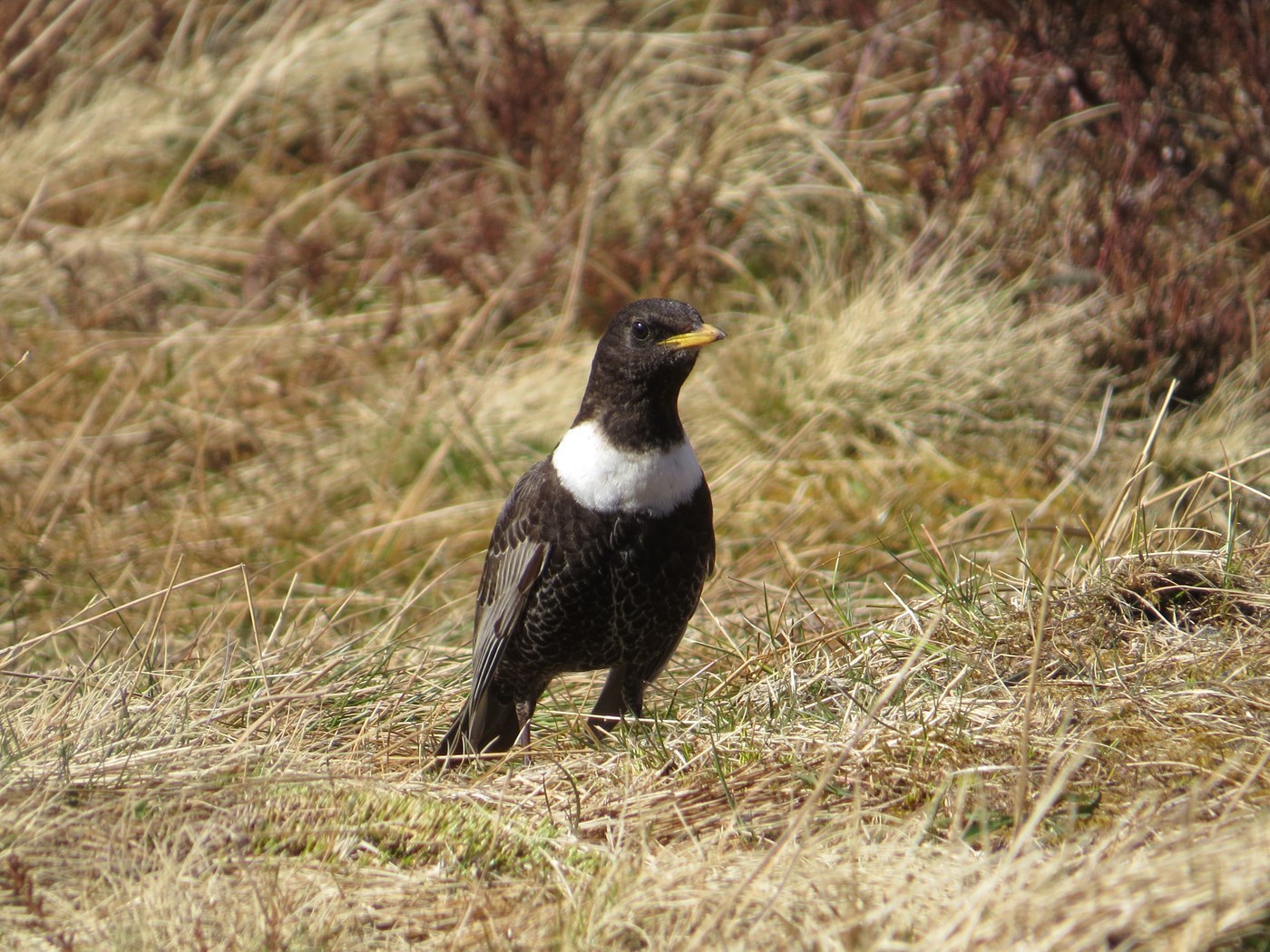
A blackbird relative of upland Europe, told from the Eurasian Blackbird by its bold white crescent across the breast and pale-scaled wing feathers.
- Feather type
- Dark body feathers with scaly pale fringes and a bold breast crescent
- Colours
- Blackish overall with a white breast crescent and pale-fringed wing feathers
- Bird size
- Robin-to-starling-sized, ~23-24 cm
Found a feather like this?
Identify any feather from a photo, free.
Overview
The Ring Ouzel is a thrush of upland and mountainous Europe, breeding on moorland, rocky slopes, and mountain scrub from the British Isles across parts of Scandinavia and into Alpine and other montane regions of the continent. Its resemblance to the Eurasian Blackbird combined with a bold white breast crescent makes it a distinctive, if often localized, species of open upland habitat.
Identifying the Feather
- Body feathers: Overall blackish in males, sooty-brown in females, similar in base tone to the Eurasian Blackbird.
- Breast feathers: A bold white or pale crescent crosses the upper breast, the species' signature identification feature.
- Wing feathers: Pale, scaly fringes give the wings a distinctly frosted or scalloped appearance, more pronounced than in the Eurasian Blackbird.
- Compared to similar species: The white breast crescent and pale-scaled wings readily separate this species from the otherwise similarly dark Eurasian Blackbird, which lacks both features.
Plumage & Molt
Males show blackish body plumage, a bold white breast crescent, and pale-fringed wing feathers creating a scaly pattern. Females are duller sooty-brown with a less distinct, more mottled breast crescent and similarly pale-fringed wings. Juveniles lack the clear crescent, showing mottled brownish underparts before their first molt. A single complete post-breeding molt renews the plumage, with fresh pale fringing looking crisper than in worn, late-season birds.
Habitat & Range
Ring Ouzels breed on open moorland, rocky mountain slopes, and montane scrub across upland Britain, Scandinavia, and the mountain ranges of central and southern Europe. They are migratory, wintering mainly in mountainous parts of North Africa and southern Europe, and their breeding range is closely tied to open, treeless upland terrain.
Behavior & Field Notes
This thrush forages on the ground for invertebrates in short upland vegetation, and readily takes berries, particularly during migration and winter. Its song is a simple, far-carrying series of fluted phrases, often delivered from a rock or low perch in open terrain. Nests are built low in heather, rocky crevices, or low shrubs. Its preference for remote, open upland habitat, combined with the bold breast crescent, makes it a distinctive species for observers in mountain and moorland regions.
Frequently asked questions
What is the key feature for identifying a Ring Ouzel?
Look for a bold white or pale crescent across the breast, along with pale-scaled wing feathers, both absent in the similar Eurasian Blackbird.
How does this species differ between sexes?
Males show a bolder, cleaner white breast crescent than females, which have a duller, more mottled crescent.
What kind of habitat does the Ring Ouzel use?
It breeds on open moorland, rocky slopes, and montane scrub in upland regions of Europe.
Where does it spend the winter?
Most populations migrate to winter in mountainous areas of North Africa and southern Europe.
Ring Ouzel guides
In-depth guides for identifying and understanding Ring Ouzel.
Other feathers you may enjoy

Yellow-breasted Bunting
Contour and flight feathers, chestnut-and-yellow breeding pattern

Sedge Wren
Tiny streaked crown and back feathers

Yellow-winged Cacique
Glossy black body feathers, yellow wing patch, shaggy crest

Yellow Warbler
Small contour and flight feathers

Yellow-throated Warbler
Small contour and flight feathers

Yellow-throated Vireo
Bright yellow throat and spectacle feathers; olive-green back feathers; two white wing-bar feathers

Yellow-rumped Warbler
Small contour and flight feathers

Yellow-hooded Blackbird
Contrasting hood and body feathers

Yellow-headed Blackbird
Glossy black body plumage with a bright yellow head and breast

Yellow-eyed Junco
Contour and flight feathers

Yellow-fronted Canary
Small, smooth body plumage

Yellow-breasted Greenfinch
Compact, smooth body plumage