
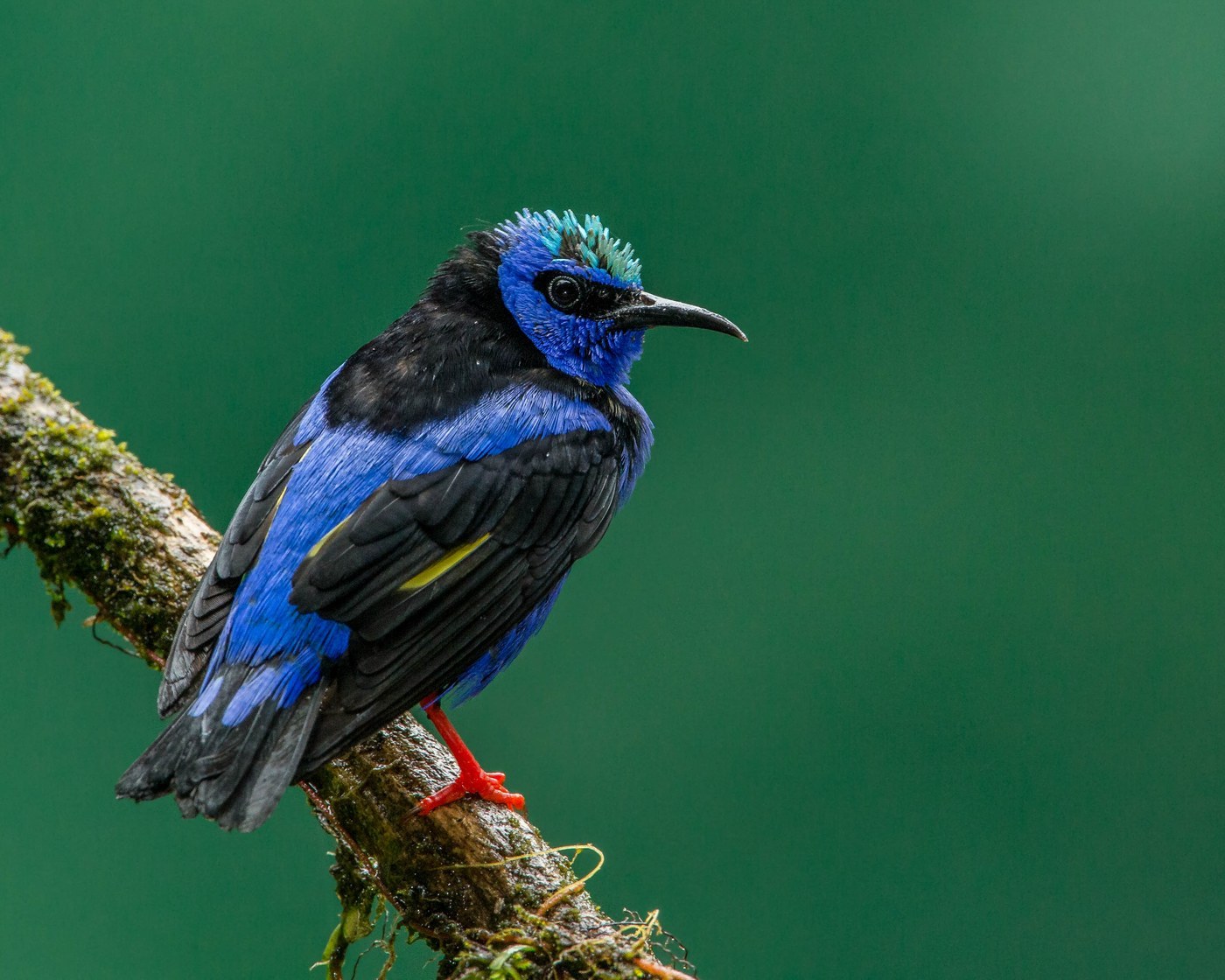
Red-legged Honeycreeper
Cyanerpes cyaneus
A small tropical songbird whose breeding males flash violet-blue plumage against solid black wings and tail, while females and non-breeding males wear soft green. It ranges from Mexico through much of South America, favoring forest edges and gardens where it sips nectar and gleans fruit.
- Feather type
- Short, silky contour feathers on a small, compact body
- Colours
- Violet-blue body with jet-black wings, back, and tail (breeding male); green overall in females and non-breeding males
- Bird size
- Sparrow-sized, ~11-12 cm
Found a feather like this?
Identify any feather from a photo, free.
Overview
Overview
The Red-legged Honeycreeper is a small, brightly plumaged member of the tanager family found throughout Central America, the Caribbean lowlands, and much of tropical South America. Breeding males are unmistakable, combining rich violet-blue body plumage with glossy black wings, back, and tail and a small turquoise crown patch. Females and non-breeding males are colored a soft leaf-green overall, and males in transition show a patchy mix of blue and green feathers. The species is a familiar sight at forest edges, plantations, and gardens, where its slim, slightly downcurved bill is well suited to probing flowers for nectar.
Identifying the Feather
Feather Identification
- Body feathers: In breeding males, contour feathers on the head, throat, and underparts are a saturated violet-blue that can look almost black in dim light and electric blue in direct sun.
- Wings and tail: Flight feathers and tail feathers are solid glossy black with little or no barring, creating strong contrast against the blue body.
- Crown patch: A small patch of pale turquoise feathering on the forecrown is often the brightest spot on the bird.
- Female/non-breeding male: Feathers are uniformly green with a paler, slightly yellowish throat and lack the black-and-blue contrast of the breeding male.
- Versus similar species: Other honeycreepers show different color combinations (more overall purple, or blue restricted to certain regions); the combination of violet-blue body with solid black wings and tail is diagnostic for this species in breeding male plumage.
Plumage & Molt
Plumage Notes
Adult males show a dramatic seasonal difference: full breeding plumage is violet-blue with black wings and tail, while a duller transitional plumage can mix blue and green feathers in a patchy pattern. Females retain green plumage year-round, with slightly brighter green on the crown and duller olive tones on the flanks. Juveniles resemble females. The species undergoes a complete molt after breeding, during which males may briefly show an untidy blend of old blue and new green feathers before achieving fresh plumage.
Habitat & Range
Habitat & Range
This species ranges from central Mexico through Central America and much of tropical South America to Bolivia and southern Brazil. It inhabits forest edges, secondary growth, shade coffee and cacao plantations, and gardens with flowering trees, generally at lowland and foothill elevations. It is largely resident, with local movements tied to flowering and fruiting cycles rather than long-distance migration.
Behavior & Field Notes
Behavior & Field Notes
Red-legged Honeycreepers forage actively in pairs or small groups, often joining mixed-species flocks at forest edge and canopy. They feed on nectar, small fruit, and insects, using their fine bill to probe flowers. Nests are small open cups placed in tree forks, built and tended mainly by the female. Calls are thin, high-pitched notes given while foraging, useful for locating the species in dense foliage before it comes into view.
Frequently asked questions
What color are Red-legged Honeycreeper feathers?
Breeding males show violet-blue body feathers set off by solid black wings and tail, while females and non-breeding males are green overall.
How can I tell a male from a female Red-legged Honeycreeper?
Males in breeding plumage are blue with black wings and tail; females and non-breeding males are green, without the blue-and-black contrast.
Where do Red-legged Honeycreepers live?
They occur in forest edges, second growth, and gardens from Mexico through Central America into tropical South America.
Why do male Red-legged Honeycreepers sometimes look patchy blue and green?
This happens during molt, when males transition between duller non-breeding plumage and full breeding blue, producing a mixed pattern of feathers.
Red-legged Honeycreeper guides
In-depth guides for identifying and understanding Red-legged Honeycreeper.
Other feathers you may enjoy

Yellow-breasted Bunting
Contour and flight feathers, chestnut-and-yellow breeding pattern

Sedge Wren
Tiny streaked crown and back feathers

Yellow-winged Cacique
Glossy black body feathers, yellow wing patch, shaggy crest

Yellow Warbler
Small contour and flight feathers

Yellow-throated Warbler
Small contour and flight feathers

Yellow-throated Vireo
Bright yellow throat and spectacle feathers; olive-green back feathers; two white wing-bar feathers

Yellow-rumped Warbler
Small contour and flight feathers

Yellow-hooded Blackbird
Contrasting hood and body feathers

Yellow-headed Blackbird
Glossy black body plumage with a bright yellow head and breast

Yellow-eyed Junco
Contour and flight feathers

Yellow-fronted Canary
Small, smooth body plumage

Yellow-breasted Greenfinch
Compact, smooth body plumage