
Red-breasted Nuthatch
Sitta canadensis
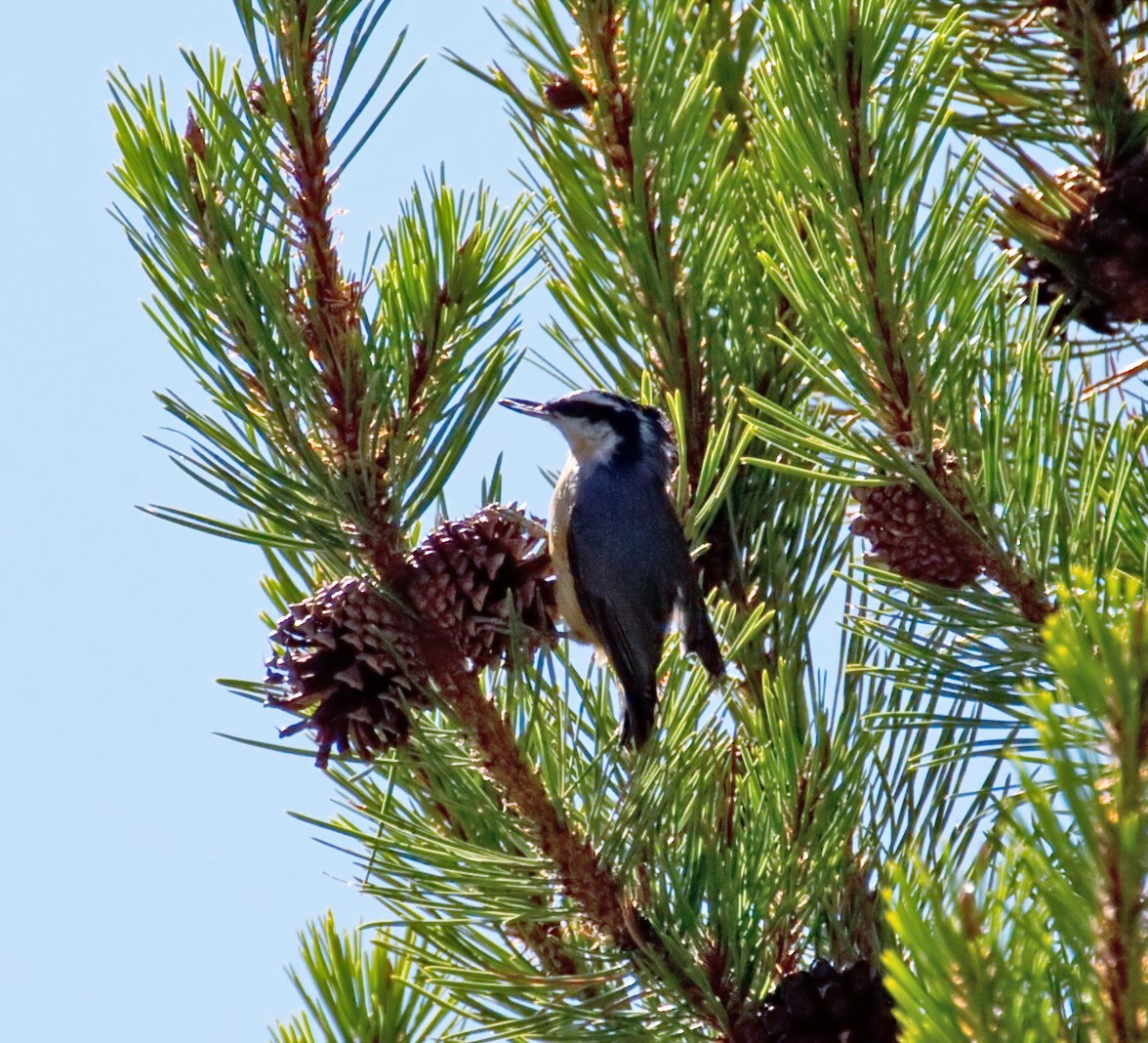
The Red-breasted Nuthatch is a small conifer-forest nuthatch whose rusty-orange underside feathers and bold black eye-stripe set it apart from its white-breasted relative.
- Feather type
- Blue-gray back feathers; rusty-orange underside feathers; black eye-stripe feathers
- Colours
- Blue-gray upperparts, black cap & eye-stripe, white eyebrow, rusty-orange underparts
- Bird size
- Small, ~11 cm
Found a feather like this?
Identify any feather from a photo, free.
Overview
Overview
The Red-breasted Nuthatch is a small, energetic tree-climber closely tied to coniferous forest, recognized by its rusty-orange underside and bold black eye-stripe. Its feathers combine the blue-gray back typical of nuthatches with a warm rust wash below, unlike its white-breasted relative.
Populations shift southward in some winters when conifer seed crops fail, so its feathers can turn up outside typical range in those years.
Identifying the Feather
Recognizing the Feathers
- Back feathers: blue-gray, unbarred
- Underside feathers: warm rusty-orange, distinguishing it from the White-breasted Nuthatch
- Head feathers: black cap and black eye-stripe framing a white eyebrow stripe
- Tail feathers: short, dark with white markings
The rusty-orange breast/belly feather is the key diagnostic separating this species from the White-breasted Nuthatch; the bold black eye-line is also a helpful facial feather clue.
Plumage & Molt
Plumage
Males show a black cap and richer rust underside; females have a grayer cap and paler rust wash. Juveniles resemble adults. A single complete molt occurs after breeding.
Habitat & Range
Habitat & Range
This species favors coniferous and mixed forests across Canada, the northern and western United States, and higher elevations further south. Some populations migrate irregularly southward in years of poor cone crops, while others are resident.
Behavior & Field Notes
Behavior & Field Notes
Red-breasted Nuthatches forage on conifer trunks and branches for insects and seeds, cache food, and often smear pitch around their nest cavity entrance, possibly to deter predators. Their call is a thin, nasal note higher-pitched than the White-breasted Nuthatch's. A rusty-orange body feather with a blue-gray back is a good sign of this species, especially in conifer forest.
Frequently asked questions
What color is the underside feather of a Red-breasted Nuthatch?
Warm rusty-orange, unlike the pure white of the White-breasted Nuthatch.
Does this species have a black eye-stripe?
Yes, a bold black line through the eye is characteristic.
Is this species always found in the same place?
No, it can move southward irregularly in some winters when conifer seed crops fail.
How big are Red-breasted Nuthatch feathers compared to White-breasted?
Slightly smaller overall, reflecting its smaller body size.
Red-breasted Nuthatch guides
In-depth guides for identifying and understanding Red-breasted Nuthatch.
Other feathers you may enjoy

Yellow-breasted Bunting
Contour and flight feathers, chestnut-and-yellow breeding pattern

Sedge Wren
Tiny streaked crown and back feathers

Yellow-winged Cacique
Glossy black body feathers, yellow wing patch, shaggy crest

Yellow Warbler
Small contour and flight feathers

Yellow-throated Warbler
Small contour and flight feathers

Yellow-throated Vireo
Bright yellow throat and spectacle feathers; olive-green back feathers; two white wing-bar feathers

Yellow-rumped Warbler
Small contour and flight feathers

Yellow-hooded Blackbird
Contrasting hood and body feathers

Yellow-headed Blackbird
Glossy black body plumage with a bright yellow head and breast

Yellow-eyed Junco
Contour and flight feathers

Yellow-fronted Canary
Small, smooth body plumage

Yellow-breasted Greenfinch
Compact, smooth body plumage