
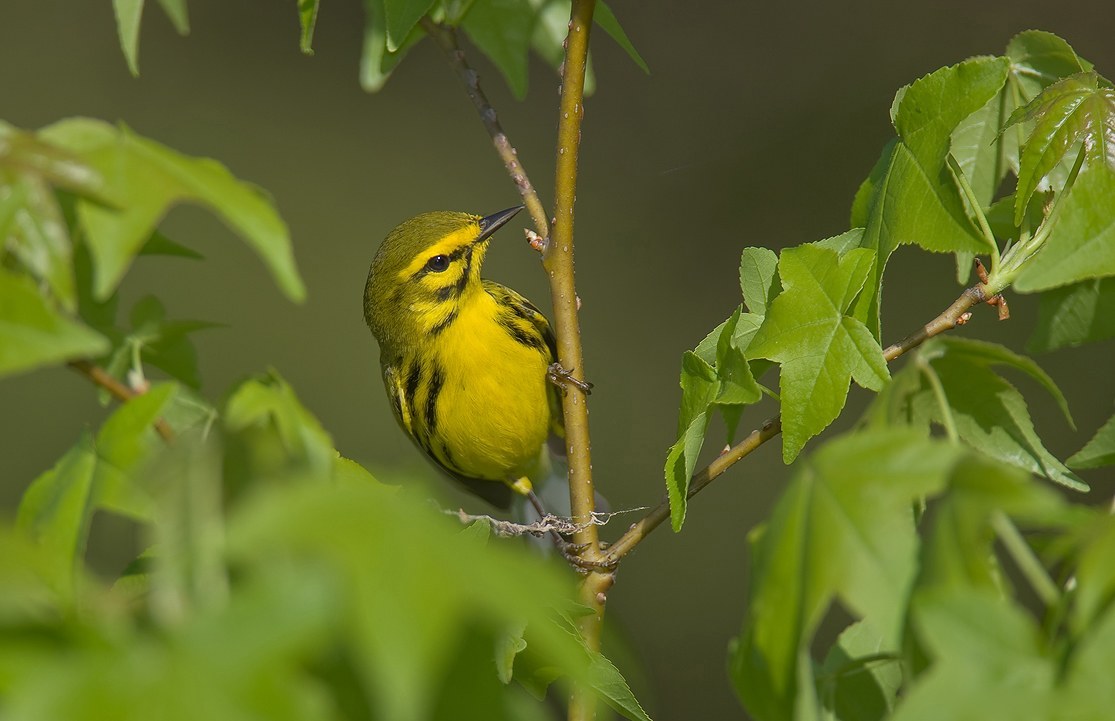
Prairie Warbler
Setophaga discolor
A small yellow wood-warbler with chestnut streaks on the back and bold facial markings, common in shrubby old fields and pine barrens, often seen bobbing its tail.
- Feather type
- Small contour and flight feathers
- Colours
- Olive-yellow upperparts with chestnut streaks on the back, yellow underparts with black flank streaking
- Bird size
- Small, ~12 cm
Found a feather like this?
Identify any feather from a photo, free.
Overview
The Prairie Warbler is a small wood-warbler of shrubby, early successional habitat across the eastern United States, despite its name having little association with open prairie grassland. It shows yellow underparts marked with black streaking, an olive back with chestnut streaks, and bold black facial markings, and is well known for its habit of frequently bobbing its tail while foraging.
Identifying the Feather
The crown and back are olive-yellow with a patch of chestnut streaking on the upper back, most visible in breeding adults. Underparts are bright yellow with bold black streaking along the flanks, and the face shows a black eye-line and a black crescent below the eye. Wings show two faint yellowish wingbars. The combination of chestnut back streaking with yellow underparts and strong facial markings distinguishes it from other yellow warblers.
Plumage & Molt
Breeding adults, especially males, show the most defined chestnut back streaking and boldest facial pattern. Females and immatures are duller, with reduced chestnut streaking and less contrasting facial markings. A single complete molt occurs after the breeding season.
Habitat & Range
Prairie Warblers breed in shrubby old fields, pine barrens, mangrove edges, and other early successional or scrubby habitat across the eastern United States. They winter primarily in the Caribbean and parts of Central America and southern Florida.
Behavior & Field Notes
This species forages actively in low shrubs and small trees for insects, frequently bobbing or wagging its tail, a habit useful for identification even at a distance. The male's song is a distinctive ascending series of buzzy notes. Nests are built low in dense shrubs. It is a nocturnal migrant traveling to wintering grounds in the Caribbean and nearby regions.
Frequently asked questions
How do I identify a Prairie Warbler feather?
Look for olive-yellow back feathers marked with chestnut streaking, paired with yellow underpart feathers showing bold black flank streaking.
Why is it called the Prairie Warbler if it doesn't live on prairies?
The name reflects early naturalists' encounters with the species in open, shrubby habitat, though it is not tied to true prairie grassland today.
What behavior helps identify this species in the field?
It frequently bobs or wags its tail while foraging, a habit that can help confirm identification.
Where does the Prairie Warbler winter?
It winters mainly in the Caribbean and parts of Central America and southern Florida.
Prairie Warbler guides
In-depth guides for identifying and understanding Prairie Warbler.
Other feathers you may enjoy

Yellow-breasted Bunting
Contour and flight feathers, chestnut-and-yellow breeding pattern

Sedge Wren
Tiny streaked crown and back feathers

Yellow-winged Cacique
Glossy black body feathers, yellow wing patch, shaggy crest

Yellow Warbler
Small contour and flight feathers

Yellow-throated Warbler
Small contour and flight feathers

Yellow-throated Vireo
Bright yellow throat and spectacle feathers; olive-green back feathers; two white wing-bar feathers

Yellow-rumped Warbler
Small contour and flight feathers

Yellow-hooded Blackbird
Contrasting hood and body feathers

Yellow-headed Blackbird
Glossy black body plumage with a bright yellow head and breast

Yellow-eyed Junco
Contour and flight feathers

Yellow-fronted Canary
Small, smooth body plumage

Yellow-breasted Greenfinch
Compact, smooth body plumage