

Namaqua Dove
Oena capensis
The Namaqua Dove is a small, long-tailed dove of arid Africa, with males showing a bold black face and throat patch and a slender, pointed tail.
- Feather type
- Slender body contour feathers with an elongated pointed tail
- Colours
- Grey-brown upperparts, black face and breast patch in males, with blue-tinged wing patches
- Bird size
- Small, long-tailed dove, ~22-26 cm including tail
Found a feather like this?
Identify any feather from a photo, free.
Overview
The Namaqua Dove is a small, delicate dove adapted to dry, open habitats across Africa and parts of the Middle East. Its notably long, graduated tail and, in males, a striking black facial mask make it easy to identify even at a distance as it flushes low across open ground.
Identifying the Feather
The tail feathers are long and strongly graduated, giving a pointed, wedge-shaped tail unlike the shorter, squarer tails of most small doves. Males show a solid black patch covering the face, throat, and upper breast, contrasting with grey-brown upperparts and a few small iridescent blue-purple patches on the folded wing. Females lack the black facial patch, showing a plainer greyish-brown face and breast. This combination of long pointed tail and, in males, a black facial mask is diagnostic.
Plumage & Molt
Males show the bold black face and breast patch described above; females are much plainer, with grey-brown replacing the black areas and reduced wing spotting. Juveniles resemble females, with young males acquiring the black mask gradually through molt. Molt is continuous and tied to arid-zone breeding conditions rather than a fixed season.
Habitat & Range
Found in dry savanna, scrub, semi-desert, and cultivated edges across sub-Saharan Africa, parts of the Middle East, and Madagascar. It is largely resident but can show local nomadic movement in response to rainfall and food availability.
Behavior & Field Notes
Namaqua Doves forage on bare ground for small seeds, walking quickly with a low crouched posture. They build a flimsy twig nest in a low bush. Their call is a soft, mournful cooing. Their preference for open, sparsely vegetated ground and fast, low flushing flight are useful field behaviors for identification.
Frequently asked questions
How do you identify Namaqua Dove feathers?
Look for the long, pointed graduated tail and, in males, a bold black face and breast patch.
How do males and females differ?
Males have a black facial mask and throat patch; females are plainer grey-brown without the black areas.
Where does the Namaqua Dove live?
In dry savanna, scrub, and semi-desert across Africa and parts of the Middle East.
What does it eat?
Small seeds picked from bare or sparsely vegetated ground.
Namaqua Dove guides
In-depth guides for identifying and understanding Namaqua Dove.

Other feathers you may enjoy

Victoria Crowned Pigeon
Large lace-like fan crest plumes over dense body contour feathers

Plain Pigeon
Contour feathers, plain and uniformly toned, with a white wing patch

Zenaida Dove
Contour and flight feathers, faint iridescent sheen on neck

Pink Pigeon
Soft contour feathers with graduated tail

Nicobar Pigeon
Long, hackle-like elongated neck feathers with iridescent sheen
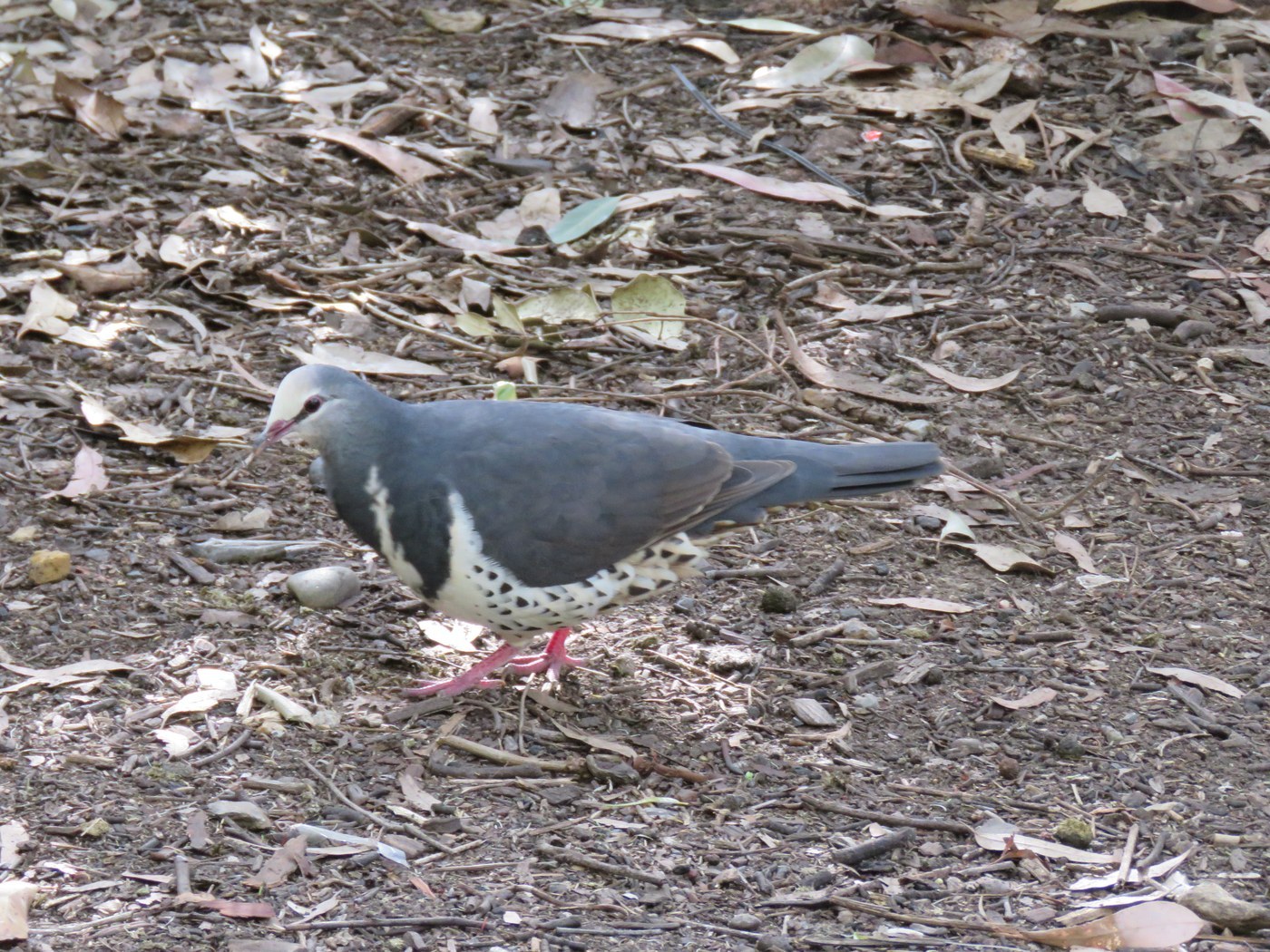
Wonga Pigeon
Dense, soft body contour feathers over a stocky frame

Squatter Pigeon
Dense, cryptic body contour feathers with a bold facial pattern

White-winged Dove
Broad, sturdy flight feathers with a bold white wing stripe

Western Crowned Pigeon
Rounded fan crest plumes over dense soft body feathers

Snow Pigeon
Dense insulating body contour feathers with a bold white rump and belly patch

Zebra Dove
Contour feathers with bold, extensive black-and-white barring

Scaly-naped Pigeon
Contour feathers with iridescent scaled nape pattern