
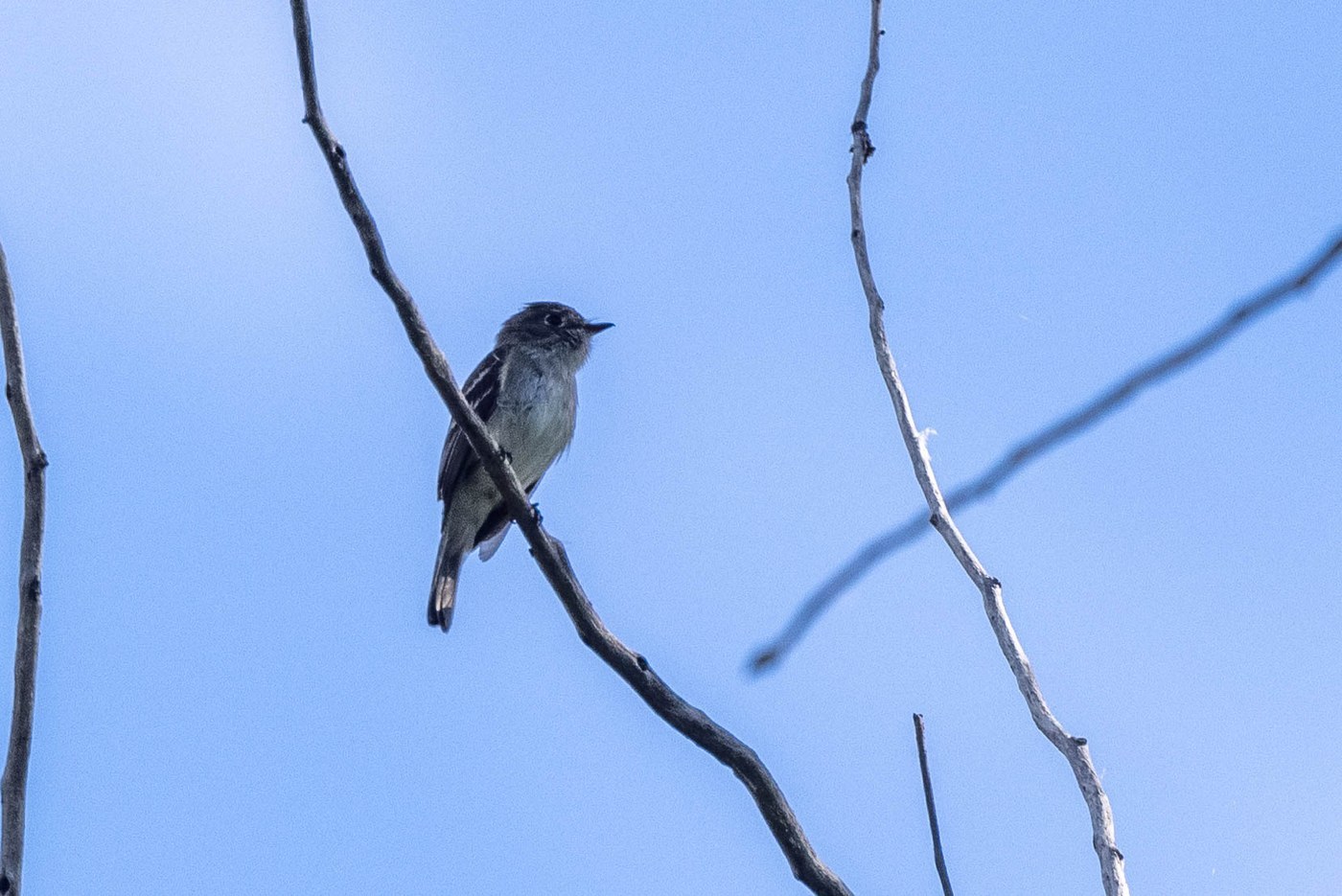
Least Flycatcher
Empidonax minimus
One of the smallest Empidonax flycatchers, notable for its bold white eye-ring and crisp wing bars against grayish-olive plumage.
- Feather type
- Contour, body plumage
- Colours
- Grayish-olive upperparts, whitish underparts, bold white eye-ring, whitish wing bars
- Bird size
- Small, sparrow-sized, ~13 cm
Found a feather like this?
Identify any feather from a photo, free.
Overview
Overview
The Least Flycatcher is among the smallest members of the Empidonax genus, breeding in deciduous woodland edges, orchards, and parks across much of North America. Like its relatives, it can be difficult to separate visually from similar species, though its comparatively bold white eye-ring and small size provide useful clues alongside its distinctive, emphatic call.
Overall plumage is grayish-olive above and whitish below, with crisp whitish wing bars and a notably bold, complete white eye-ring that stands out more prominently than in some other similarly sized Empidonax species.
Identifying the Feather
Feather ID Notes
Least Flycatcher feathers are grayish-olive above and pale whitish-gray below, generally cooler-toned and less yellowish than some related species. The eye-ring is white, bold, and complete, more prominent than in Willow Flycatcher, and the wing bars are crisp and whitish.
- Head/back feathers: grayish-olive, relatively cool-toned
- Underpart feathers: whitish-gray, with little to no yellow wash
- Eye-ring: bold, white, and complete, a strong field mark
- Wing feathers: dark with crisp whitish wing bars The bold, complete white eye-ring combined with small overall size and grayish (rather than yellowish or brownish) tones helps separate this species from Willow and Acadian Flycatchers, though voice remains the most definitive identifier among Empidonax species.
Plumage & Molt
Plumage Details
Sexes look alike in this species, both showing the same grayish-olive and whitish pattern with a bold eye-ring. Juveniles show buffier wing bars and slightly warmer tones that fade to the cooler adult pattern after their first molt. There is no strong seasonal plumage change, though feather wear can make the eye-ring appear slightly less crisp by late summer.
Habitat & Range
Habitat & Range
This species breeds in deciduous woodland edges, orchards, parks, and second-growth habitat across much of the northern and eastern parts of North America. It is a long-distance migrant, wintering in Central America, often in a variety of semi-open wooded habitats.
Behavior & Field Notes
Behavior & Field Notes
Least Flycatchers forage by sallying from a perch to catch flying insects, often flicking their wings and tail while perched, a habit shared with several Empidonax species. Diet is primarily flying insects. Nests are small, compact cups placed in the fork of a shrub or tree branch. The call, a sharp, emphatic "che-BEK," repeated frequently, is one of the most useful tools for confirming identification in the field, particularly where it overlaps with similar species.
Frequently asked questions
What feather feature stands out on Least Flycatcher?
A bold, complete white eye-ring paired with cool grayish-olive upperparts and whitish underparts.
How big is this species compared to other Empidonax flycatchers?
It is among the smallest members of the genus, generally appearing slightly more compact than related species.
What call helps confirm identification?
A sharp, repeated "che-BEK" call is distinctive and frequently given, aiding identification where plumage alone is inconclusive.
Where does this species breed?
In deciduous woodland edges, orchards, and parks across much of northern and eastern North America.
Least Flycatcher guides
In-depth guides for identifying and understanding Least Flycatcher.
Other feathers you may enjoy

Yellow-breasted Bunting
Contour and flight feathers, chestnut-and-yellow breeding pattern

Sedge Wren
Tiny streaked crown and back feathers

Yellow-winged Cacique
Glossy black body feathers, yellow wing patch, shaggy crest

Yellow Warbler
Small contour and flight feathers

Yellow-throated Warbler
Small contour and flight feathers

Yellow-throated Vireo
Bright yellow throat and spectacle feathers; olive-green back feathers; two white wing-bar feathers

Yellow-rumped Warbler
Small contour and flight feathers

Yellow-hooded Blackbird
Contrasting hood and body feathers

Yellow-headed Blackbird
Glossy black body plumage with a bright yellow head and breast

Yellow-eyed Junco
Contour and flight feathers

Yellow-fronted Canary
Small, smooth body plumage

Yellow-breasted Greenfinch
Compact, smooth body plumage