
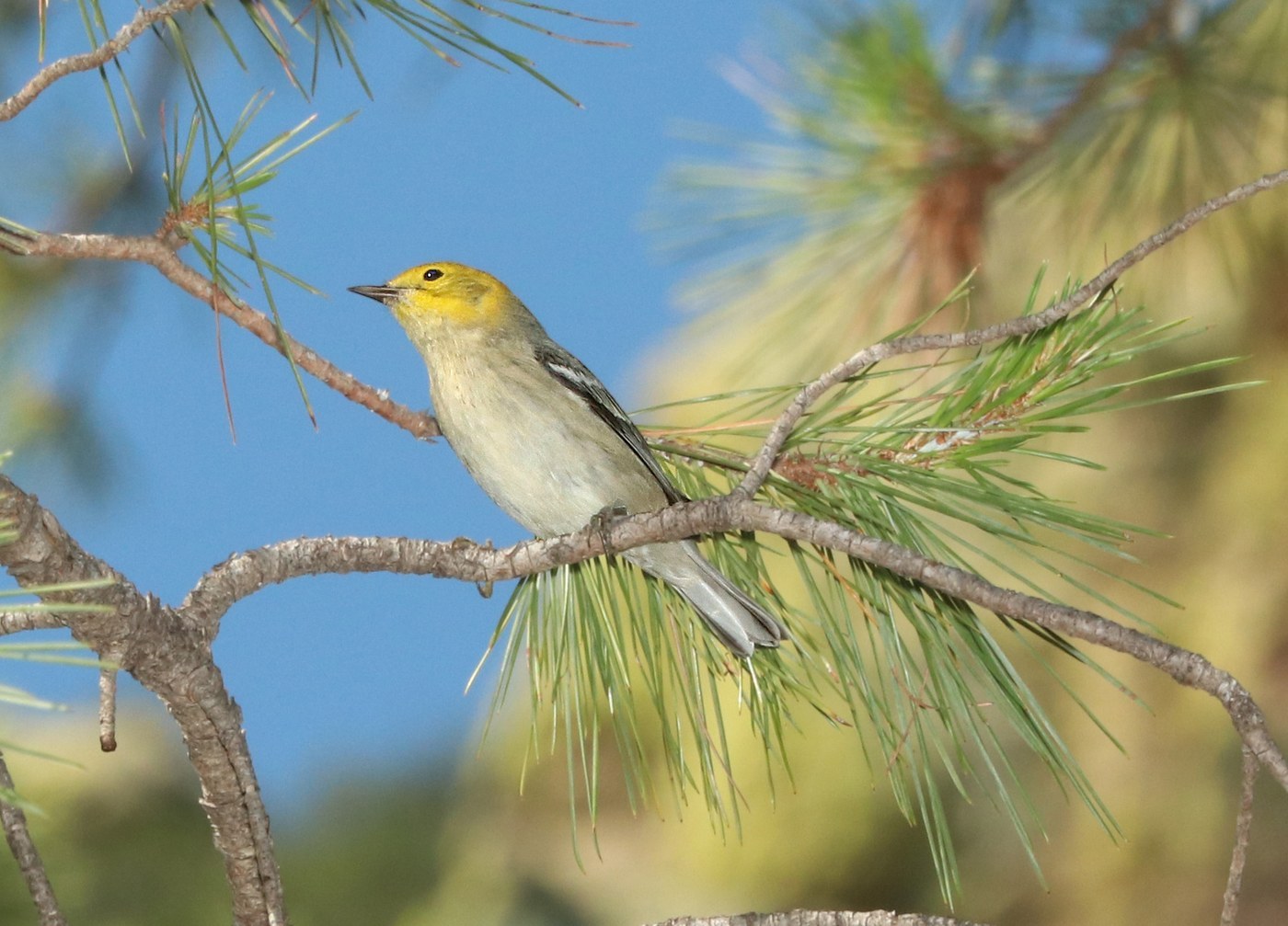
Hermit Warbler
Setophaga occidentalis
The Hermit Warbler has a brilliant yellow head, black throat, and plain gray back, and it breeds high in tall conifer forests along the Pacific coast.
- Feather type
- Plain gray back feathers; two white wing-bar feathers; bright yellow head feathers
- Colours
- Bright yellow head, plain gray unstreaked back, black throat in males, white underparts
- Bird size
- Small warbler, ~12 cm
Found a feather like this?
Identify any feather from a photo, free.
Overview
Overview
Hermit Warbler breeds in tall, old-growth or mature coniferous forest in the mountains of the Pacific coast states, wintering mainly in the highlands of Mexico and Central America. Its glowing yellow head is set off cleanly against a plain gray back, unlike the streaked pattern of its close relative Townsend's Warbler.
Where the two species meet in Washington and Oregon, hybrid and intergrade birds are frequent, so feathers from that zone may show mixed characteristics.
Identifying the Feather
Recognizing the Feathers
- Head feathers: entirely bright, unmarked yellow with no dark cheek patch
- Throat feathers: solid black in adult males, paler and more mottled in females and immatures
- Back feathers: plain gray, unstreaked or only very lightly streaked
- Underpart feathers: white to pale gray, generally unstreaked on the sides
- Wing feathers: dark with two clean white wing bars
The unstreaked gray back and unmarked yellow head (no black cheek patch) are the key features that separate this species from Townsend's Warbler.
Plumage & Molt
Plumage
Adult males have a solid black throat and immaculate yellow head; females and young birds show a paler yellow head with a partial, mottled dark throat patch rather than solid black. There is no strong seasonal plumage variation, with one complete post-breeding molt each year.
Habitat & Range
Habitat & Range
This warbler nests high in tall conifers - often Douglas-fir, true firs, or similar species - in mountain forests from Washington south through California. It winters primarily in pine-oak highlands of Mexico and Central America, making it a medium- to long-distance migrant.
Behavior & Field Notes
Behavior & Field Notes
Hermit Warblers forage high in the crowns of tall conifers, gleaning insects from needle clusters and occasionally hovering briefly to reach prey. The nest is typically placed far out on a horizontal conifer branch, well concealed from below. Its song is a series of high, buzzy notes similar to several other Setophaga warblers, requiring careful listening to separate from relatives.
Frequently asked questions
What separates Hermit Warbler feathers from Townsend's Warbler feathers?
Hermit Warbler has a plain, unstreaked gray back and an unmarked yellow head, while Townsend's shows a streaked back and a bold black cheek patch.
Do hybrids between the two species occur?
Yes, hybridization is regular where their breeding ranges overlap in the Pacific Northwest, producing birds with intermediate features.
Is the black throat present in both sexes?
No, adult males show a solid black throat while females and immatures have a paler throat with only partial dark mottling.
What kind of forest does this species prefer?
Tall, often old-growth coniferous forest at higher elevations along the Pacific coast during the breeding season.
Hermit Warbler guides
In-depth guides for identifying and understanding Hermit Warbler.
Other feathers you may enjoy

Yellow-breasted Bunting
Contour and flight feathers, chestnut-and-yellow breeding pattern

Sedge Wren
Tiny streaked crown and back feathers

Yellow-winged Cacique
Glossy black body feathers, yellow wing patch, shaggy crest

Yellow Warbler
Small contour and flight feathers

Yellow-throated Warbler
Small contour and flight feathers

Yellow-throated Vireo
Bright yellow throat and spectacle feathers; olive-green back feathers; two white wing-bar feathers

Yellow-rumped Warbler
Small contour and flight feathers

Yellow-hooded Blackbird
Contrasting hood and body feathers

Yellow-headed Blackbird
Glossy black body plumage with a bright yellow head and breast

Yellow-eyed Junco
Contour and flight feathers

Yellow-fronted Canary
Small, smooth body plumage

Yellow-breasted Greenfinch
Compact, smooth body plumage