
How to Identify Hermit Warbler Feathers
A guide to the bright yellow face, clean unstreaked grey back, and white wing bars that identify a Hermit Warbler feather and separate it from the closely related, hybridizing Townsend's Warbler.
Read the full Hermit Warbler encyclopedia entry →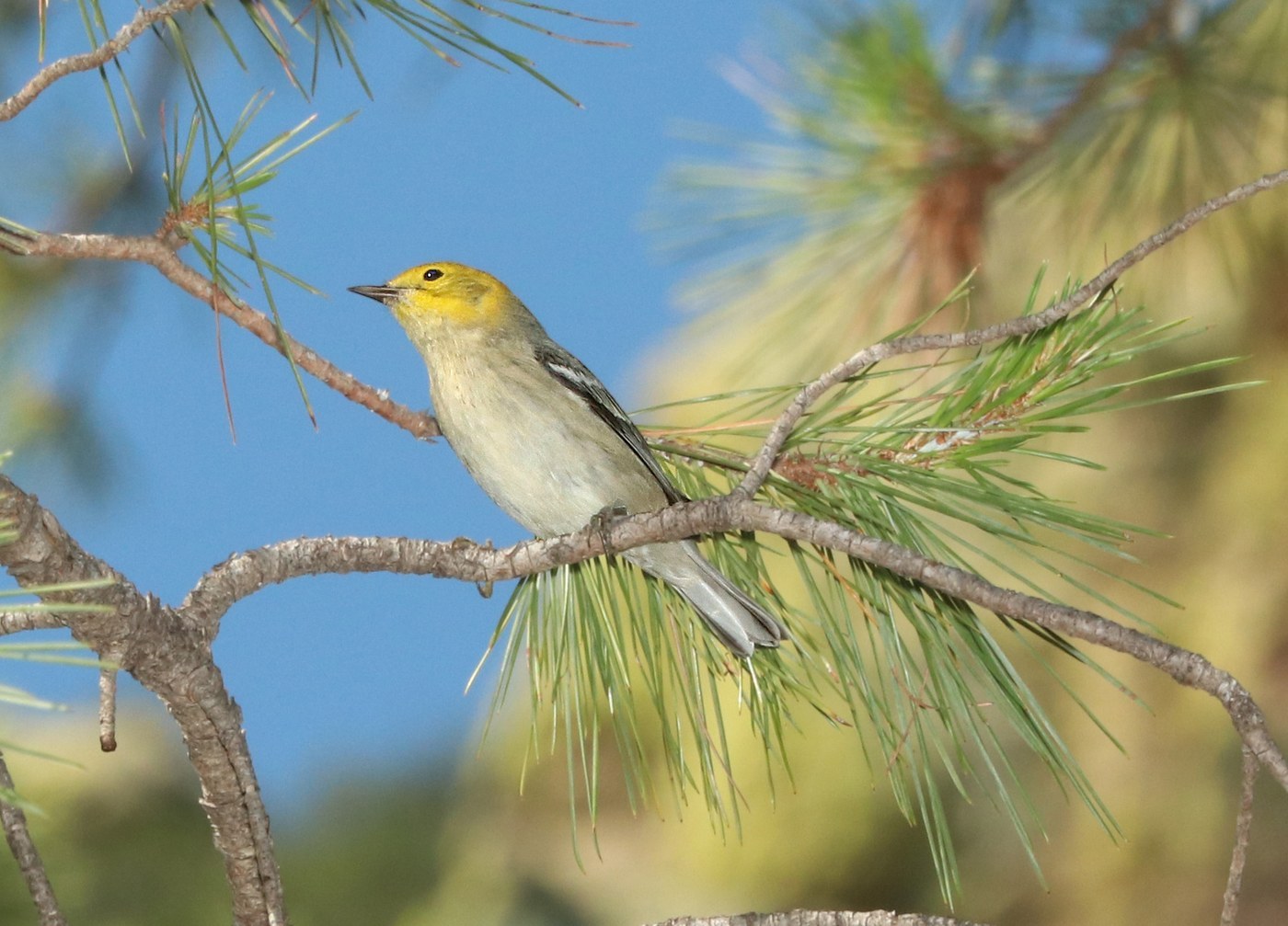
What Hermit Warbler Feathers Look Like
The Hermit Warbler is a canopy-dwelling specialist of old-growth Pacific coast conifers, and its plumage is clean and relatively simple compared to some of its more boldly patterned relatives.
- Head/face feathers: bright, solid yellow covering the face and crown, without a dark cheek patch.
- Throat feathers (breeding male): black, contrasting sharply against the yellow face.
- Back feathers: clean, unstreaked grey — importantly, without the olive streaking or spotting shown by some close relatives.
- Underparts: white belly, unmarked or only lightly marked.
- Wing feathers: black with two crisp white wing bars.
- Tail feathers: dark with white patches on the outer feathers, typical of the genus Setophaga.
Step-by-Step: Is This Feather From a Hermit Warbler?
- Check the back feather for streaking. A clean, plain grey back with no streaks or spotting is the most useful diagnostic — this rules out several similar warblers.
- Look at the face. Solid yellow without any dark cheek/auricular patch supports Hermit Warbler.
- Confirm the wing bars. Two crisp white wing bars against black wing feathers fit this species.
- Consider hybrid possibility. Hermit and Townsend's Warblers hybridize where their ranges meet, so a feather with intermediate features (some streaking plus a partial cheek patch) may come from a hybrid individual.
- Note the habitat. Tall old-growth coniferous forest canopy in the Pacific Northwest or California mountains is the right context; this species rarely comes low enough for feathers to be found easily.
Similar Species & How to Tell Them Apart
- Townsend's Warbler: shows a dark cheek/auricular patch and yellow-and-black streaked flanks and back, versus Hermit Warbler's clean grey back and unmarked face — the two hybridize, so some individuals show mixed features.
- Black-throated Green Warbler: also has a yellow face and black throat, but shows an olive-green, streaked back rather than clean grey, and occurs mainly in eastern North America.
- Yellow Warbler: overall yellow including the back, lacking the grey back and black throat combination of Hermit Warbler.
Where & When You'll Find Them
Hermit Warblers breed almost exclusively in tall, old-growth coniferous forest canopy along the Pacific coast from Washington through California's mountains, spending much of their time high in the treetops where feathers are rarely found. They winter in Mexico and Central America, with molt occurring on the breeding grounds in late summer before migration; feather finds are most likely near the base of old-growth conifers during or shortly after the breeding season.
Frequently asked questions
What's the clearest way to separate Hermit Warbler from Townsend's Warbler by feather?
Check the back: Hermit Warbler has a clean, unstreaked grey back and unmarked yellow face, while Townsend's Warbler shows streaking on the back/flanks and a dark cheek patch.
Why are Hermit Warbler feathers hard to find?
The species spends most of its time high in old-growth conifer canopy, so feathers rarely make it down to where they'd be noticed on the ground.
Do Hermit and Townsend's Warblers really interbreed?
Yes, they hybridize where their ranges overlap, so some individuals show intermediate features like partial cheek patches or light streaking that don't match either parent species perfectly.
What habitat should I search for Hermit Warbler feathers?
Tall, old-growth coniferous forest in the Pacific Northwest or California's mountains, ideally near mature trees used for nesting and foraging.