
Hepatic Tanager
Piranga flava
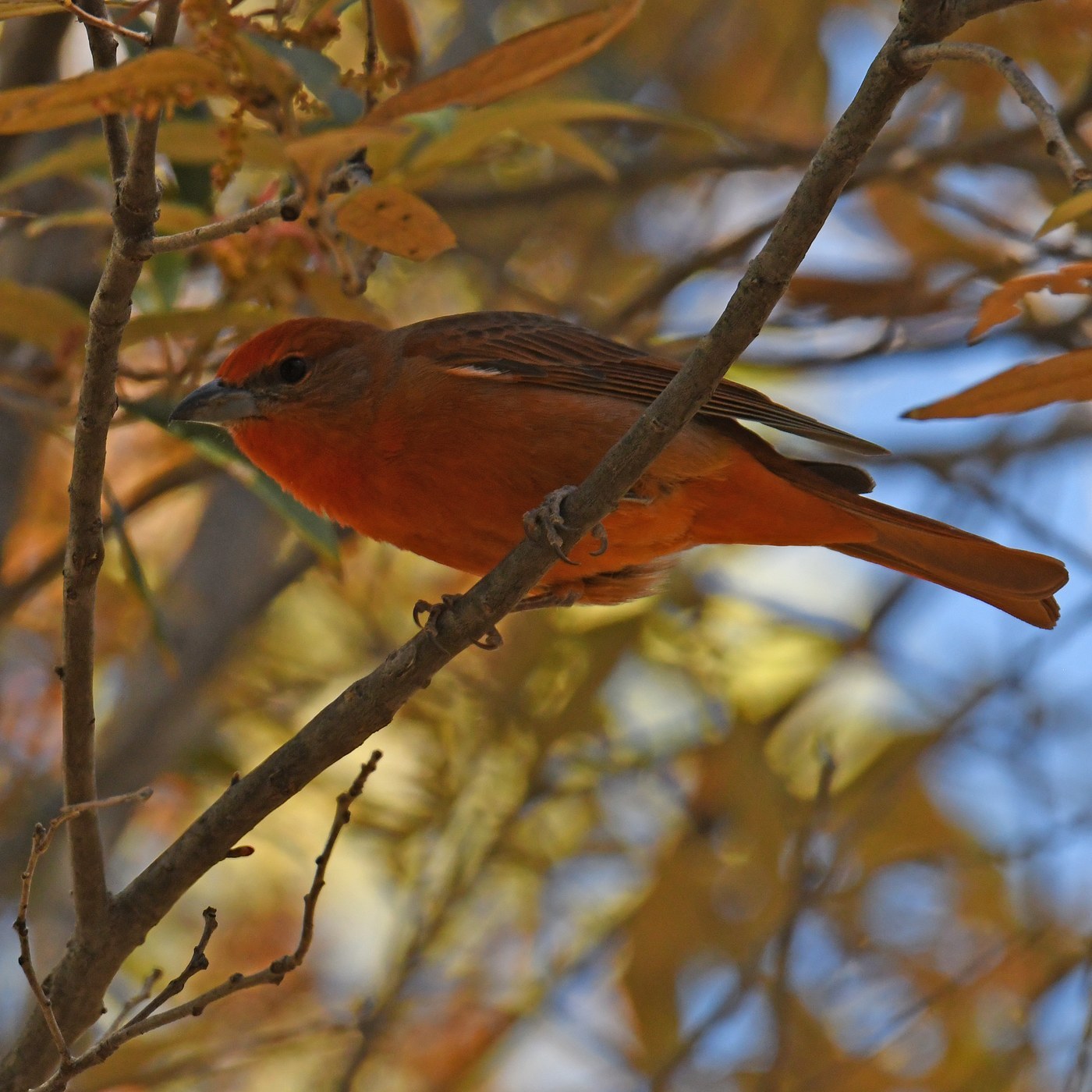
A dusky-red tanager of pine-oak mountain forest, the male Hepatic Tanager is brick-red overall with a subtle grayish cheek patch and a dark bill.
- Feather type
- Smooth contour feathers, brick-red overall with a grayish cheek patch
- Colours
- Brick-red to liver-red overall in males; olive-yellow in females
- Bird size
- ~19-20 cm
Found a feather like this?
Identify any feather from a photo, free.
Overview
The Hepatic Tanager occupies pine-oak woodland and montane forest from the southwestern United States through Mexico and Central America into parts of South America, one of the more widespread tanagers in the Americas. Males show an overall brick-red to liver-red plumage, somewhat duller and more muted than the vivid scarlet of Scarlet Tanager or the rosy-red of Summer Tanager, with a subtle grayish patch on the cheek that offers a useful identification feature. Females are olive-yellow overall, similar to other female tanagers but generally lacking bright orange or yellow tones.
Identifying the Feather
Adult male body feathers show a somewhat muted, brick-red to liver-red tone across the head, back, wings, and underparts, without the black wings of Scarlet or Western Tanager and without the brighter rosy tone of Summer Tanager. A grayish patch on the cheek/auricular area is a distinctive, subtle feature not present in other similarly red tanagers. The bill is notably dark and heavier than that of Summer Tanager, a helpful supporting feature. Females show olive-yellow body plumage, generally duller and grayer-toned than female Summer or Scarlet Tanager, with the same darker bill shape as males.
Plumage & Molt
Adult males retain their brick-red plumage with the grayish cheek patch year-round without a strong seasonal change. Females maintain olive-yellow plumage consistently through the year. Immature males typically resemble females before gradually acquiring adult red plumage through molt.
Habitat & Range
Hepatic Tanagers inhabit pine-oak woodland and montane forest across a broad range from the southwestern United States (Arizona, New Mexico) through Mexico, Central America, and into parts of South America. Northern populations are migratory, wintering further south, while populations in the tropical portion of the range tend to be resident.
Behavior & Field Notes
This species forages in the mid-story and canopy of pine-oak forest for insects and fruit. The song is a rich, warbling phrase generally similar to other Piranga tanagers but often described as more measured, and calls include a distinctive low chuck note. Nests are cup-shaped, placed on a horizontal branch in a pine or oak tree. Hepatic Tanagers can be locally common in appropriate montane pine-oak habitat but are often overlooked due to their more muted coloration compared to other red tanagers.
Frequently asked questions
How does the Hepatic Tanager's color differ from Summer Tanager's?
The Hepatic Tanager shows a more muted brick-red to liver-red tone with a subtle grayish cheek patch, rather than the brighter, more uniform rosy-red of Summer Tanager.
What color are female Hepatic Tanagers?
Females are olive-yellow overall, generally duller and grayer-toned than female Summer or Scarlet Tanagers.
What habitat does the Hepatic Tanager favor?
It prefers pine-oak woodland and montane forest, ranging from the southwestern United States through Mexico, Central America, and into parts of South America.
Is the Hepatic Tanager migratory?
Northern populations migrate south for winter, while tropical populations tend to remain resident year-round.
Hepatic Tanager guides
In-depth guides for identifying and understanding Hepatic Tanager.
Other feathers you may enjoy

Yellow-breasted Bunting
Contour and flight feathers, chestnut-and-yellow breeding pattern

Sedge Wren
Tiny streaked crown and back feathers

Yellow-winged Cacique
Glossy black body feathers, yellow wing patch, shaggy crest

Yellow Warbler
Small contour and flight feathers

Yellow-throated Warbler
Small contour and flight feathers

Yellow-throated Vireo
Bright yellow throat and spectacle feathers; olive-green back feathers; two white wing-bar feathers

Yellow-rumped Warbler
Small contour and flight feathers

Yellow-hooded Blackbird
Contrasting hood and body feathers

Yellow-headed Blackbird
Glossy black body plumage with a bright yellow head and breast

Yellow-eyed Junco
Contour and flight feathers

Yellow-fronted Canary
Small, smooth body plumage

Yellow-breasted Greenfinch
Compact, smooth body plumage