
How to Identify Hepatic Tanager Feathers
How to tell the dark brick-red, dusky-cheeked feathers of a male Hepatic Tanager apart from the brighter Summer Tanager, using bill color and cheek patch as key clues.
Read the full Hepatic Tanager encyclopedia entry →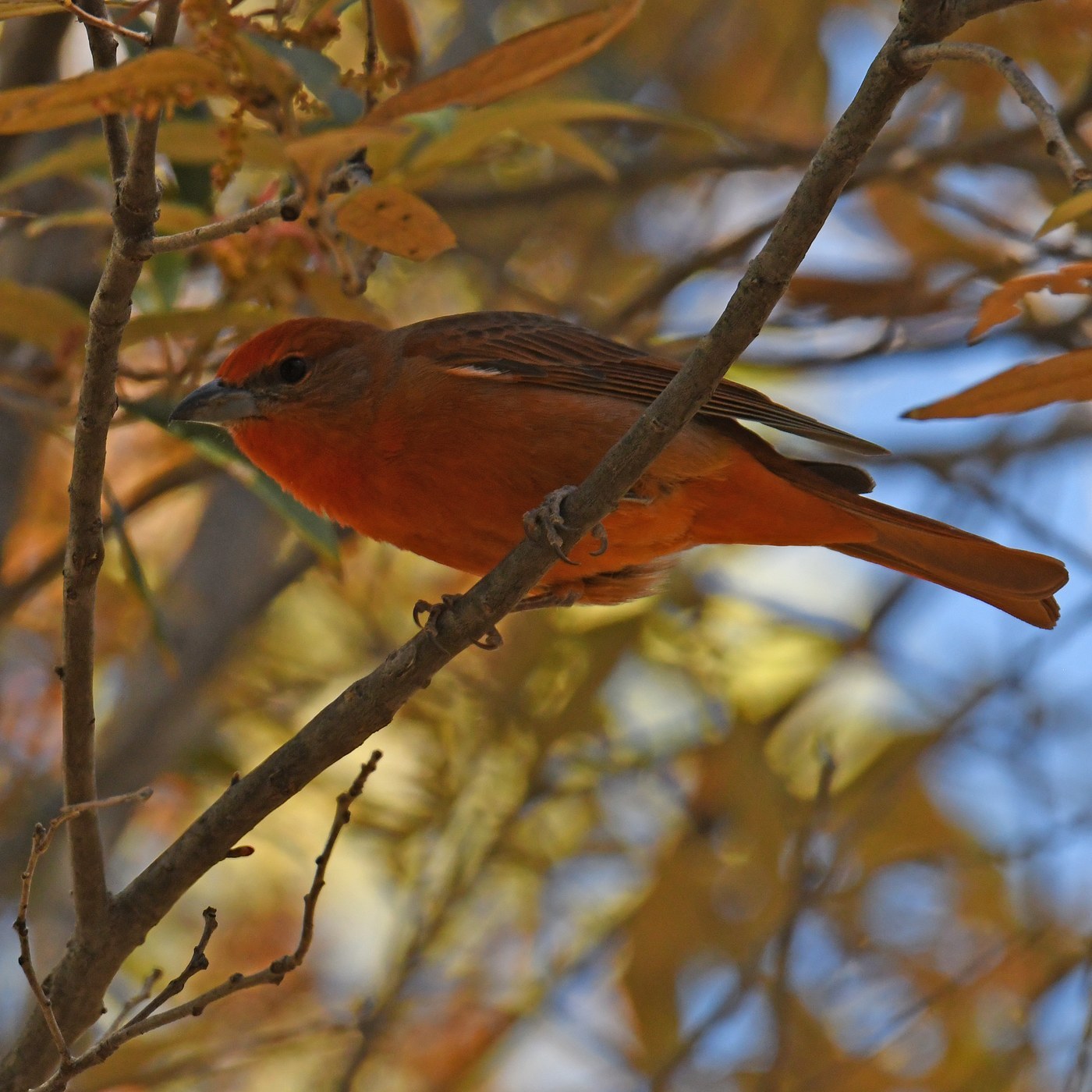
What Hepatic Tanager Feathers Look Like
The Hepatic Tanager is a pine-oak woodland songbird of the Southwest, and its plumage is often confused with the more familiar Summer Tanager — but a few details set it apart.
- Male body feathers: dull, brick-red to liver-red overall (the name "hepatic" refers to this liver-colored tone), duller and darker than the bright rose-red of a male Summer Tanager.
- Cheek/auricular feathers: show a dusky grayish patch, giving the face a slightly two-toned look — a key diagnostic missing from Summer Tanager.
- Female body feathers: olive-yellow overall with a grayish cast, less uniformly golden than female Summer or Western Tanagers.
- Wing feathers: plain, without white wing bars — helpful in ruling out Western Tanager, which shows bars.
- Bill color context: dark, blackish-grey bill rather than the pale horn-colored bill of Summer Tanager.
- Overall texture: feathers tend to look slightly more matte than the glowing, almost waxy red of Summer Tanager, a subtle difference best appreciated when comparing feathers side by side.
Step-by-Step: Is This Feather From a Hepatic Tanager?
- Assess the exact shade of red. A darker, more brick/liver-toned red rather than a bright rose-red points to Hepatic Tanager over Summer Tanager.
- Look for a dusky cheek patch. If a facial feather shows a greyish tone against the red, that's a strong Hepatic Tanager indicator.
- Check for wing bars. Plain, unbarred wing feathers rule out Western Tanager, which shows white or yellow bars.
- For duller feathers, check the olive-yellow-grey tone. Female Hepatic Tanager feathers show a somewhat greyer olive cast than the cleaner yellow of female Summer Tanager.
- Consider the habitat. Montane pine-oak woodland in the Southwest US (Arizona, New Mexico) and further south fits this species better than lowland riparian areas favored by Summer Tanager.
Similar Species & How to Tell Them Apart
- Summer Tanager: brighter rose-red overall, with a pale horn-colored bill and no dusky cheek patch — the closest look-alike, but distinguishable with careful comparison.
- Western Tanager: shows obvious white wing bars and a black-and-yellow body pattern, quite different from the plain-winged Hepatic Tanager.
- Scarlet Tanager: males show jet-black wings against bright scarlet body, a much higher-contrast pattern than Hepatic Tanager's more uniform brick-red.
Where & When You'll Find Them
Hepatic Tanagers breed in montane pine-oak forests of the southwestern United States, including Arizona and New Mexico, extending south through Mexico and Central America into parts of South America. The US breeding population is migratory, molting before heading south in fall, so feathers are most likely to be found in pine-oak canyon woodlands during the breeding season and shortly before fall migration. Because this species tends to forage higher in the canopy than Summer Tanager, feathers more often turn up beneath tall pines rather than the streamside cottonwoods and willows favored by its lowland relative.
Frequently asked questions
What's the key difference between Hepatic Tanager and Summer Tanager feathers?
Hepatic Tanager shows a darker, more brick/liver-toned red with a dusky greyish cheek patch, while Summer Tanager is brighter rose-red with no cheek patch and a paler bill.
Does Hepatic Tanager have wing bars like Western Tanager?
No, Hepatic Tanager's wings are plain and unbarred, which helps rule out Western Tanager, whose wings show clear white or yellow bars.
What habitat should I check for Hepatic Tanager feathers?
Montane pine-oak forest in the southwestern US and further south, rather than lowland riparian woodland where Summer Tanager is more typical.
Are female Hepatic Tanager feathers as distinctive as the males'?
They're subtler, showing an olive-yellow tone with a greyish cast, somewhat duller than the cleaner yellow of a female Summer Tanager, but still a useful clue.