
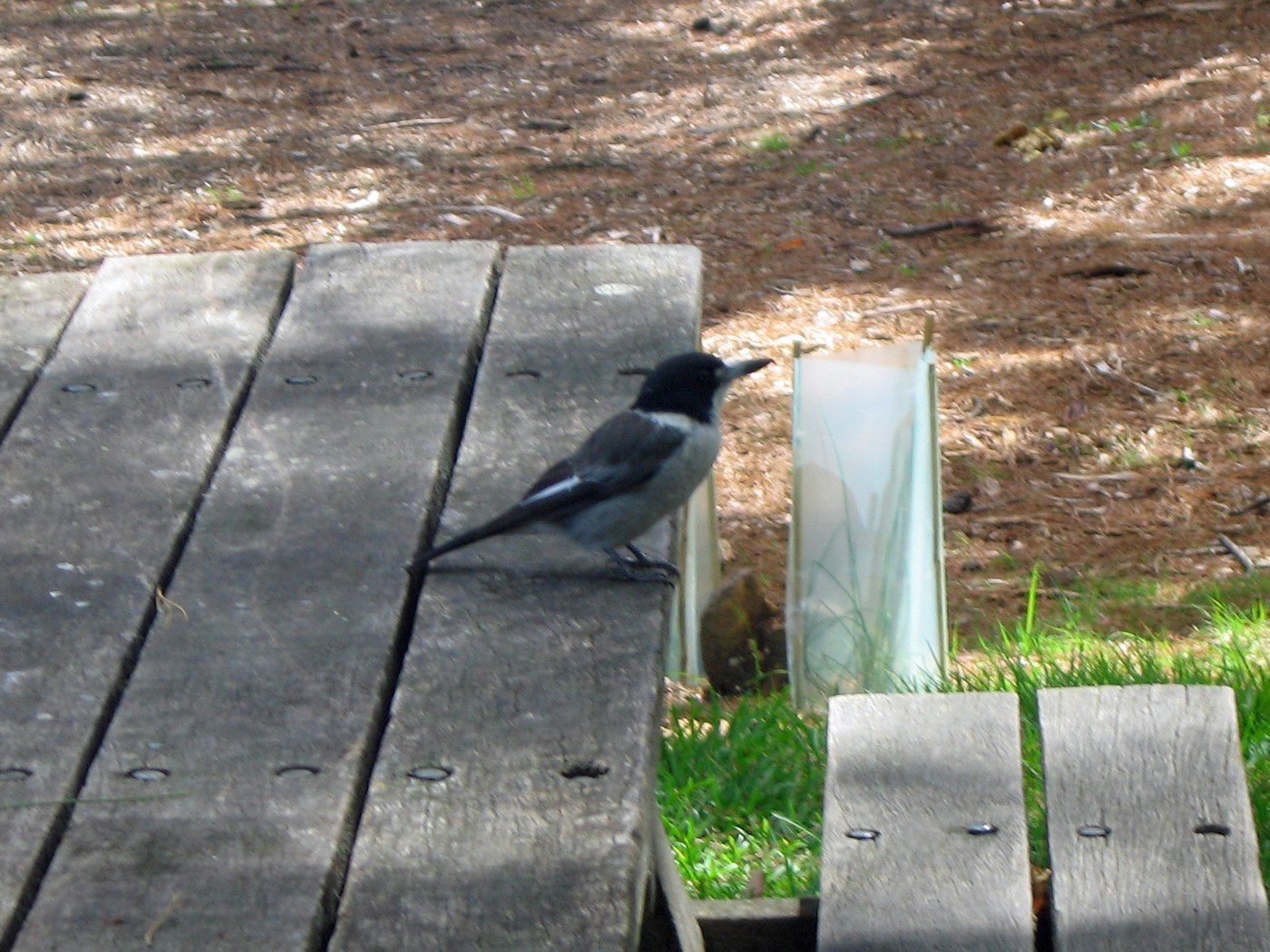
Grey Butcherbird
Cracticus torquatus
A boldly patterned Australian songbird, the Grey Butcherbird shows gray upperparts, a black head marking, and clean white underparts, paired with a strong, hooked bill used to catch and impale prey.
- Feather type
- Sturdy contour feathers; hooked bill-associated facial bristles
- Colours
- Gray upperparts, black head and throat marking, white underparts and collar
- Bird size
- Robin-to-jay-sized, ~28-30 cm
Found a feather like this?
Identify any feather from a photo, free.
Overview
The Grey Butcherbird is a medium-sized, boldly patterned songbird found in woodland, forest edge, and gardens across much of Australia. Named for its habit of catching and sometimes storing prey by impaling it on thorns or in forks, it combines a strong, hooked bill with a distinctive black-and-gray-and-white plumage pattern.
Identifying the Feather
Upperpart feathers are plain gray, sharply set off by a black hood covering the crown, nape, and throat area, and by clean white underparts and a white collar band around the neck. A thin white wing bar and white patches at the base of the primaries add contrast on the folded wing. The bill is heavy and distinctly hooked at the tip, an adaptation for gripping and tearing prey, though the bill itself is not a feather. Compared to true butcherbird relatives, the combination of gray back, black hood, and white collar is a reliable identification feature separating this species from similarly patterned magpies and currawongs, which lack the same head and collar pattern.
Plumage & Molt
Sexes are similar in plumage, both showing the gray, black, and white pattern described above. Juveniles are duller, showing brownish tones in place of the sharp gray and black adult pattern, with the black hood developing gradually as they mature. Molt is regular through the year.
Habitat & Range
Grey Butcherbirds occupy woodland, forest edge, scrub, and well-vegetated urban and suburban gardens across much of Australia. The species is generally sedentary, maintaining a territory year-round rather than migrating.
Behavior & Field Notes
This species has a varied diet of invertebrates and small vertebrates, sometimes caching prey by wedging it into a fork or impaling it on a thorn for later consumption. It builds an open cup nest in a tree fork. Its voice includes clear, melodious whistled phrases, considered among the more musical calls of Australian songbirds, alongside harsher alarm notes. Grey Butcherbirds can become quite bold around human habitation, sometimes approaching people closely in search of food.
Frequently asked questions
How can you tell a Grey Butcherbird from a Magpie by feathers?
The Grey Butcherbird shows a black head hood set against plain gray upperparts and a white collar, a pattern distinct from the broader black-and-white pattern of magpies.
Why is it called a butcherbird?
It sometimes caches prey by wedging it into a branch fork or impaling it on a thorn, a habit reminiscent of a butcher's hooks.
What does its call sound like?
Clear, melodious whistled phrases, considered among the more musical calls of Australian songbirds.
Is it migratory?
No, it is generally sedentary and maintains a territory year-round.
Grey Butcherbird guides
In-depth guides for identifying and understanding Grey Butcherbird.
Other feathers you may enjoy

Yellow-breasted Bunting
Contour and flight feathers, chestnut-and-yellow breeding pattern

Sedge Wren
Tiny streaked crown and back feathers

Yellow-winged Cacique
Glossy black body feathers, yellow wing patch, shaggy crest

Yellow Warbler
Small contour and flight feathers

Yellow-throated Warbler
Small contour and flight feathers

Yellow-throated Vireo
Bright yellow throat and spectacle feathers; olive-green back feathers; two white wing-bar feathers

Yellow-rumped Warbler
Small contour and flight feathers

Yellow-hooded Blackbird
Contrasting hood and body feathers

Yellow-headed Blackbird
Glossy black body plumage with a bright yellow head and breast

Yellow-eyed Junco
Contour and flight feathers

Yellow-fronted Canary
Small, smooth body plumage

Yellow-breasted Greenfinch
Compact, smooth body plumage