
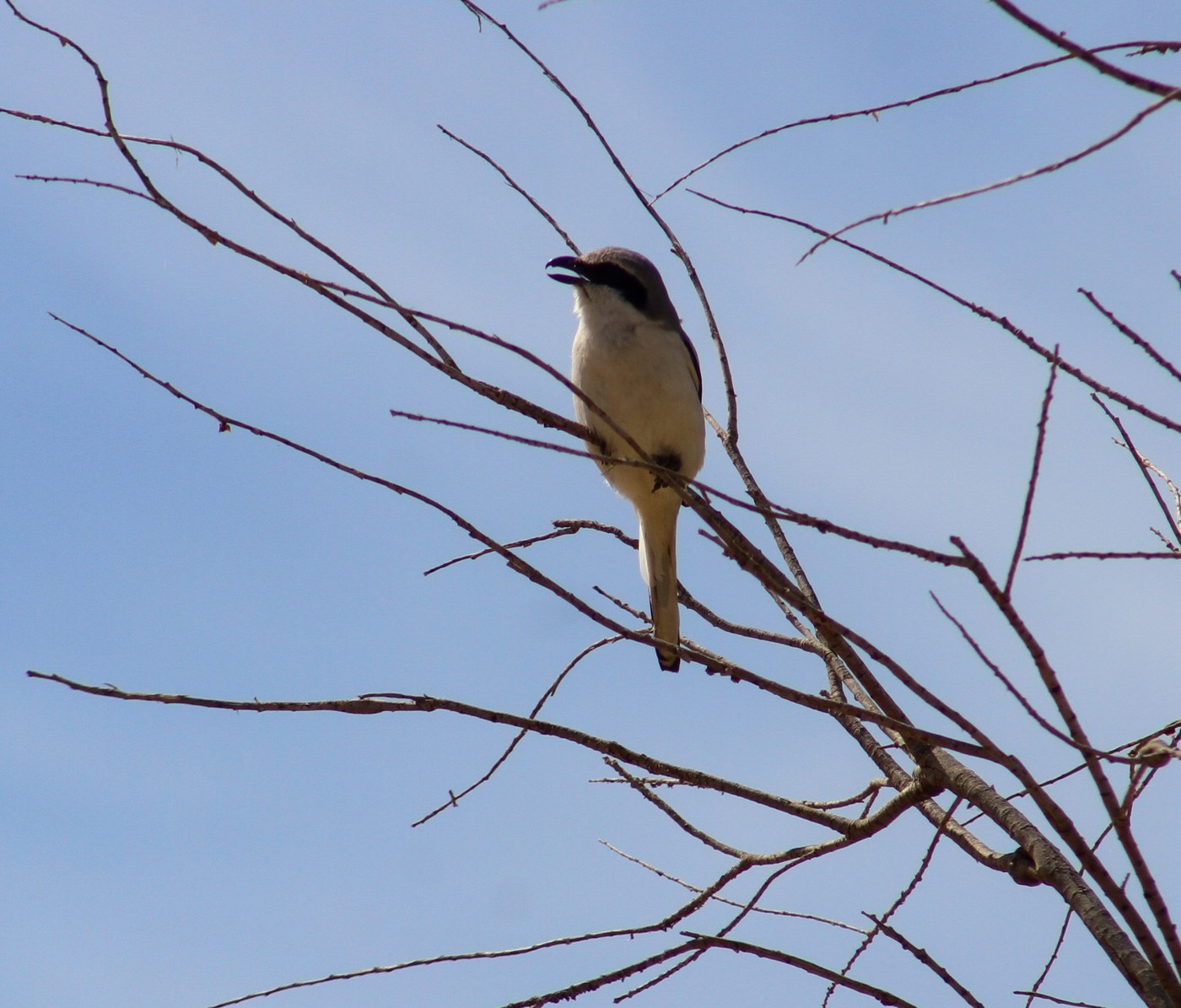
Great Grey Shrike
Lanius excubitor
A pale gray Eurasian predator songbird with a black mask and long tail, often seen perched conspicuously atop bushes or wires while watching for prey.
- Feather type
- Firm body feathers, hooked bill, stiff flight feathers
- Colours
- Pale gray above, white below, black mask and black-and-white wings
- Bird size
- Robin-sized to slightly larger, ~24-25 cm
Found a feather like this?
Identify any feather from a photo, free.
Overview
The Great Grey Shrike is a striking predatory songbird found across open country in Europe and parts of Asia, closely related to the North American Northern Shrike, with which it was formerly considered a single species. It is a conspicuous bird of open habitats, frequently seen perched high on an exposed branch or wire scanning for prey.
Identifying the Feather
Flight feathers: black with a white patch at the base of the primaries, forming a visible flash in flight. Tail feathers: notably long and black with white outer edges, giving the bird a long-tailed silhouette. Body feathers: pale gray above, clean white below, with a black mask through the eye bordered narrowly above by white, and black wings marked with white. Feathers are similar in pattern to the Northern Shrike but the underparts are typically cleaner white with less barring in adults.
Plumage & Molt
Sexes look similar, though females may show a faint scaly pattern on the underparts that males lack. Adults are pale gray above, white below, with a black mask, black wings with a white primary patch, and a long black-and-white tail. Juveniles show a browner tinge and faint barring on the underparts, molting toward the adult pattern within their first year. Plumage does not vary strongly by season.
Habitat & Range
Great Grey Shrikes breed across open boreal and temperate habitats of northern and central Eurasia, favoring heathland, forest edges, and scrubby open country with scattered perches. Northern populations migrate south in winter, while some southern populations are largely resident.
Behavior & Field Notes
This shrike hunts from an elevated perch, dropping onto insects, small mammals, and small birds, and is known for impaling prey on thorns or barbed wire to store food. It nests in dense shrubs or low trees, building a substantial cup nest. Its calls are harsh and scolding, while its song incorporates warbled notes and mimicry of other birds, though it is not frequently heard outside the breeding season.
Frequently asked questions
How can I distinguish Great Grey Shrike feathers from Red-backed Shrike feathers?
Great Grey Shrike feathers are gray and white without the chestnut back and pink underparts shown by male Red-backed Shrikes, and the tail is proportionately longer.
What is the purpose of the black mask feathers?
The dark mask through the eye is thought to help reduce glare while hunting, similar to the function seen in some raptors, though it also serves as a species field mark.
Do juveniles have different feather patterns?
Yes, juveniles show a browner tinge and faint barring on the underparts, becoming cleaner gray and white as they molt into adult plumage.
Where is this species typically found?
In open country with scattered perches, such as heathland, farmland edges, and scrubby habitat across northern and central Eurasia.
Great Grey Shrike guides
In-depth guides for identifying and understanding Great Grey Shrike.

Other feathers you may enjoy

Yellow-breasted Bunting
Contour and flight feathers, chestnut-and-yellow breeding pattern

Sedge Wren
Tiny streaked crown and back feathers

Yellow-winged Cacique
Glossy black body feathers, yellow wing patch, shaggy crest

Yellow Warbler
Small contour and flight feathers

Yellow-throated Warbler
Small contour and flight feathers

Yellow-throated Vireo
Bright yellow throat and spectacle feathers; olive-green back feathers; two white wing-bar feathers

Yellow-rumped Warbler
Small contour and flight feathers

Yellow-hooded Blackbird
Contrasting hood and body feathers

Yellow-headed Blackbird
Glossy black body plumage with a bright yellow head and breast

Yellow-eyed Junco
Contour and flight feathers

Yellow-fronted Canary
Small, smooth body plumage

Yellow-breasted Greenfinch
Compact, smooth body plumage