
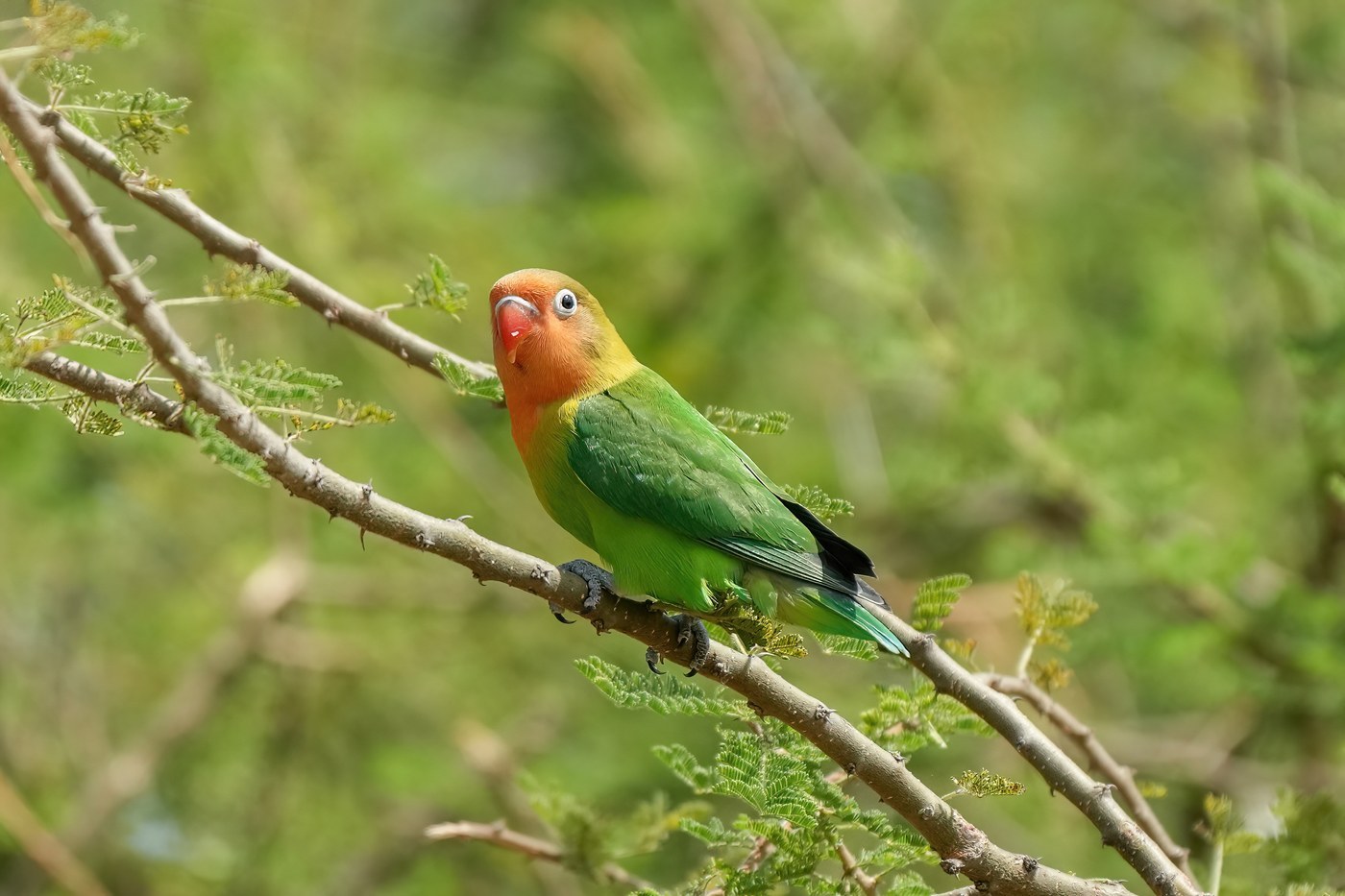
Fischer's Lovebird
Agapornis fischeri
A small lovebird with a bright orange-red face, an olive-yellow collar around the nape, and a green body, native to East Africa.
- Feather type
- Small compact flight feathers, short rounded tail
- Colours
- Green body with an orange-red face and throat, olive-yellow collar, and blue rump
- Bird size
- Very small, ~14 cm
Found a feather like this?
Identify any feather from a photo, free.
Overview
Overview
Fischer's Lovebird is a small parrot native to a limited area of East Africa, primarily around northern Tanzania. It is a popular species in aviculture and is known for its vivid facial coloring and distinctive collar marking.
Its combination of an orange-red face, olive-yellow neck collar, and green body distinguishes it clearly from other lovebird species in its region.
Identifying the Feather
Feather Identification
- Body feathers: Bright green over the back, wings, and underparts, typical of the lovebird group.
- Face and throat: Vivid orange-red feathers cover the face and throat, brighter and more saturated than the peach tones of the Peach-faced Lovebird.
- Collar: A band of olive-yellow feathers crosses the nape and upper back, transitioning between the orange face and green body.
- Rump: A patch of blue feathers on the lower back, similar in placement to other Agapornis lovebirds.
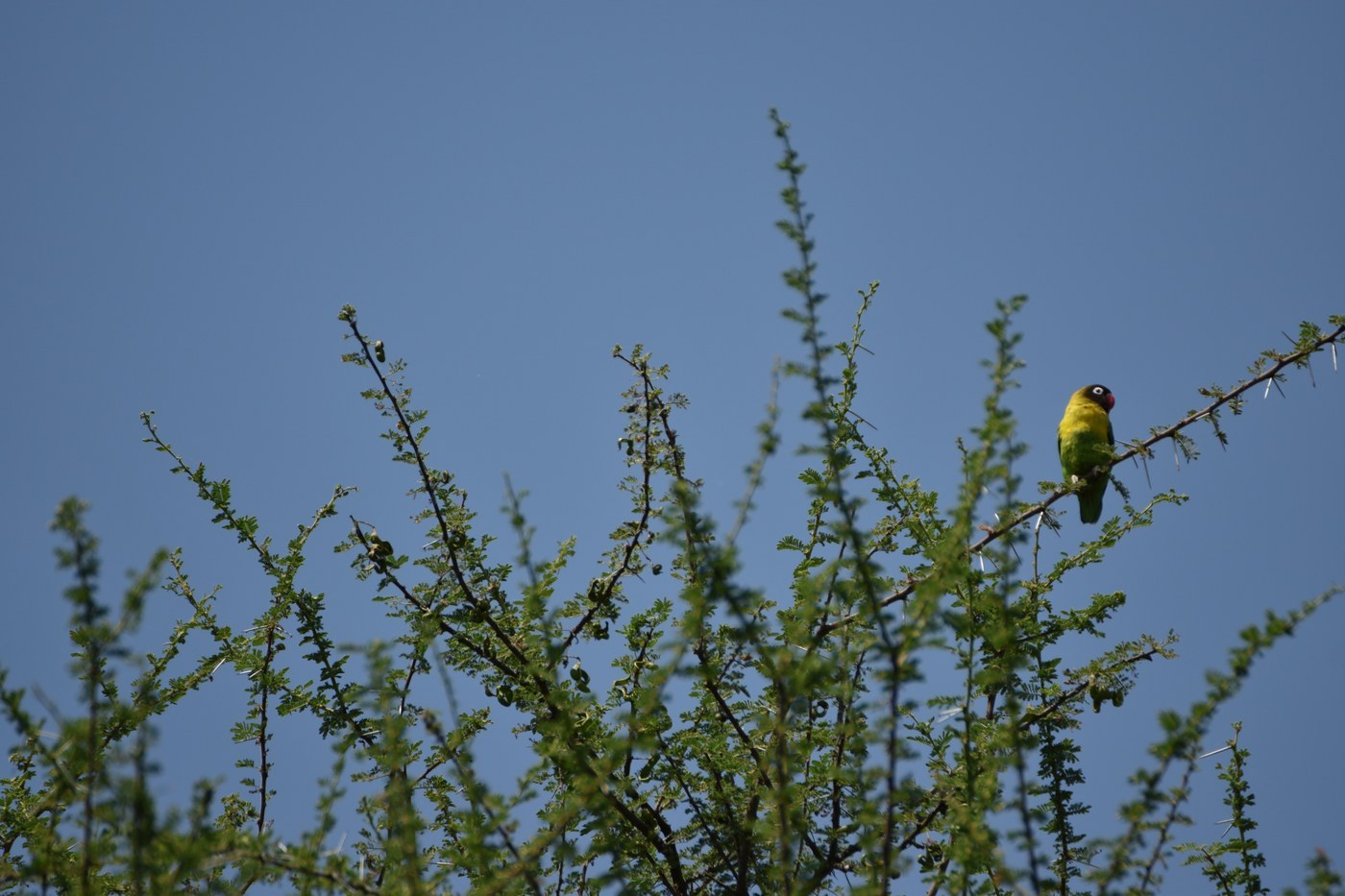
- Compared to similar species: The orange-red face and distinct olive-yellow collar separate Fischer's Lovebird from the peach-faced tones of Agapornis roseicollis and the dark, masked head of the Yellow-collared Lovebird.
Plumage & Molt
Plumage Notes
Sexes look alike in plumage. Juveniles show duller facial coloring and a less defined collar, brightening after their first molt.
Molt occurs gradually through the year. A bare white eye-ring is present around the eye in adults, a feature shared with several related masked lovebird species.
Habitat & Range
Habitat & Range
This species is native to a limited range in north-central Tanzania, around Lake Victoria and nearby grassland and woodland edge habitat close to water. Feral populations have also become established in parts of Kenya.
It is generally resident, with local movement tied to food and water availability.
Behavior & Field Notes
Behavior & Field Notes
Fischer's Lovebirds are social and are usually seen in flocks, foraging for seeds and grasses on the ground and in low vegetation. They form strong pair bonds and are often seen perched closely together.
They nest in tree cavities or within the nests of weaver birds, carrying nesting material in their bill rather than tucked into rump feathers as some related species do. Their calls are shrill, high-pitched chattering notes typical of small lovebirds.
Frequently asked questions
What color is Fischer's Lovebird's face?
A vivid orange-red covers the face and throat, brighter than the softer peach tone of the Peach-faced Lovebird.
What is the collar marking on Fischer's Lovebird?
A band of olive-yellow feathers crosses the nape and upper back, transitioning between the orange face and green body.
Where does Fischer's Lovebird live?
It is native to a limited area in north-central Tanzania around Lake Victoria, with feral populations also in parts of Kenya.
Does Fischer's Lovebird have a bare eye-ring?
Yes, adults show a bare white eye-ring around the eye.
Fischer's Lovebird guides
In-depth guides for identifying and understanding Fischer's Lovebird.
Other feathers you may enjoy
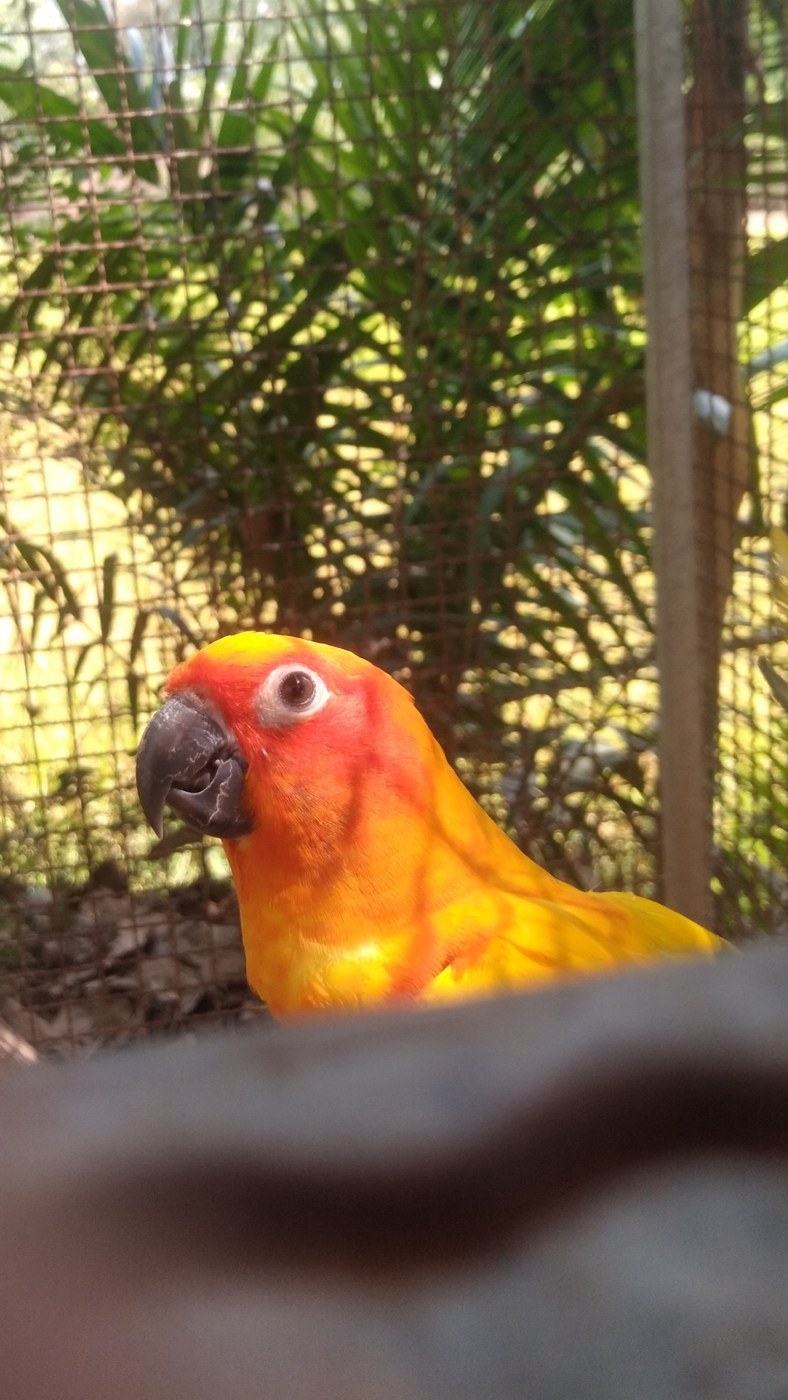
Sun Parakeet
Bright, dense body contour feathers; medium pointed tail feathers

Yellow-naped Amazon
Broad rounded contour feathers with sturdy flight feathers
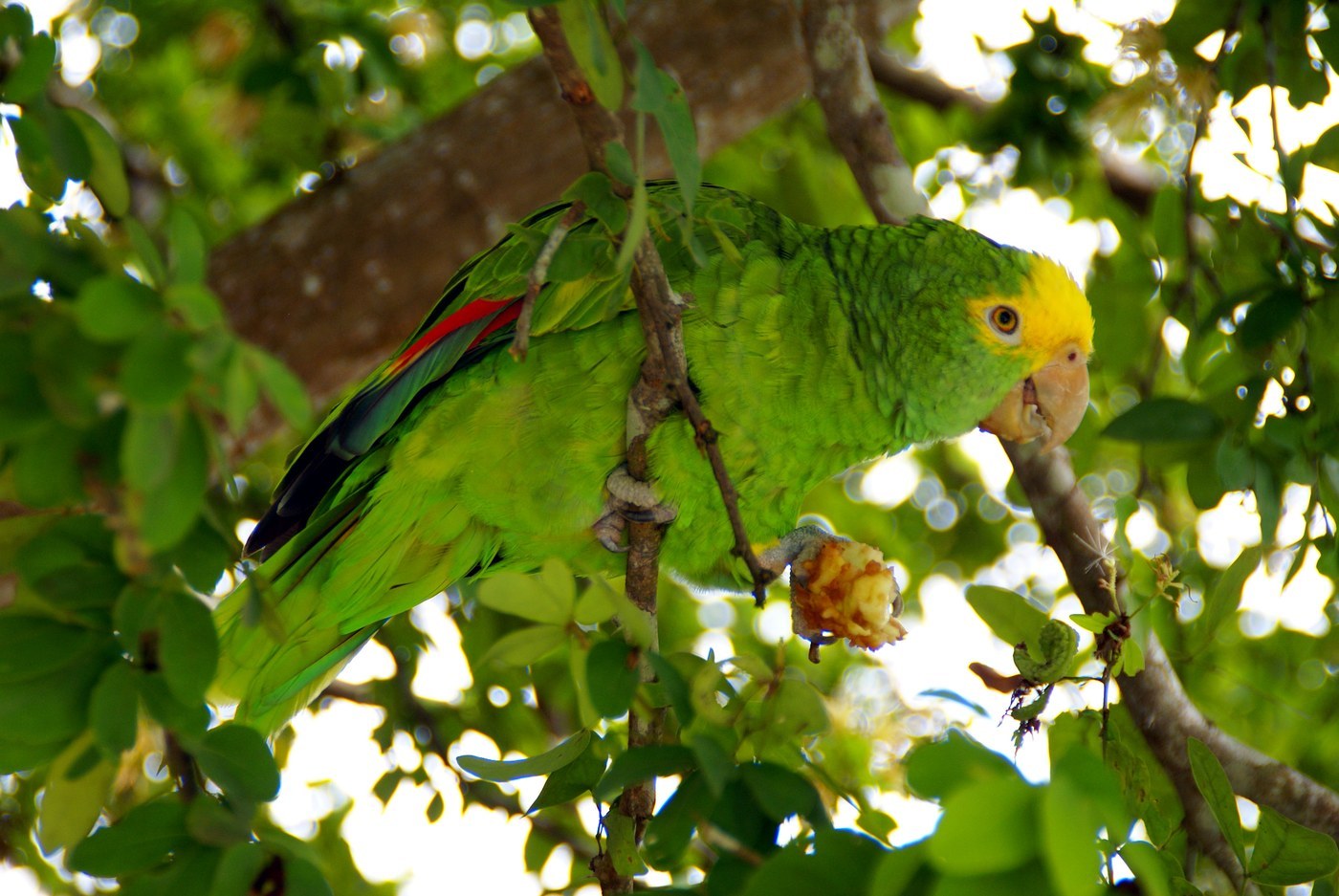
Yellow-headed Amazon
Dense, rounded body contour feathers; broad flight feathers
Yellow-collared Lovebird
Small compact flight feathers, short rounded tail

White-eyed Conure
Medium contour and long, graduated tail feathers

Yellow-tailed Black Cockatoo
Large, sturdy contour and flight feathers; short crest

Scarlet-chested Parrot
Small contour and flight feathers

Timneh Parrot
Broad flight feathers, scalloped body feathers with pale edges
Superb Parrot
Sleek contour feathers with a long tapering tail

Red-shouldered Macaw
Compact body contour feathers; medium flight and tail feathers
Red-rumped Parrot
Sleek contour feathers with a bright rump patch in males

White-capped Pionus
Compact contour feathers and short, squared tail feathers