
How to Identify Fischer's Lovebird Feathers
A guide to the bright green body feathers and orange-red, color-blocked head feathers of this small East African parrot.
Read the full Fischer's Lovebird encyclopedia entry →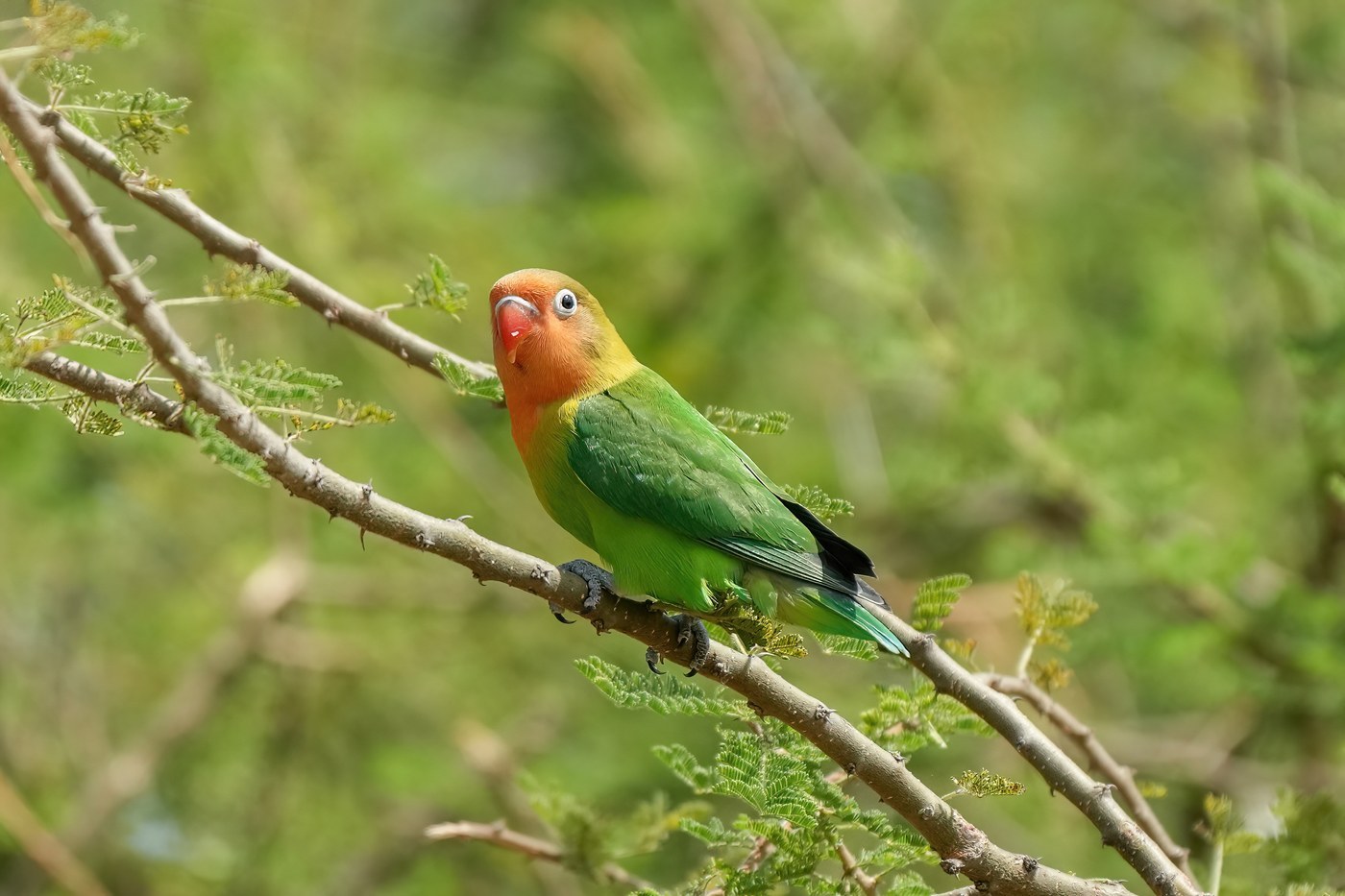
What Fischer's Lovebird's Feathers Look Like
Fischer's Lovebird is a small, brightly colored parrot, and its feathers show bold, clean color blocks rather than the streaking or barring typical of many songbirds. Body feathers are a vivid grass-green, dense and glossy in the way typical of parrot plumage, covering the back, wings, and belly. The head shows a distinctive color-blocked pattern: the face and forehead are orange-red, blending into a golden-yellow band around the nape and upper neck (collar), before transitioning to the green body, a gradient pattern useful for identifying isolated head feathers. The rump is a contrasting cobalt to sky blue, a small but bright patch visible when the wings are lifted, and this blue rump feather is a strong diagnostic clue on its own. Flight feathers are green with darker blackish tips on the primaries, and the tail is short, green, and squared-off. Feathers overall have the characteristic thick, slightly waxy texture typical of parrot plumage.
Step-by-Step: Is This Feather From a Fischer's Lovebird?
- Look for a blue rump feather: a small feather that is a bright cobalt or sky blue, found among green body feathers, is one of the most useful single clues.
- Check for an orange-red face feather blending to yellow: a feather showing orange-red grading into gold-yellow, rather than a sharp single-color block, matches the head/collar transition of this species.
- Assess overall color vividness: bright grass-green, glossy feathers with a slightly thick, waxy texture are typical of small parrots including this species.
- Check the tail: short, green, squared-off tail feathers (not long and pointed) fit a lovebird rather than a larger parakeet.
- Consider size: feathers should be small, consistent with a bird only about 14 cm long.
Similar Species & How to Tell Them Apart
Yellow-collared (Masked) Lovebird, a close relative often kept as a pet and naturalized in some areas, shows a solid black or dark brown head, not orange-red, though it shares the yellow collar band, so a black head feather paired with a yellow collar feather points to that species instead. Peach-faced Lovebird, another common relative and popular pet species, shows a soft peach-pink face without a sharp collar boundary, blending more gradually into the green body without the distinct gold band that Fischer's Lovebird shows, though it does share a blue rump. Because lovebirds hybridize readily in captivity and aviary escapes are common, feathers found outside the species' native range or in urban parks may reflect hybrid or mixed parentage, so the cleanest identification relies on the distinct orange-red-to-yellow head gradient specific to pure Fischer's Lovebird.
Where & When You'll Find Them
Fischer's Lovebird is native to a relatively small range in north-central Tanzania, around Lake Victoria's southern shores, where it inhabits grassland with scattered acacia trees, cultivated land, and areas near water. It has also become established through escapes and releases in other areas, including parts of urban East Africa. Feathers are most likely to be found near roosting and nesting sites in acacia trees and around feeding areas in grassland and cultivated fields. As a tropical resident, this species does not follow a sharply defined migratory molt calendar, but feather replacement is typically most active in the months following the local breeding season, and feathers can plausibly be found in its range across much of the year.
Frequently asked questions
What is the single most useful feather clue for Fischer's Lovebird?
A small bright cobalt-blue rump feather combined with an orange-red face feather that grades into golden-yellow at the collar.
How do I tell it apart from Yellow-collared Lovebird?
Yellow-collared Lovebird has a solid black or dark brown head rather than orange-red, though both species share a similar yellow collar band.
Is Peach-faced Lovebird a likely confusion species?
Yes, but its face is a softer peach-pink blending gradually into the green body, lacking the sharp orange-red-to-gold collar transition of Fischer's Lovebird.
Why might I find a hybrid-looking lovebird feather?
Lovebirds hybridize readily in captivity, and escaped or released birds are common, so feathers outside the native Tanzanian range may show mixed traits.
Where is this species native to?
A relatively small range in north-central Tanzania around the southern shores of Lake Victoria, in grassland and acacia habitat.