
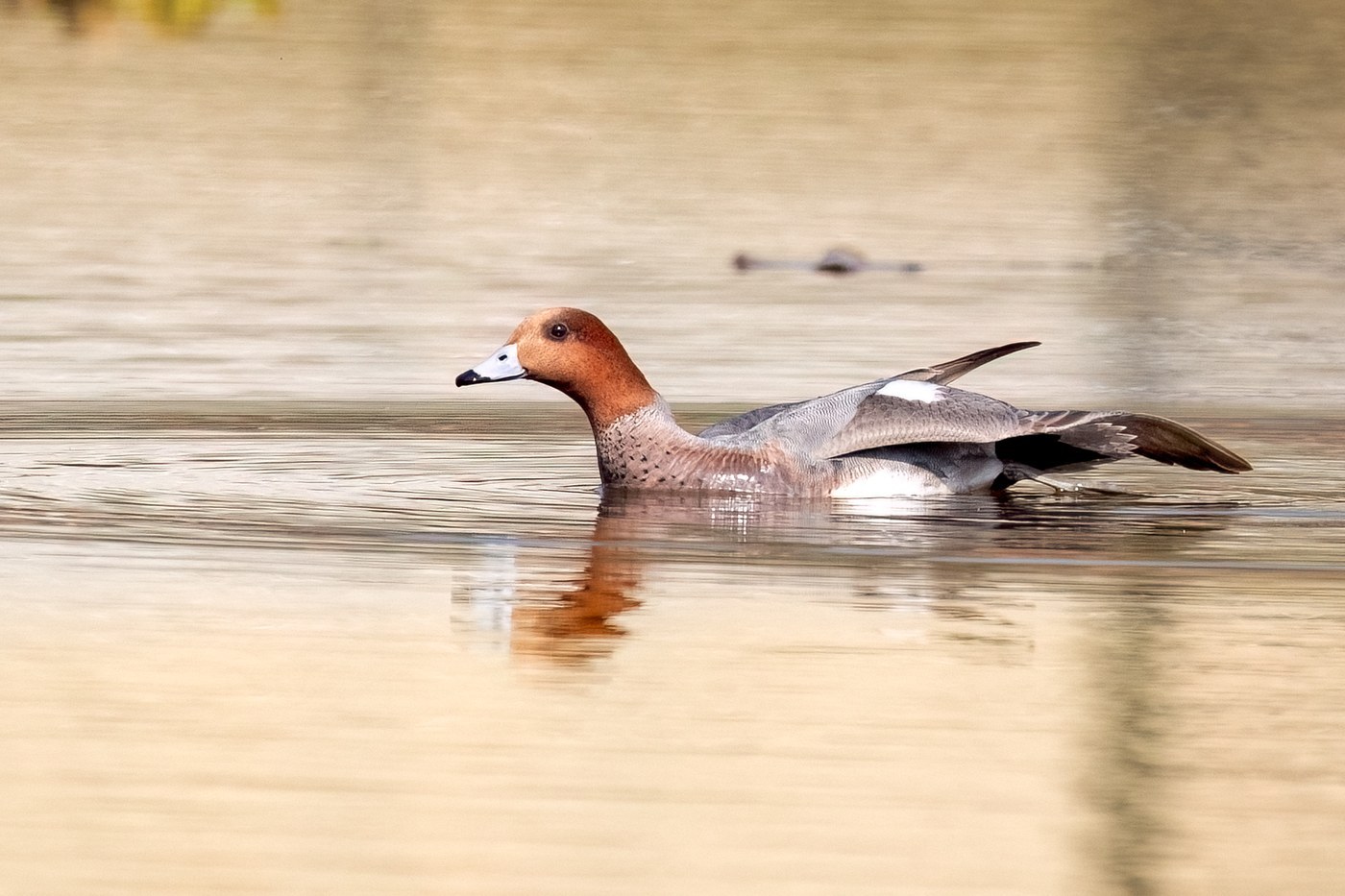
Eurasian Wigeon
Mareca penelope
The Old World counterpart to the American Wigeon, with a rich chestnut head, pale cream crown stripe, and grey axillary feathers that distinguish it from its American relative.
- Feather type
- Chestnut head feathers with cream crown stripe; grey axillary feathers; white upperwing covert feathers
- Colours
- Chestnut head with cream crown stripe, vinous-pink breast, grey body (male); warm reddish-brown overall (female)
- Bird size
- Medium dabbling duck, ~45-51 cm
Found a feather like this?
Identify any feather from a photo, free.
Overview
The Eurasian Wigeon is a medium-sized dabbling duck breeding across northern Europe and Asia and wintering across a broad range further south, including parts of Africa and southern Asia. It is the Old World counterpart to the American Wigeon, and the two occasionally occur together, especially in western North America during migration and winter.
Males show a rich chestnut-colored head with a pale cream stripe running down the center of the crown, set above a warm vinous-pink breast and grey flanks, all fairly similar in overall design to the American Wigeon but with different color tones.
Feathers of this species are best distinguished from the American Wigeon by their grey (rather than white) axillary or underwing feathers, along with the warmer chestnut head tone rather than the American Wigeon's cooler grey-brown head.
Identifying the Feather
Size and shape
- Medium-sized dabbling-duck contour and flight feathers, very similar in size and shape to American Wigeon
- Large white patch of upperwing covert feathers in males, similar in extent to the American Wigeon's
Color and pattern
- Male head feathers rich chestnut-red, with a pale cream to buffy stripe running down the crown
- Male breast feathers vinous-pink, flank feathers grey, contrasting with a white belly
- Upperwing covert feathers white in males, forming a bold patch, bordered by a green speculum
- Axillary (underwing) feathers grey in both sexes, a key difference from American Wigeon's white axillaries
Distinguishing from similar species
- Compare with American Wigeon: Eurasian Wigeon shows a warmer chestnut head and grey axillary feathers, versus the American's greyer head and white axillaries
- Female Eurasian Wigeon tends to show warmer, more reddish-brown tones than the somewhat greyer-headed female American Wigeon
Plumage & Molt
Breeding males show a chestnut head with a cream crown stripe, vinous-pink breast, grey flanks, and a white belly, with a pale blue-grey bill tipped black. Females are warm reddish-brown overall, generally a touch warmer-toned than female American Wigeon. Males undergo an eclipse molt after breeding, briefly resembling females. All undergo a flightless period during wing molt.
Habitat & Range
Breeds across northern Europe and Asia in lakes, marshes, and tundra wetlands, and winters across a broad range including western Europe, the Mediterranean, Africa, and southern Asia, with regular but scarce occurrences in North America, especially along the Pacific coast. It favors lakes, estuaries, and coastal marshes in winter. Most populations are migratory.
Behavior & Field Notes
Feeds by grazing on aquatic vegetation and grasses, often in mixed flocks with other wigeon or dabbling ducks, and readily grazes on land near water. Nests on the ground in vegetation near water. Voice includes a distinctive whistled call in males, similar in style to the American Wigeon's whistle but often described as slightly different in tone. When found outside its normal Old World range, a Eurasian Wigeon feather is most reliably separated from American Wigeon by its grey rather than white axillary feathers.
Frequently asked questions
How can I tell Eurasian Wigeon feathers from American Wigeon feathers?
The clearest distinction is axillary (underwing) feather color: Eurasian Wigeon has grey axillaries, while American Wigeon has white axillaries; the Eurasian male's head is also a warmer chestnut rather than greyish.
Where does the Eurasian Wigeon live?
It breeds across northern Europe and Asia and winters south into western Europe, Africa, and southern Asia, with occasional individuals seen in North America.
Is the Eurasian Wigeon ever seen in North America?
Yes, small numbers regularly appear, especially along the Pacific coast, often mixed in with flocks of American Wigeon.
What is the most distinctive head feature of the male?
A rich chestnut head with a pale cream to buffy stripe running down the center of the crown.
Eurasian Wigeon guides
In-depth guides for identifying and understanding Eurasian Wigeon.
Other feathers you may enjoy

Mallard
Wing (speculum), body, and tail feathers

Spectacled Eider
Large sea-duck body feathers with distinctive eye-ring patches

Canada Goose
Body and flight feathers
Mute Swan
Body (contour) and flight feathers

Wood Duck
Iridescent crest feathers; ornate scapular and flank feathers; white teardrop facial feathers (female)
Whooper Swan
Contour and flight feathers

White-winged Scoter
Large sea-duck body feathers with a white wing patch

Ruddy Duck
Stiff tail feathers and compact body plumage

Ross's Goose
Contour and flight feathers

White-cheeked Pintail
Contour and elongated tail feathers

Torrent Duck
Dense, sleek contour feathers; stiff, pointed tail feathers used for bracing against rocks

Tundra Swan
Contour and flight feathers