
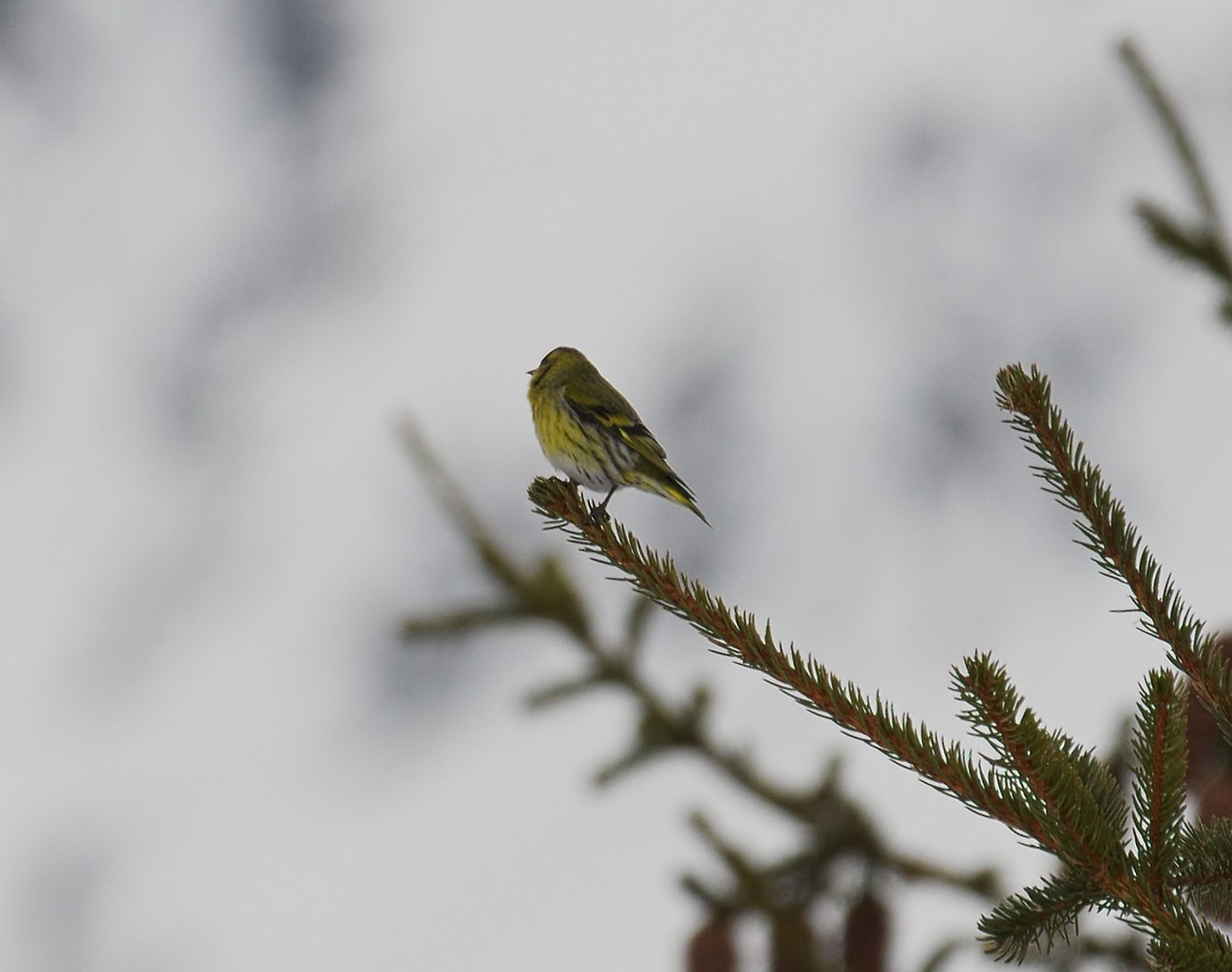
Eurasian Siskin
Spinus spinus
A small, active finch of conifer and alder woodland, with males showing a black cap on a yellow-green head and both sexes displaying bold black-and-yellow wing bars and a forked tail with yellow at the base.
- Feather type
- Small, streaked finch contour feathers; forked tail feathers with yellow bases
- Colours
- Yellow-green with a black cap (male), streaky flanks, black-and-yellow wing bars
- Bird size
- Very small, ~11-12 cm
Found a feather like this?
Identify any feather from a photo, free.
Overview
The Eurasian Siskin is a small, agile finch strongly associated with conifer forests, especially spruce, as well as alder and birch stands where it feeds acrobatically, often hanging upside down like a tit to extract seeds from cones and catkins. Males show a distinctive black cap absent in females.
It frequently visits gardens in winter, particularly where nyjer seed feeders are available, sometimes in the company of redpolls.
Its bold black-and-yellow wing pattern and forked tail with yellow patches at the base are useful identification features even from a single feather.
Identifying the Feather
Identifying Eurasian Siskin feathers
- Head feathers: Males show a black cap and small black chin patch on an otherwise yellow-green head; females lack the black cap, showing a duller streaked greenish-grey head instead.
- Body feathers: Yellow-green, with dark streaking along the flanks, more pronounced in females and juveniles than in adult males.
- Wing feathers: Black with bold yellow wing bars, forming a striking two-toned pattern.
- Tail feathers: Forked, black with yellow patches at the base, visible as yellow flashes when the tail is spread.
- Compared to similar species: The combination of a forked tail with yellow (not white) base patches and bold yellow wing bars separates Siskin feathers from similarly small finches like redpolls, which show streakier, browner tones without this yellow-black wing contrast.
Plumage & Molt
Plumage overview
Adult males show a black cap and chin, yellow-green face and underparts with some dark streaking on the flanks, and bold black-and-yellow wings and tail. Females lack the black cap, appearing duller and more streaked overall, with a greyer-green head.
Juveniles resemble females but are even more heavily streaked below, gradually acquiring adult-type plumage through their first molt.
Habitat & Range
Habitat and range
Eurasian Siskins are found across much of Europe and temperate Asia, closely tied to coniferous forest, especially spruce, for breeding, though they also use alder and birch stands, particularly in winter. Many populations show irruptive movements, appearing in larger numbers farther south and at garden feeders in years when conifer seed crops fail.
This unpredictable, seed-crop-dependent movement pattern makes Siskin abundance highly variable from year to year in a given area.
Behavior & Field Notes
Behavior and field notes
Eurasian Siskins forage acrobatically, often hanging upside down from cone tips or catkins to extract seeds, a foraging style that requires considerable agility for such a small bird. They are gregarious outside the breeding season, forming flocks that often include redpolls.
Its call is a thin, wheezy "tsy-zee" and its song includes twittering trills mixed with wheezy notes. Nests are built high in conifer trees, often well hidden near the top. A useful field note: a black-and-yellow streaked feather with yellow tail-base patches found near conifers or alder in winter is a good candidate for Eurasian Siskin, especially if garden nyjer feeders are nearby.
Frequently asked questions
How can I tell a male from a female Eurasian Siskin by its feathers?
Males show a solid black cap and chin patch, while females lack the black cap and appear more streaked and greyish-green overall.
How is a Siskin feather different from a redpoll feather?
Siskin feathers show bolder yellow-and-black wing and tail patterning, while redpoll feathers are browner and streakier with a red forehead patch instead of yellow tones.
Why does Siskin abundance vary so much year to year in some areas?
Its movements are closely tied to conifer seed crop success, so poor cone crops push more birds south or into gardens in a given winter.
Where are Eurasian Siskin feathers commonly found?
Near coniferous forest, especially spruce, as well as alder stands and garden feeders offering nyjer seed in winter.
Eurasian Siskin guides
In-depth guides for identifying and understanding Eurasian Siskin.
Other feathers you may enjoy

Yellow-breasted Bunting
Contour and flight feathers, chestnut-and-yellow breeding pattern

Sedge Wren
Tiny streaked crown and back feathers

Yellow-winged Cacique
Glossy black body feathers, yellow wing patch, shaggy crest

Yellow Warbler
Small contour and flight feathers

Yellow-throated Warbler
Small contour and flight feathers

Yellow-throated Vireo
Bright yellow throat and spectacle feathers; olive-green back feathers; two white wing-bar feathers

Yellow-rumped Warbler
Small contour and flight feathers

Yellow-hooded Blackbird
Contrasting hood and body feathers

Yellow-headed Blackbird
Glossy black body plumage with a bright yellow head and breast

Yellow-eyed Junco
Contour and flight feathers

Yellow-fronted Canary
Small, smooth body plumage

Yellow-breasted Greenfinch
Compact, smooth body plumage