
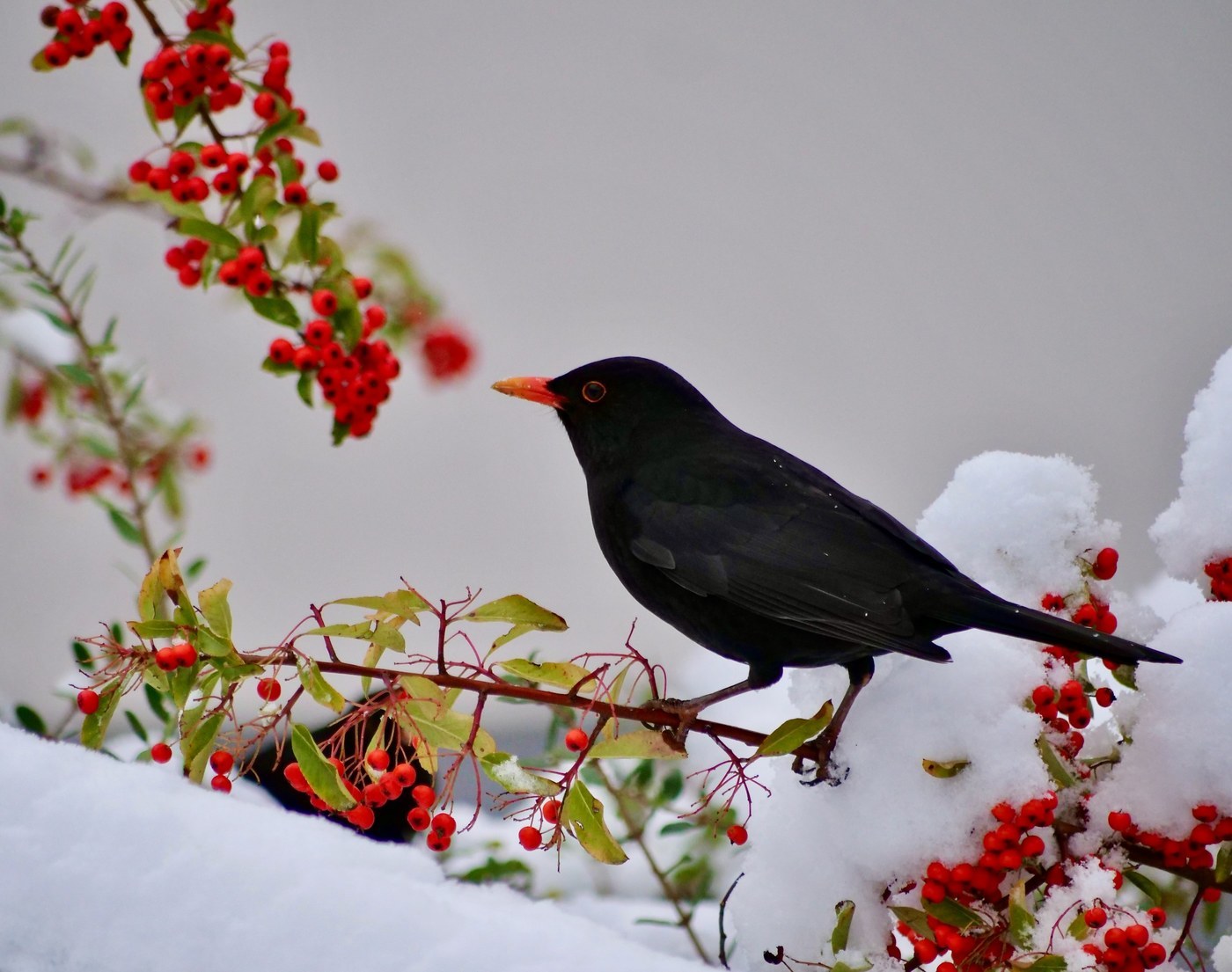
Eurasian Blackbird
Turdus merula
A familiar thrush of European gardens and woodland, with males entirely glossy black offset by a bright yellow-orange bill, while females are a more subdued dark brown.
- Feather type
- Glossy, uniform body feathers with a bright bill for contrast
- Colours
- Solid glossy black in males with a yellow-orange bill; dark brown in females
- Bird size
- Robin-to-starling-sized, ~24-25 cm
Found a feather like this?
Identify any feather from a photo, free.
Overview
The Eurasian Blackbird is one of the most widespread and familiar thrushes across Europe, parts of Asia, and North Africa, thriving in woodland, parks, hedgerows, and gardens. Its confiding nature and frequent presence around human habitation have made it one of the best-known garden birds throughout much of its range.
Identifying the Feather
- Body feathers (male): Uniformly glossy black from head to tail, with no streaking or spotting.
- Bill: Bright yellow-orange in adult males, a striking contrast against the black plumage and a key identification feature.
- Body feathers (female): Dark sooty-brown overall, sometimes with faint mottling on the breast, and a duller, brownish bill.
- Compared to similar species: The combination of solid black plumage and a bright bill in males is distinctive in its range; females can be told from other brown thrushes by their generally unmarked underparts and duller overall tone.
Plumage & Molt
Adult males are entirely glossy black with a bright yellow-orange bill and matching eye-ring. Females and immatures are dark brown, sometimes with subtle mottling on the throat and breast, and a duller brownish-yellow bill. First-year males may show a mix of brownish and black feathers as they transition into full adult plumage over their first year. A single complete molt after breeding renews the plumage annually.
Habitat & Range
Eurasian Blackbirds inhabit a wide range of habitats, including deciduous and mixed woodland, hedgerows, parks, and gardens, across Europe, parts of western Asia, and North Africa, with introduced populations established in Australia and New Zealand. Many northern and eastern populations migrate south for winter, while birds in milder western and southern regions are largely resident.
Behavior & Field Notes
This species forages on open ground, characteristically running, pausing, and cocking its head to locate invertebrates in soil and leaf litter, also taking fruit readily. Its song is a rich, melodious series of fluted phrases, often delivered from a high perch at dawn and dusk and considered one of the more accomplished songs among European birds. Nests are cup-shaped structures built in shrubs, hedges, or building ledges. Its adaptability to urban and suburban environments has made it a common sight in gardens across its range.
Frequently asked questions
How do you identify a male Eurasian Blackbird?
Look for entirely glossy black plumage combined with a bright yellow-orange bill and matching eye-ring.
What do female Eurasian Blackbirds look like?
Females are dark brown overall, sometimes with faint mottling on the breast, and have a duller bill than males.
Where is this species commonly found?
It is widespread across Europe, parts of Asia, and North Africa, and is a familiar bird in woodland, parks, and gardens.
What is distinctive about its song?
Its song is a rich, melodious series of fluted phrases, often given from a high perch at dawn or dusk.
Eurasian Blackbird guides
In-depth guides for identifying and understanding Eurasian Blackbird.
Eurasian Blackbird identified by the community
Real feathers identified with Feather Identifier.


Other feathers you may enjoy

Yellow-breasted Bunting
Contour and flight feathers, chestnut-and-yellow breeding pattern

Sedge Wren
Tiny streaked crown and back feathers

Yellow-winged Cacique
Glossy black body feathers, yellow wing patch, shaggy crest

Yellow Warbler
Small contour and flight feathers

Yellow-throated Warbler
Small contour and flight feathers

Yellow-throated Vireo
Bright yellow throat and spectacle feathers; olive-green back feathers; two white wing-bar feathers

Yellow-rumped Warbler
Small contour and flight feathers

Yellow-hooded Blackbird
Contrasting hood and body feathers

Yellow-headed Blackbird
Glossy black body plumage with a bright yellow head and breast

Yellow-eyed Junco
Contour and flight feathers

Yellow-fronted Canary
Small, smooth body plumage

Yellow-breasted Greenfinch
Compact, smooth body plumage