
How to Identify Eurasian Blackbird Feathers
How to tell a male's glossy all-black feathers and a female's mottled brown ones from similar dark garden birds like starlings and crows.
Read the full Eurasian Blackbird encyclopedia entry →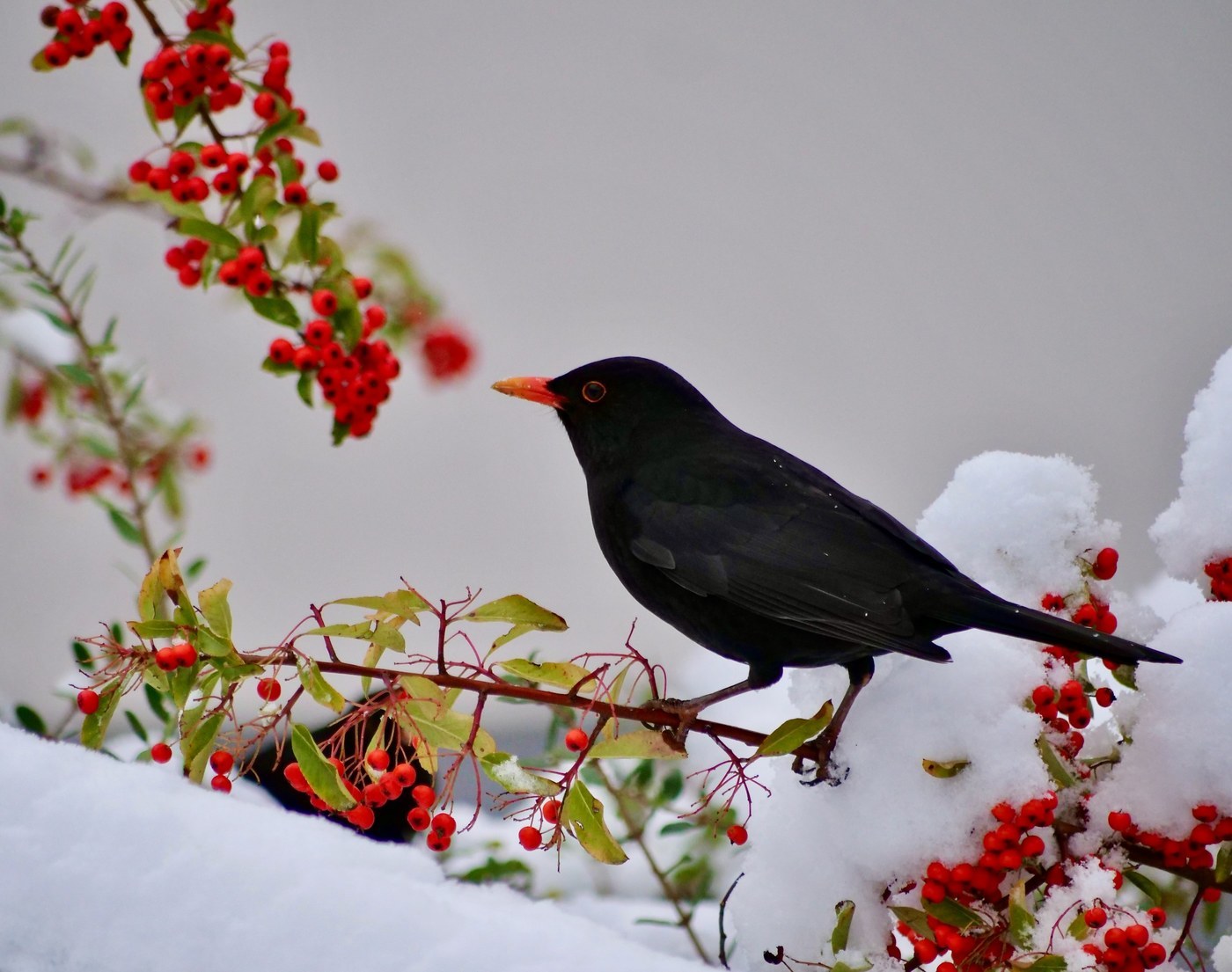
What Eurasian Blackbird Feathers Look Like
The Eurasian Blackbird (no relation to New World blackbirds) shows one of the starkest sex differences in common garden birds, which makes feather identification straightforward once you know what to look for.
- Male body feathers: entirely glossy jet-black, with a subtle sheen on fresh feathers but no iridescent color flash and no spotting or barring anywhere.
- Female/juvenile feathers: dark sooty brown overall, with faint mottling or fine streaking on the breast and a somewhat paler, streaked throat.
- Flight feathers: plain, matching the body tone (black on males, brown on females) without wing bars or pale patches.
- Tail feathers: fairly long and plain, black on males and dark brown on females.
- Texture: soft, smooth-looking contour feathers typical of thrushes, without the stiffer, more angular feel of starling feathers.
Step-by-Step: Is This Feather From a Eurasian Blackbird?
- Check for solid black without sheen. A male blackbird feather should be uniformly black with, at most, a faint gloss — not a strong iridescent green or purple flash.
- Look for absence of pale spotting. Fresh blackbird feathers lack the pale speckling seen on fresh starling feathers.
- For brownish feathers, look for subtle mottling. Female/juvenile blackbird feathers show faint streaking or mottling on the breast rather than crisp scaling.
- Compare size to a starling. Blackbird feathers are somewhat longer and less compact than the shorter, more triangular feathers of a starling.
- Consider habitat. A dark feather found in a garden, hedgerow, or woodland edge in Europe fits well with this very common species.
Similar Species & How to Tell Them Apart
The Common Starling is the most frequent source of confusion, but starling feathers show a distinct iridescent green-and-purple sheen and, when fresh, pale spotting at the tips — features absent on a true blackbird feather. Carrion Crow feathers are much larger and stiffer, ruling them out on size alone. A female Blackbird can also be confused with a Ring Ouzel, but Ring Ouzel feathers typically show pale, scaly-looking edges that create a scaled appearance, plus a white crescent bib on the breast, neither of which appears on a Blackbird.
Where & When You'll Find Them
Eurasian Blackbirds are one of the most familiar garden and woodland birds across Europe and western Asia, foraging conspicuously on lawns and under hedges, which is exactly where their molted feathers commonly turn up. Most populations are resident or short-distance migrants. Adults undergo a complete post-breeding molt from July through September, so late summer and early autumn are the best times to find shed feathers in garden leaf litter and along hedgerows. Because Blackbirds are territorial and often use the same patch of garden or woodland edge for feeding and bathing across multiple years, favorite dust-bathing spots and the ground beneath regularly used song perches tend to yield more feathers over time than searching at random across a whole garden.
Frequently asked questions
Why don't male Blackbird feathers have any iridescent sheen like a starling's?
The black in Blackbird feathers is largely pigment-based melanin without the specialized microstructure that produces a starling's structural iridescent colors, so it stays a flat, matte-to-glossy black rather than flashing green or purple.
How do I tell a female Blackbird feather from a young starling's?
Young starling feathers tend to be a more uniform grayish-brown without the subtle mottled streaking seen on a female Blackbird's breast feathers, and starling feathers are generally shorter and more compact in shape.
Is there a size difference between male and female Blackbird feathers?
Not dramatically — males and females are similar in overall body size, so feather size differences between the sexes are minor compared to the obvious color difference.
Can Blackbird feathers be found in cities as well as woodland?
Yes, this species thrives in urban parks and gardens as much as in woodland, so feathers turn up in both settings across its range.
When is the best time of year to find Blackbird feathers?
Late summer into early autumn, during and just after the complete post-breeding molt, tends to produce the most feather finds.
Eurasian Blackbird identified by the community
Recent Eurasian Blackbird feathers identified with Feather Identifier.

