
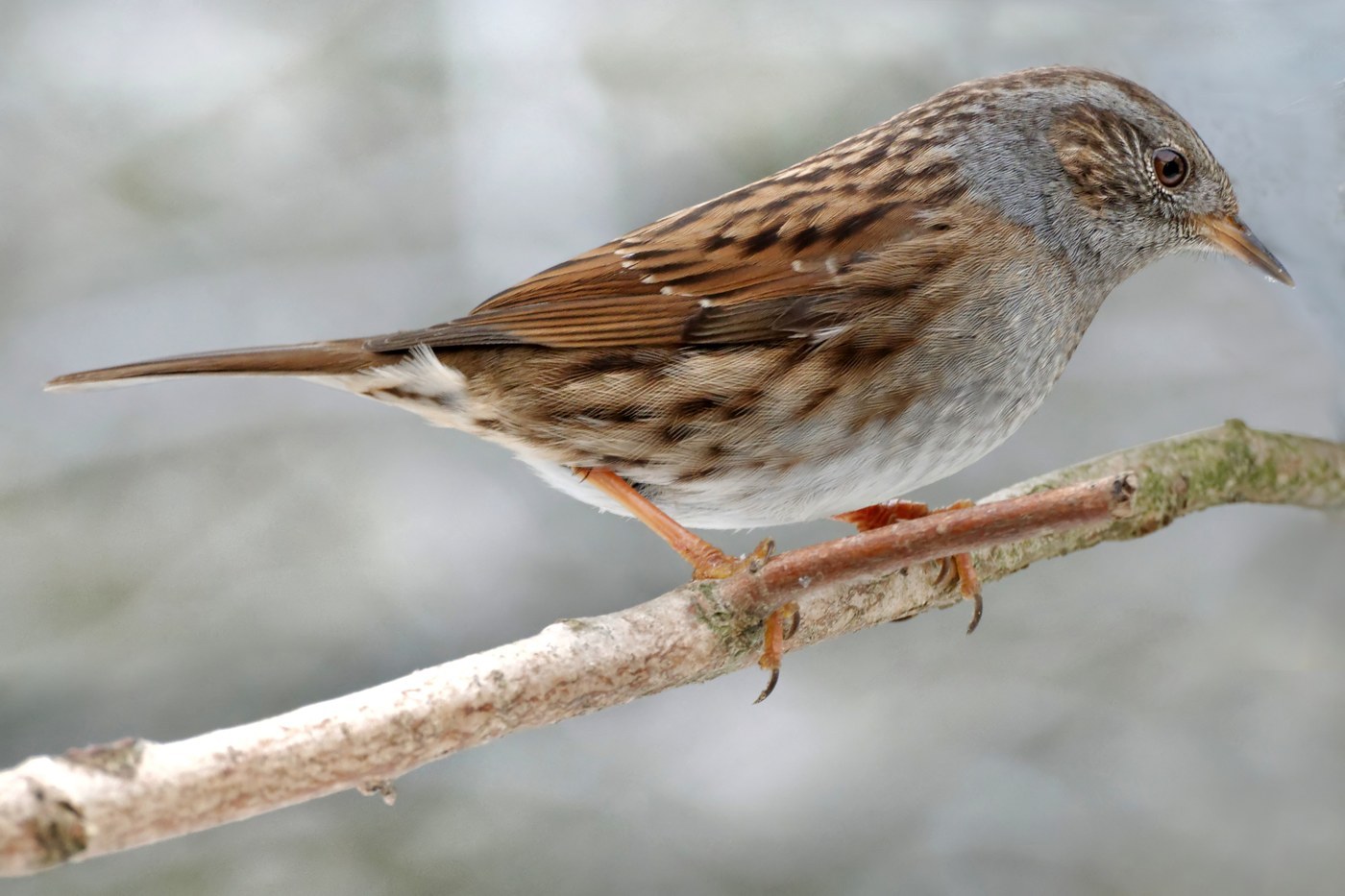
Dunnock
Prunella modularis
An unassuming, sparrow-like songbird with soft grey head and breast feathers and a streaked brown back, easily overlooked but distinct once compared with true sparrows.
- Feather type
- Soft grey head and breast feathers; brown, streaked back feathers; thin insectivore-type bill implied by feather structure
- Colours
- Slate-grey head and breast, warm brown streaked back and flanks
- Bird size
- Small songbird, ~14.5 cm
Found a feather like this?
Identify any feather from a photo, free.
Overview
The Dunnock is a quiet, skulking songbird often mistaken for a sparrow at first glance, but it belongs to a different family and has a much finer, more delicate bill suited to an insect-based diet rather than seed-cracking.
It is a common resident across much of Europe, typically found creeping along the ground or through low vegetation in hedgerows and gardens rather than out in the open.
A Dunnock feather is best recognized by the soft slate-grey tone on the head and breast, contrasting with warm brown, streaked feathers on the back and flanks — a more subdued combination than the boldly patterned feathers of true sparrows.
Identifying the Feather
Head and breast feathers
- Soft slate-grey, unstreaked, giving a smooth, muted appearance quite different from the bold facial markings of sparrows.
Back and flank feathers
- Warm brown with dark streaking on the back; flanks show soft brown streaking as well.
Size and texture
- Feathers are small, soft, and fine-textured, consistent with the Dunnock's slender, insect-picking bill and unobtrusive habits.
Confusion species
House Sparrow and Tree Sparrow feathers show bolder black-and-white facial markings and heavier bills suited to seed-eating; a plain grey head/breast feather paired with brown streaked back feathers is more consistent with Dunnock.
Plumage & Molt
Adults have a slate-grey head, neck, and breast, with a warm brown, black-streaked back and flanks. The bill is thin and dark, suited to an insectivorous diet.
Males and females look similar, with only subtle differences. Juveniles are browner and more heavily streaked overall, including on the breast, before molting into the smoother grey-and-brown adult plumage.
Dunnocks undergo a complete post-breeding molt in late summer.
Habitat & Range
Dunnocks favor hedgerows, scrub, woodland edge, and gardens with dense low cover, where they forage quietly on the ground. They are widespread and common across much of Europe.
The species is largely resident, with some northern populations moving short distances south in winter.
Behavior & Field Notes
Dunnocks feed mainly on small invertebrates and some seeds, foraging with a characteristic shuffling, mouse-like gait close to cover rather than in the open. They are often overlooked due to their quiet, skulking habits.
Their song is a thin, warbling, rapid series of notes, and their call is a distinctive high, piping 'tseep'. They build a neat cup nest low in a hedge or shrub.
A soft grey feather from the head or breast paired with a brown, streaked feather from the back, found near hedgerows or garden shrubbery, suggests Dunnock rather than a true sparrow.
Frequently asked questions
How is a Dunnock feather different from a sparrow feather?
Dunnock head and breast feathers are plain slate-grey without the bold black-and-white facial markings typical of House or Tree Sparrows.
Is the Dunnock actually related to sparrows?
No, despite superficial resemblance and the old name 'hedge sparrow', the Dunnock belongs to a separate family (accentors) with a finer, more insectivorous bill.
What color are Dunnock back feathers?
Warm brown with dark streaking, similar in general tone to many sparrow-type birds but paired with plain grey (not streaked) head and breast feathers.
Do juvenile Dunnocks have different feathers from adults?
Yes, juveniles are browner and more heavily streaked overall, including on the breast, before acquiring the smoother grey adult plumage.
Where would I likely find a Dunnock feather?
Near hedgerows, garden shrubbery, or woodland edge, reflecting the bird's preference for dense, low cover.
Dunnock guides
In-depth guides for identifying and understanding Dunnock.
Other feathers you may enjoy

Yellow-breasted Bunting
Contour and flight feathers, chestnut-and-yellow breeding pattern

Sedge Wren
Tiny streaked crown and back feathers

Yellow-winged Cacique
Glossy black body feathers, yellow wing patch, shaggy crest

Yellow Warbler
Small contour and flight feathers

Yellow-throated Warbler
Small contour and flight feathers

Yellow-throated Vireo
Bright yellow throat and spectacle feathers; olive-green back feathers; two white wing-bar feathers

Yellow-rumped Warbler
Small contour and flight feathers

Yellow-hooded Blackbird
Contrasting hood and body feathers

Yellow-headed Blackbird
Glossy black body plumage with a bright yellow head and breast

Yellow-eyed Junco
Contour and flight feathers

Yellow-fronted Canary
Small, smooth body plumage

Yellow-breasted Greenfinch
Compact, smooth body plumage