
How to Identify Dunnock Feathers
How to recognize the streaky brown and slate-gray feathers of the Dunnock, a common European hedgerow bird often mistaken for a sparrow.
Read the full Dunnock encyclopedia entry →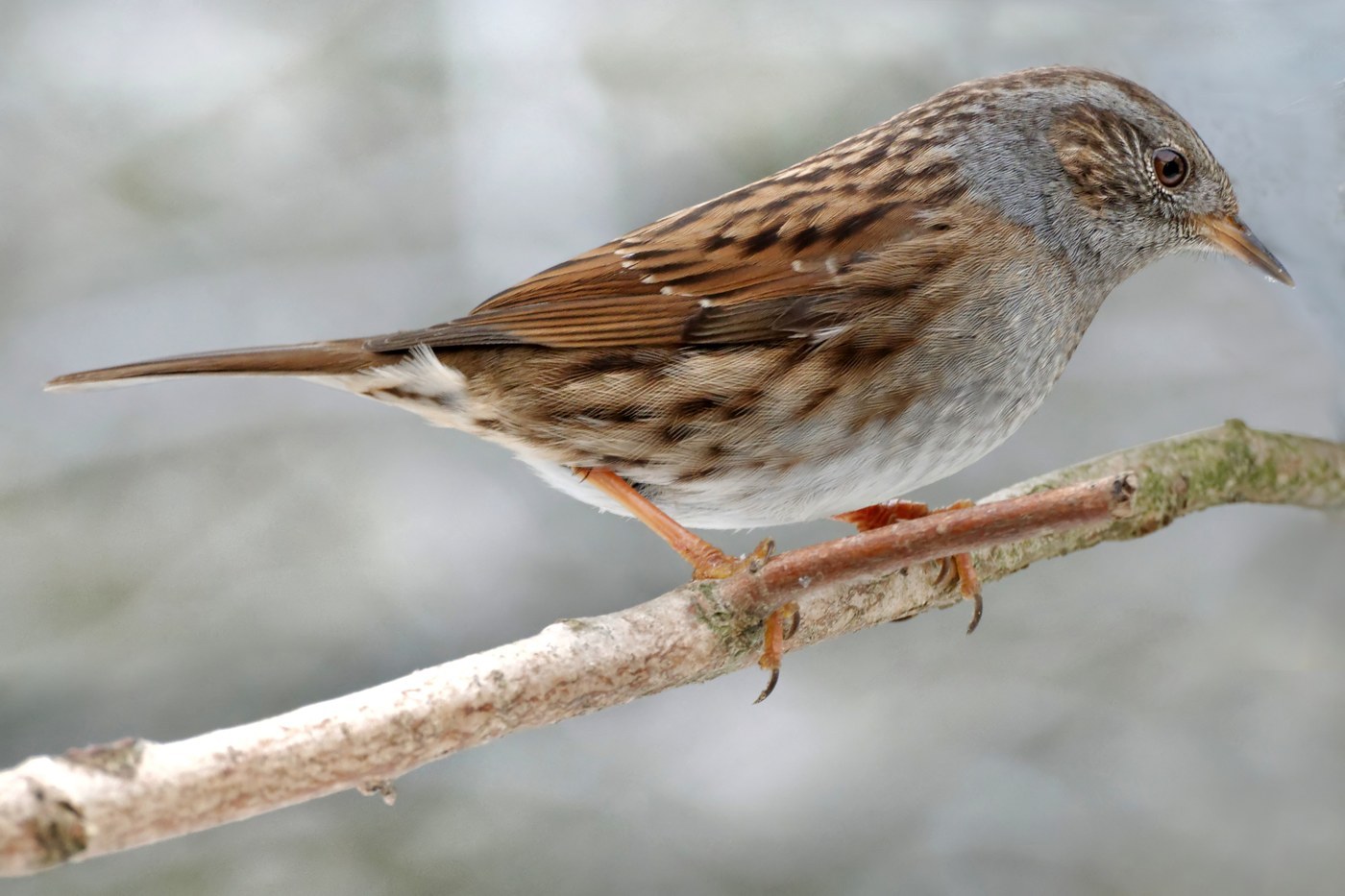
What Dunnock's Feathers Look Like
Dunnocks are small, unassuming songbirds, and their feathers reflect that quiet camouflage. Back and wing feathers are warm brown with bold blackish streaking, very similar at a glance to a House Sparrow's, but Dunnock feathers tend to run slightly narrower and more finely marked. The real giveaway is on the head, throat, and breast: these feathers are a soft slate-gray, quite different from the streaky brown breast of a sparrow, and this gray extends down the sides of the neck. Flank feathers show fine chestnut-brown streaking against a paler gray-buff background. Flight feathers are dark brown with narrow pale edges, unremarkable and typical of a small insectivorous songbird, and the tail is plain dark brown without white edges or spots. Overall feather size is modest — body feathers just a centimeter or two — consistent with a bird roughly sparrow-sized but more slender-bodied.
Step-by-Step: Is This Feather From a Dunnock?
- Check for slate-gray on the head/throat/breast. This is the most reliable Dunnock clue — sparrows and finches almost never show clean gray in this exact zone.
- Look at the back streaking. Warm brown feathers with bold black streaks match Dunnock's mantle, but confirm with the gray-breast clue before ruling out sparrows.
- Inspect the flanks. Fine chestnut streaking on a grayish-buff background is typical of Dunnock and a bit more delicate than a sparrow's bolder streaking.
- Rule out a stout, cone-shaped bill association. Dunnocks are insectivores with a thin bill, so any feather found near a thin, pointed bill (if the bird is nearby) supports Dunnock over a seed-eating sparrow.
- Note the plain tail and wings. No white outer tail feathers, no wing bars, no bright patches — Dunnock plumage is entirely subdued.
- Consider the habitat. Feathers found in dense hedgerows, garden shrubbery, or bramble thickets fit Dunnock's skulking habits.
Similar Species & How to Tell Them Apart
The classic confusion species is the House Sparrow, especially females and juveniles, which share a similar brown-and-black streaked back. The decisive difference is the breast and head: House Sparrows show buffy-brown or gray-brown tones without the clean, cool slate-gray wash Dunnocks carry on the throat and breast. Hedge Accentor relatives elsewhere in Europe are extremely similar, but range rarely overlaps enough to cause confusion in most areas. Warblers such as Reed or Garden Warbler have finer, plainer olive-brown feathers without any streaking at all, so a streaky-backed feather immediately rules those out. If in doubt, the slate-gray throat/breast feather is the single best diagnostic to separate Dunnock from every common look-alike.
Where & When You'll Find Them
Dunnocks are widespread across gardens, hedgerows, woodland edges, and scrubby parkland throughout Britain, Ireland, and much of Europe, where they forage quietly on the ground beneath cover rather than out in the open. Feathers can be found year-round, since Dunnocks are largely non-migratory across most of their range, but they turn up most often in late summer, when adults undergo their post-breeding molt and juveniles are also replacing their first set of feathers. Look in dense hedge bases, under garden shrubs, and along woodland-edge brambles where Dunnocks spend most of their time hopping and shuffling through leaf litter.
Frequently asked questions
What's the single best way to tell a Dunnock feather from a sparrow's?
Look for slate-gray coloring on the head, throat, and breast — sparrows show brown or buffy tones in this area, while Dunnocks are cleanly gray.
Do Dunnock feathers have any bright colors or wing bars?
No — the whole plumage is subdued brown, black-streaked, and slate-gray with no wing bars, spots, or bright patches.
Are Dunnock feathers the same size as House Sparrow feathers?
Very close in size, since both are small songbirds of similar body size, though Dunnock feathers tend to look slightly more slender and finely marked.
When is molt season for Dunnocks?
Late summer, after breeding, when both adults and newly fledged juveniles replace their feathers — the best time to find fresh ones near hedgerows.
Where should I search for Dunnock feathers in a garden?
Check dense hedge bases, under shrubs, and bramble patches, since Dunnocks forage low and secretively rather than in open lawns.